

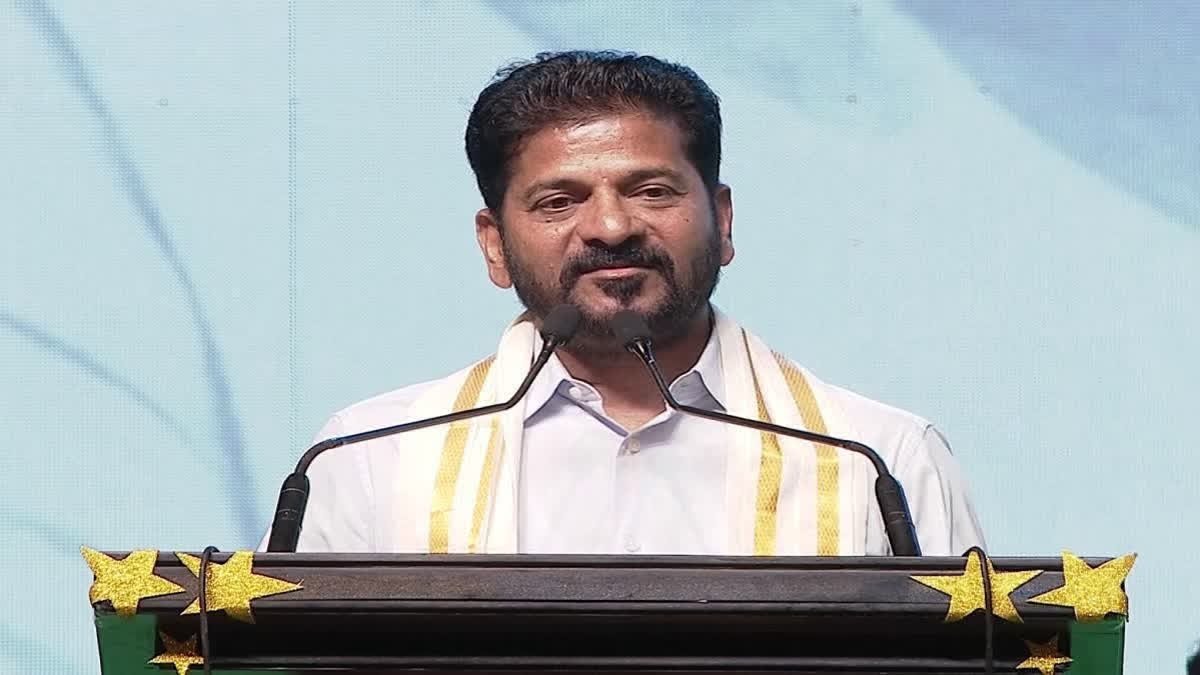

Hyderabad: Telangana Chief Minister Revanth Reddy on Tuesday appealed to Prime Minister Narendra Modi, proposing a “Hybrid Model” for Lok Sabha seat expansion as an alternative to the Centre’s proposed pro-rata population-based plan.
In an open letter, Reddy warned that a purely population-driven increase to 850 seats would “irreversibly distort” India’s federal balance, effectively punishing southern states for their decades of successful population control and human development.
CM Reddy suggested a formula inspired by the Supreme Court’s 50-50 logic on reservation versus merit, designed to reward economic and developmental performance.
Half of the new seats are to be allocated on a pro-rata population basis. The remaining half will be distributed based on Gross State Domestic Product (GSDP), public health outcomes, and other developmental metrics.
“Progress should not be penalised, and demographic expansion should not be rewarded… We are tired of paying taxes and then saying ‘salaam’ in Delhi,” said Revanth Reddy.
“Regarding the Women’s Reservation Bill, I state in unequivocal terms that the Indian National Congress fully supports the Women’s Reservation Bill. Kindly immediately implement it for the Lok Sabha, as is, with the current 543 seats, and even for all State Assemblies. Political empowerment of women is not merely a legislative reform but a moral imperative of our polity,” he wrote.
Reddy urged the government to implement the 33% Women’s Reservation immediately within the existing 543 seats, rather than waiting for the 2029 polls or a seat increase.
He asserted that there have been delimitations previously in the nation without changing the number of seats and only changing the boundaries of constituencies within states, suggesting that the country can undertake that route.
Reddy flagged the proposal to increase Lok Sabha seats to 850 seats to be done using a pro rata basis as the “real contentious issue”
“I again emphasise that these three issues are distinctly separate and not connected. We totally support the reservation of 33 per cent seats for women, and will also support delimitation without increasing the number of seats,” he explained.
He claimed that such a proposal to increase the Lok Sabha seats on either the population or pro rata model is not acceptable to many states, among them, southern states.
“I wish to bring to your notice our serious concerns regarding the proposal to increase Lok Sabha seats, which, if done on a pro rata basis, is fraught with dangers for the country,” he said.
Citing the 1970s population control emphasis, Reddy argued that rewarding higher population growth with more seats, ignoring economic contribution, causes an irreversible federal imbalance. He warned of a systemic power shift, urging a “hybrid model” and immediate, separate implementation of women’s reservation.
Going forward in the letter, he claimed that under the present proposal, southern states would be disadvantaged and politically unempowered. “The consequence of a pro rata model is not merely a statistical adjustment; it will result in a systemic shift in political power,” he added.
He claimed that the proposal would also lead to “political injustice over and above continued financial and policy discrimination”.
“This effectively translates into a scenario where progress is penalised, and demographic expansion is rewarded,” he wrote.
He noted that boundaries can be redrawn within states to account for local population shifts without changing the total inter-state seat allocation.
Reddy has reached out to his counterparts in Tamil Nadu, Karnataka, Andhra Pradesh, Kerala, and Puducherry, urging a united southern front against the “North-South divide” in political representation.
“The southern states of Telangana, Tamil Nadu, Karnataka, Andhra Pradesh, Puducherry and Kerala, over the past several decades, have consciously adopted policies aimed at population stabilisation, improved public health, and higher human development outcomes. These efforts were undertaken in alignment with national priorities and have contributed significantly to India’s overall progress,” he said.
The letter comes just 48 hours before a special three-day sitting of Parliament (April 16-18), where the Union Government is expected to move the Constitution (131st Amendment) Bill, 2026.
Reddy concluded by calling for an all-party meeting and the formation of an expert committee, asserting that national unity depends on a framework that is “politically, and not just arithmetically, equitable.”
Framing it as a question of equity, fairness and integrity, rather than numbers, he said that the framework that overlooks the southern states’ contribution to the national exchequer “risks creating a perception of systemic imbalance, with serious negative implications for national unity.”
As an alternative to the proposed 850-seat model, the Telangana CM proposed a “hybrid model” that allocates half the seats on population and the other half based on performance criteria like GSDP, aiming to protect the representation of progressive states.
“We can follow what the Hon’ble Supreme Court, in landmark cases on the issue of reservations versus merit, has said – split halfway, 50% quota and 50% merit,” he explained.
“Since you are proposing to increase existing Lok Sabha seats from 543 to 850 seats, half of this new number can be done on a pro rata basis. The remaining half must be done based on economic contribution (GSDP), and other performance criteria,” he added.

