

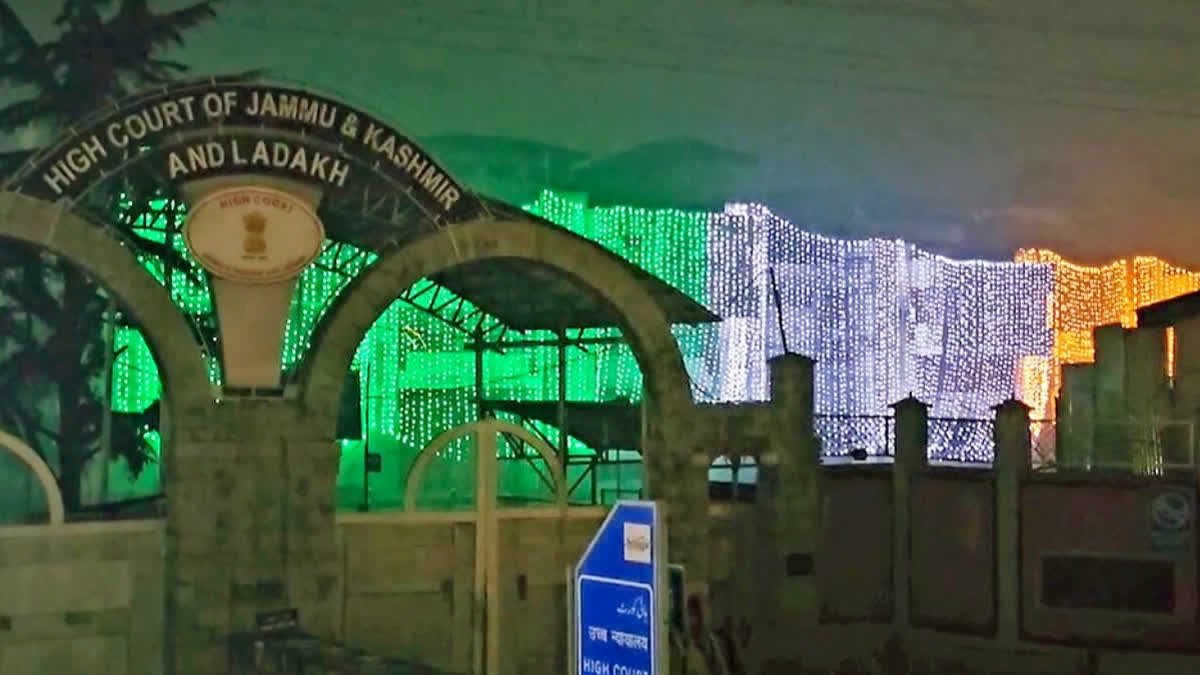

Srinagar: The High Court of Jammu & Kashmir and Ladakh has held that compensation for acquired land cannot be released exclusively to one claimant when questions of co-ownership, title and apportionment are already pending before a civil court and the competent authority.
In its seven-page judgment, a Division Bench of Justice Sindhu Sharma and Justice Shahzad Azeem allowed LPA No. 79/2025 in WP(C) No. 504/2025, filed by Abdul Aziz Bhat and others, and set aside a March 11, 2025 order of the single judge directing release of the entire compensation amount to private respondent Abdul Ahad Bhat.
The appeal was filed by Abdul Aziz Bhat and other co-claimants through advocates Imam Abdul Muizz and Naseer-ul-Akbar, against UT of J&K and others through Nowbahar Khan, Assistant Counsel, and Mariya Ashraf, Advocate, vice Altaf Mehraj, Advocate.
The dispute concerns land under Survey No 2012/4320 at Tapper Waripora, Pattan, acquired for widening of the Srinagar-Baramulla National Highway (NH-44). The appellants argued that the land was joint, unpartitioned ancestral property and that the private respondent had secured a title certificate in his name despite a pending civil suit over partition and declaration. The bench made its most significant observation while holding that the earlier writ order ignored pending ownership disputes.
“This court finds substance in the contention that the impugned order could not have been passed directing release of the entire compensation in favour of the private respondent alone, when serious disputes regarding title, co-ownership, and apportionment of compensation were already raised and were pending adjudication before the competent civil court as well as before the authority under Section 3H(4) of the National Highways Act, 1956.”
The court further underlined the legal duty of the land acquisition authority in such cases, observing: “It is a settled position of law that where there is a dispute as to entitlement or apportionment of compensation, the competent authority is under a statutory obligation to refer such dispute to the Principal Civil Court of original jurisdiction and withhold disbursement till the dispute is resolved.”
The judges also found that the private respondent had not disclosed crucial facts before the writ court, including the pendency of a civil suit and an application under Section 3H(4) of the National Highways Act, 1956, seeking reference of the compensation dispute to the Principal District Judge, Baramulla.
On the issue of natural justice, the bench said the compensation release order had prejudiced the rights of the appellants, who were not made parties before the single judge despite claiming co-ownership.
“The direction to release compensation solely in favour of the private respondent has the effect of prejudicing the rights of the appellants without affording them an opportunity of being heard, thereby offending the principles of natural justice.”
Allowing the appeal, the court ordered that the compensation amount remain in deposit with the Collector Land Acquisition, Baramulla, and directed the authority to proceed strictly under Section 3H(4) of the Act.
In its final direction, the bench ruled, “The rights and contentions of all parties with respect to title, partition, and apportionment of compensation are left open to be decided by the competent civil court.”

