

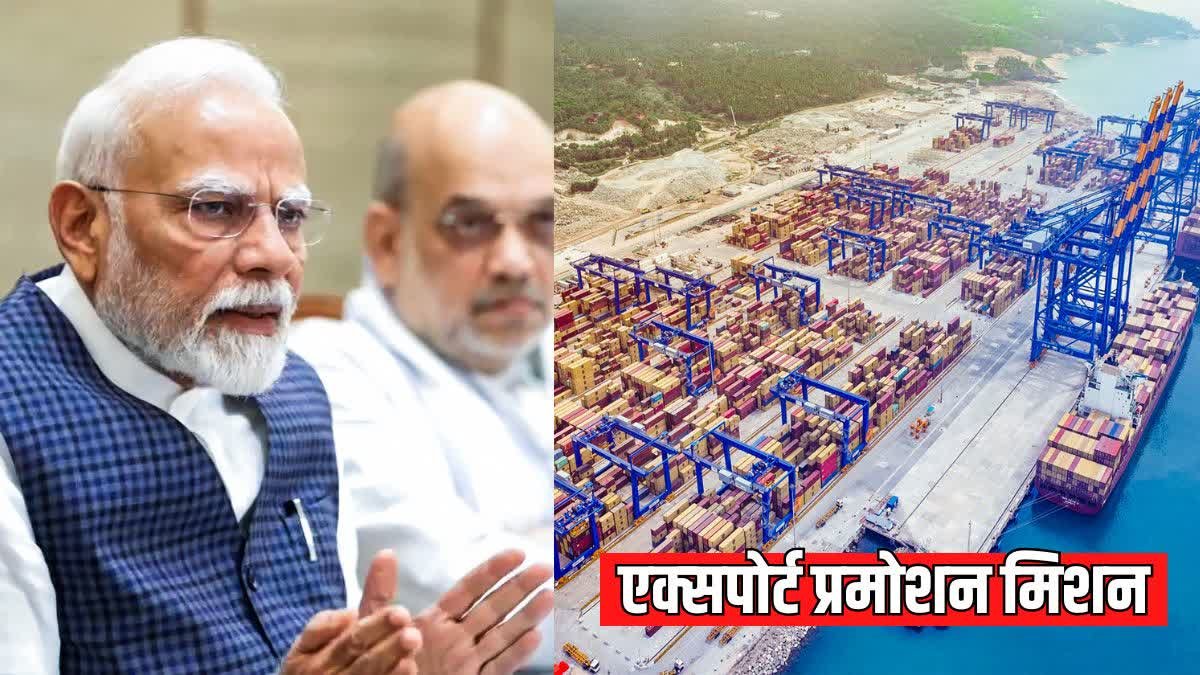

New Delhi: The Union Cabinet, chaired by Prime Minister Narendra Modi, on Wednesday approved the Export Promotion Mission (EPM) worth ₹25,060 crore. PM Modi said on Thursday that the Union Cabinet’s decisions regarding exports will improve global competitiveness and help realize the dream of self-reliance.
MSMEs will receive a boost.
The Union Cabinet, chaired by Modi on Wednesday, approved the Export Promotion Mission and the Loan Guarantee Scheme for exporters. In a post on X, PM Modi said that to ensure that “Made in India” resonates even more in the global market, the Union Cabinet has approved the Export Promotion Mission (EPM). He said that this approval will improve export competitiveness, support MSMEs, first-time exporters, and labor-intensive sectors. He said that it brings together key stakeholders to create a mechanism that is results-oriented and effective.
Cabinet approves loan guarantee scheme for exporters
The Prime Minister also said that the loan guarantee scheme for exporters, approved by the Cabinet, will promote global competitiveness and ensure smooth business operations. It will also help realize our dream of a self-reliant India.
Modi said that the decision to rationalize royalty rates for graphite, cesium, rubidium, and zirconium will strengthen supply chains and create employment opportunities. The Cabinet also approved rationalizing royalty rates for graphite, cesium, rubidium, and zirconium minerals, which are crucial for green energy. The Prime Minister said that this Cabinet decision will promote sustainability and self-reliance. It will strengthen supply chains and create employment opportunities.
Export Promotion Mission Welcomed, But…: GTRI
According to news agency ANI, the Global Trade Research Initiative (GTRI) said that while the Union Cabinet’s approval of the ₹25,060 crore Export Promotion Mission (EPM) is a step forward, the initiative still faces implementation and funding hurdles.
The think tank said that the Export Promotion Mission, which aims to “create a single framework to boost India’s export competitiveness, is only a broad framework.” The Export Promotion Mission will operate through two pillars.
According to GTRI, the Export Promotion Mission will operate through two pillars. The first, export promotion, is designed to make trade finance affordable for MSMEs through interest subvention, export factoring, collateral guarantees, loan enhancements, and credit cards for e-commerce exporters.
Sectors affected by global tariff increases will be prioritized, including textiles, leather, gems and jewelry, engineering goods, and marine products. The second pillar, Export Direction, will provide non-financial assistance, such as assistance with export quality and compliance, improved branding and packaging, participation in international trade fairs, export warehousing, logistics support, and inland transportation reimbursement.
The EPM also incorporates older programs, including the Interest Equalization Scheme (IES) and the Market Access Initiative (MAI). However, the GTRI analysis points to several weaknesses that could delay exporters from receiving benefits.
It states that the mission needs to be transformed into a comprehensive plan with precise guidelines specifying eligibility, procedures, and disbursement rules. A new online system will need to be created, a process that could take months before exporters receive any benefits.
Financing a Key Concern
According to The Global Trade Research Initiative, financing has emerged as a major concern. Although the total outlay is ₹25,060 crore over six years, GTRI states that “financial resources do not match the mission’s ambitions,” and that the IES alone cost over ₹4,200 crore last year, leaving limited scope for all other activities under the EPM.
The GTRI analysis also highlights institutional challenges. It states that the DGFT, which is now the implementing agency, will need “new knowledge to accomplish this task.” This is because previous financial schemes were managed by banks under RBI supervision. This could “delay approvals and delay operationalization.”
GTRI warns
GTRI further warns of a slowdown in scheme implementation. “Eight months of FY 2025-26 have already passed,” the think tank says. “Older schemes like MAI and IES have not made any payments this year, leaving exporters without support in a difficult global environment.”
However, GTRI further stated that while the mission is a welcome step, its success will depend on the prompt issuance of detailed guidelines, ensuring adequate funding, and establishing a strong coordination mechanism. Without swift operations, exporters, especially MSMEs, may struggle in the current global environment.

