

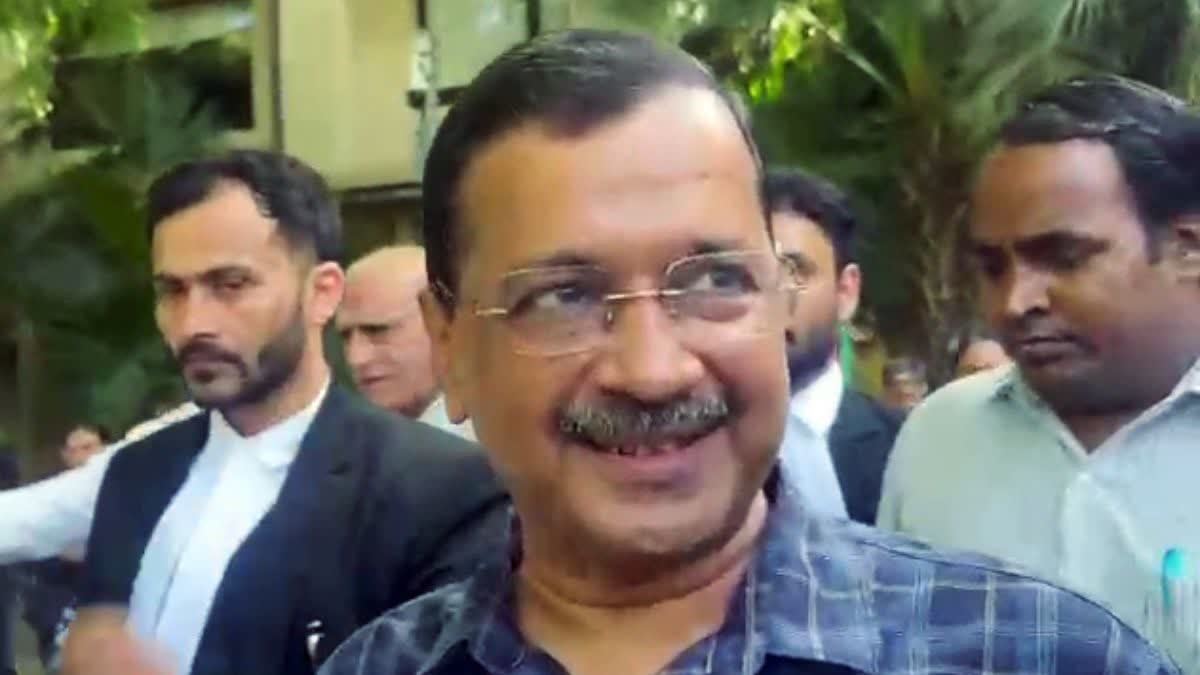

New Delhi: Delhi High Court judge Justice Swarana Kanta Sharma on Monday refused to step down from the liquor policy case, rejecting the pleas moved by Aam Aadmi Party (AAP) chief Arvind Kejriwal and others.
The former chief minister virtually appeared before the judge through video-conferencing and urged her to take on record his rejoinder to the written submissions filed by the Central Bureau of Investigation (CBI). Justice Sharma said although the pronouncement was scheduled for 2:30 pm, she was going out of her way in accepting Kejriwal’s rejoinder as a written submission in the matter.
Justice Sharma said, “I faced circumstances where my impartiality and dignity were challenged. Natural tendency was to withdraw from the case without even hearing the application”. She said that she chose to hear the arguments with an eye on impartiality. The judge further said, “The High Court, not the litigant, decides the competence of a judge”.
She said a politician cannot be allowed to “cross the line or assess judicial competence”. The judge said the inclusion of her children as government lawyers on the panel cannot raise an inference of bias in the liquor policy case.
“The CBI stated that none of the relatives of the judge have appeared before any court in any capacity in the excise policy case, nor have they had any connection with it. Even if relatives are on the government panel, the plaintiff must prove their connection and relevance to the case. No such connection has been shown”, Justice Sharma said.
She said a plaintiff cannot be allowed to create a situation that undermines the judicial process.
Previously, the High Court had ordered that the new affidavit filed by Kejriwal be taken on record. In fact, Kejriwal had filed a new affidavit in the High Court, making new allegations against Justice Sharma and requesting her recusal from the hearing. Kejriwal stated in his affidavit that both of Justice Swarn Kanta Sharma’s children work under Solicitor General Tushar Mehta.
Kejriwal’s affidavit stated that Mehta is the lawyer representing the CBI. “Consequently, how can Justice Swarn Kanta Sharma pass an order against Tushar Mehta?,” he questioned. Earlier, on April 13, Kejriwal, while presenting his own arguments, questioned Justice Sharma’s bench and requested her to recuse herself from the hearing.
Kejriwal, while requesting Justice Sharma’s recusal, stated that the court proceedings in the case had led to this situation, and that he did not expect a fair hearing. Expressing distrust in Justice Sharma, Kejriwal stated that the Sessions Court’s order was erroneous as it was passed without hearing the parties.
He had stated that when the first hearing took place in the High Court on March 9, none of the 23 accused were present. Only the CBI was present. However, in the very first hearing, Justice Swarn Kanta Sharma, without even hearing the arguments of the other side, declared that the Sessions Court’s order “prima facie” appeared to be wrong, the AAP convener had said.
Kejriwal had alleged that the ED’s proceedings were stayed without an application. He stated that the CBI’s appeal was being heard on March 9, but Justice Sharma also stayed the ED’s proceedings.
Meanwhile, in another hearing on Monday, involving Aam Aadmi Party leader Naresh Balyan’s bail plea in the MCOCA case, Justice Sharma recused herself, leaving the matter to be heard by another bench on April 23. She gave no reasons while recusing herself from the matter.
Balyan is currently lodged at Mandoli jail under judicial custody. The case involves allegations of an organised criminal syndicate run by UK-based gangster Kapil Sangwan. Earlier, the trial court denied Balyan bail in the case on January 15, 2024, noting that there was substantial evidence linking him to the criminal syndicate. This came after the BJP released an audio clip of Balyan containing his conversation with gangster Sangwan, alias Nandu, which allegedly dates back to 2023.
Speaking on the matter, AAP’s Delhi unit chief Saurabh Bharadwaj said that during the hearing, Arvind Kejriwal listed ten points, highlighting the main reasons why they had apprehensions over receiving justice, but the court declared that all of the apprehensions “legally untenable”.
“Arvind Kejriwal and his colleagues, who were discharged, told the court that they had a reasonable apprehension that they would not receive justice from this court. Arvind Kejriwal listed ten points, stating the main reasons for this apprehension. The court declared that all these apprehensions were legally untenable. The special judge Geetanjali Goel was changed on doubts being cast by ED (Central Govt). Just because the Judge asked tough questions from ED,” Bharadwaj said.
“If the High Court were actually concerned about the judiciary’s image, then Chief Minister Rekha Gupta should have been held for contempt. CM had said that the Rouse Avenue Court judge was set, and that is why Arvind Kejriwal was discharged. The High Court should have initiated contempt proceedings against Rekha Gupta,” he added.
The Back Story
On February 27, the Sessions Court had discharged Kejriwal, Sisodia and others in the Delhi Liquor Policy case, saying that the CBI’s case was wholly unable to survive judicial scrutiny and stood discredited in its entirety. That would have ended the ED’s case as well. Kejriwal argued that didn’t happen only because Justice Sharma herself stayed the Sessions Court order on the CBI case.
Besides Kejriwal, the applications for recusal of the judge were also filed by AAP leaders Manish Sisodia and Durgesh Pathak. Other respondents, including Vijay Nair and Arun Ramchandra Pillai, have also sought her recusal.
Solicitor General Tushar Mehta appeared for the CBI and opposed the plea. He urged Justice Sharma to initiate contempt action against Kejriwal and others for seeking her recusal.
Terming concerns by Kejriwal and others as “apprehensions of an immature mind,” Mehta told the court it was a matter of “institutional respect” and Justice Sharma should not succumb to pressure as her recusal on “unfounded allegations” would set a bad precedent.

