

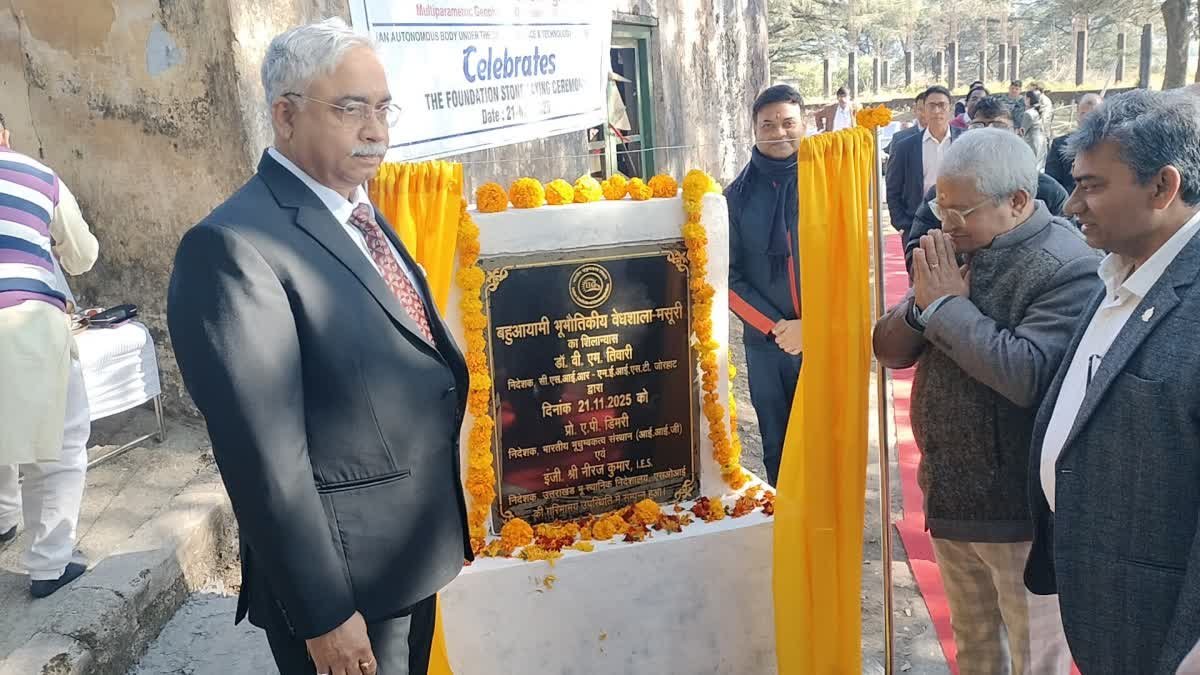

Mussoorie: Mussoorie is poised to become an important hub for understanding the geological activities of the Himalayan region and providing a scientific basis for disaster management in mountainous areas. The Indian Institute of Geomagnetism (IIG) laid the foundation stone for the Multi-Functional Geophysical Observatory (MPGO) at the Survey of India campus on Mussoorie Landour Road.
Real-time monitoring of the Himalayan region will yield benefits: CSIR-NEIST Director Dr. V.M. Tiwari stated that the Himalayas are the world’s youngest and most active mountain system, where earthquakes and landslides occur frequently. Dr. Tiwari stated that the observatory will enable real-time monitoring of underground movements, accurate recording of seismic waves, and the study of fault line movements in a more scientific manner than ever before. This observatory will be equipped with a multi-parametric system that will simultaneously provide data on seismic vibrations, geomagnetic changes, atmospheric pressure, ground tilt and stress, and electromagnetic signals. This will prove extremely useful for long-term research.
-Dr. V.M. Tiwari, Director, CSIR-NEIST-
Help in identifying earthquake precursors: Dr. Tiwari stated that the MPGO will provide scientists with important information by detecting subtle earth movements, rock stress changes, and geomagnetic disturbances. This will strengthen ongoing research on earthquake early warning systems.
Scientific support for disaster management: CSIR-NEIST Director Dr. V.M. Tiwari stated that this observatory will play a crucial role in accurately assessing risks such as landslides, cloudbursts, and hillslope instability. This will strengthen risk mapping, identification of vulnerable areas, alert systems, and relief and rescue strategies.
A new platform for national and international research: Professor Dimri, Director of IIG, stated that:
This observatory in Mussoorie will bring together several Indian and foreign institutions, including IIG, ISRO, IMD, Wadia Institute, ARIES, and DRDO. The data obtained here will open new dimensions in areas such as space-Earth-related research, impact on GPS signals, and space weather.
-Professor AP Dimri, Director, IIG-
Also helpful in local groundwater and environmental studies: The observatory’s data will also significantly contribute to the scientific study of water sources, groundwater flow, rock stability, and landslide-prone locations in mountainous regions. A new platform for national and international research: Professor Dimri, Director of IIG, stated that:
This observatory in Mussoorie will bring together several Indian and foreign institutions, including IIG, ISRO, IMD, Wadia Institute, ARIES, and DRDO. The data obtained here will open new dimensions in areas such as space-Earth research, impact on GPS signals, and space weather.
-Professor AP Dimri, Director, IIG-
Also Help in Local Groundwater and Environmental Studies: The observatory’s data will also contribute significantly to the scientific study of water sources, groundwater flow, rock stability, and landslide-prone locations in mountainous regions. Experts from ISRO, IMD, DST, DRDO, and foreign universities participated in the program. All described it as a vital project for the Himalayan region.
India’s Himalayan region includes Jammu and Kashmir, Himachal Pradesh, Uttarakhand, Arunachal Pradesh, Meghalaya, Nagaland, Manipur, Sikkim, Assam, and other northeastern states. These states are highly seismically sensitive and are frequently at risk of earthquakes.

