

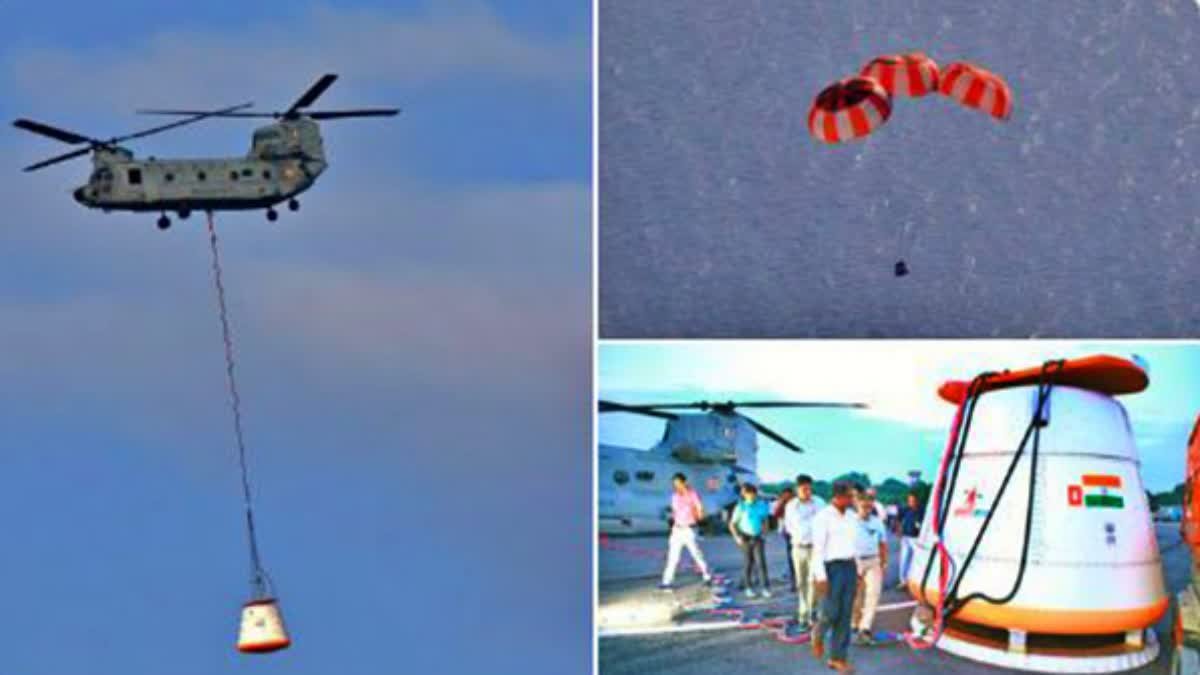

New Delhi: Indian Space Research Organisation (ISRO) successfully completed its first Integrated Air Drop Test (IADT-01). This is an important milestone in the preparation of India’s ambitious Gaganyaan mission.
According to ISRO, this successful test is the result of a collaborative effort of several defense and research organizations including Indian Air Force, Defense Research and Development Organization (DRDO), Indian Navy and Indian Coast Guard.
In a post on X, ISRO wrote, “ISRO successfully completed the first Integrated Air Drop Test (IADT-01) for end-to-end demonstration of parachute-based deceleration system for Gaganyaan mission. This test is a joint effort of ISRO, Indian Air Force, DRDO, Indian Navy and Indian Coast Guard.” Earlier, Union Minister of State for Science and Technology Dr Jitendra Singh on Wednesday said that the development and ground testing of India’s first Human Rated Launch Vehicle (HLVM3) has already been completed.
Orbital Module
Singh said in a written reply in the Lok Sabha. The propulsion system for the crew module and service module has been developed and tested. For this, the ECLSS engineering model has been prepared.
Crew Escape System (CES)
Singh said in a written reply in the Lok Sabha that five types of motors have been developed and static tested and its established infrastructure includes Orbital Module Preparation Facility, Gaganyaan Control Center, Gaganyaan Control Facility, Crew Training Facility, Second Launch Pad Modification.
Procursor Mission
A testing vehicle was developed for the verification of CES and flight tested in TV-D1. Activities are in progress for TV-D2 and IADT-01. Ground network configuration for flight operations and communication network was finalized. Also, the IDRSS-1 feeder station and terrestrial links were established and the recovery assets were finalized.
First Unmanned Mission (G1)
He further said, “Manufacture of C32-G phase and CES motors has been completed. Manufacture of HS200 motors and CES Four has been completed along with the crew module jettisoning motor. Manufacture of crew module and service module structure has been completed. Testing of crew module phase-1 has been completed.”
The aim of the human space flight program is to fulfill the aspirations of an established spacefaring nation. The technology and manufacturing capability of the nation will depend on a transformational change in research and technology development towards the goal of ‘Developed India’.
He said that after proving the basic capabilities for human space activities under the Gaganyaan program, the next logical step is to start development activities for a human habitat or space station in low Earth orbit to enable long human space missions.

