

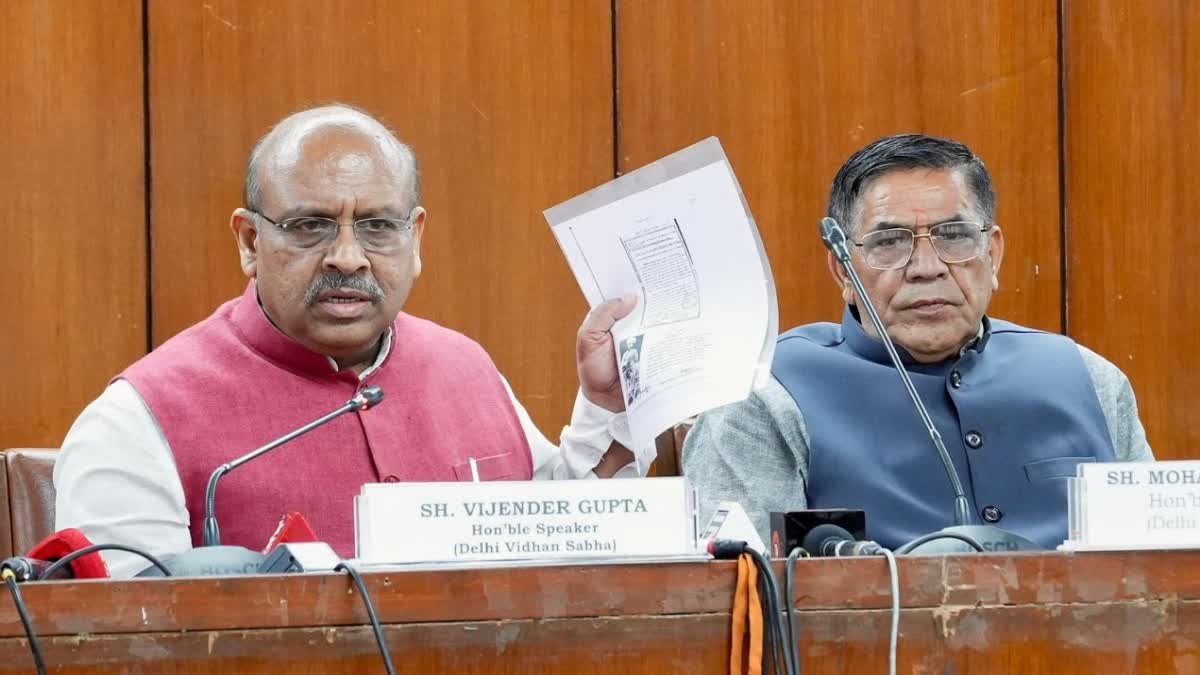

New Delhi: Delhi Assembly is the first Parliament in the country, from where revolutionaries and national leaders called for freedom, which echoed across India. Assembly Speaker Vijendra Gupta has described the All India Speakers Conference, which is going to be held for the first time in this complex, as a confluence of cultural dignity and parliamentary heritage. ‘All India Speakers Conference’ will be organized in the historic building of the Assembly on 24 and 25 August.
This program is being organized to commemorate the completion of 100 years of the presidency of the country’s first elected Central Assembly Speaker Vitthalbhai Patel. On this occasion, Union Home Minister Amit Shah will inaugurate a grand exhibition, special documentary and commemorative postage stamp based on his life, parliamentary contribution and his role in the freedom struggle.
Speaker of Bengal Assembly will not attend the conference: Giving information about this conference on Friday, Assembly Speaker Vijendra Gupta said that Union Home Minister Amit Shah will inaugurate the All India Speakers Conference and Lok Sabha Speaker Om Birla will conclude it. President Draupadi Murmu, Prime Minister Narendra Modi, Leader of Opposition in Lok Sabha Rahul Gandhi have sent good wishes for organizing such a conference in the country. They said that only the Speaker and Deputy Speaker of West Bengal Assembly are not coming to participate in this conference. Speakers and Deputy Speakers of all other states including Kerala, Tamil Nadu, Punjab, Maharashtra, Rajasthan, Madhya Pradesh, Uttar Pradesh will participate.
Arvind Kejriwal also got invitation: Current and former members of Delhi Assembly have also been invited. Vijender Gupta said that invitation has also been sent to former Chief Minister Arvind Kejriwal and Atishi.
All guests will be given the status of state guest: Assembly Speaker Vijender Gupta said that the Speakers, Deputy Speakers, Chairman and Deputy Chairman of 32 Legislative Assemblies and Legislative Councils from across the country will participate in the conference. Delhi Government has appointed 125 officers for the reception and protocol of the state guests. Speakers and Deputy Speakers of all the states will get the status of ‘State Guest’. In keeping with Prime Minister Narendra Modi’s vision of “Development through Heritage”, the Delhi Assembly has decided to not only showcase its glorious past in this conference but also include futuristic topics like paperless system, solar energy and artificial intelligence.
Special dinner and cultural programs will be organized: Special dinners and cultural programs will be organized for the guests, including welcome dinner by the Chief Minister on August 23, dinner by the Speaker of Lok Sabha at Parliament House on August 24, and dinner by the Lieutenant Governor at Raj Niwas on August 25. On each occasion, specially designed cultural programs will be presented, showcasing India’s diverse cultural heritage.
Four major sessions will be organized in the conference: The two-day conference will have four major sessions, which include, first, the role of Vitthalbhai Patel in the creation of the Constitution and Parliamentary Institutions, second, the contribution of the leaders of the pre-independence Central Assembly in the freedom struggle and social reforms, third, the role of artificial intelligence for transparency and public trust in governance, and the last session, India, the Mother of Democracy. These sessions will provide an opportunity for in-depth discussions on India’s parliamentary traditions, democratic values and the relevance of technology in modern governance.
History of the Assembly Complex: The Delhi Assembly building was constructed in 1912 and it was from here that leaders like Lala Lajpat Rai, Pandit Madan Mohan Malviya and Gopal Krishna Gokhale raised their voices against colonial policies. The protest against the Rowlatt Act also started from here, which gave birth to the non-cooperation movement. An exhibition will also be held in the two-day conference. It will display archival documents of Vitthalbhai Patel, photographs and records of the historic proceedings of the House. These also include the day when Shaheed Bhagat Singh threw a bomb in the Assembly. The documentary will also show Mahatma Gandhi’s three historic visits to the House, the protest against the Simon Commission and the moments when Patel took over as the Speaker.

