

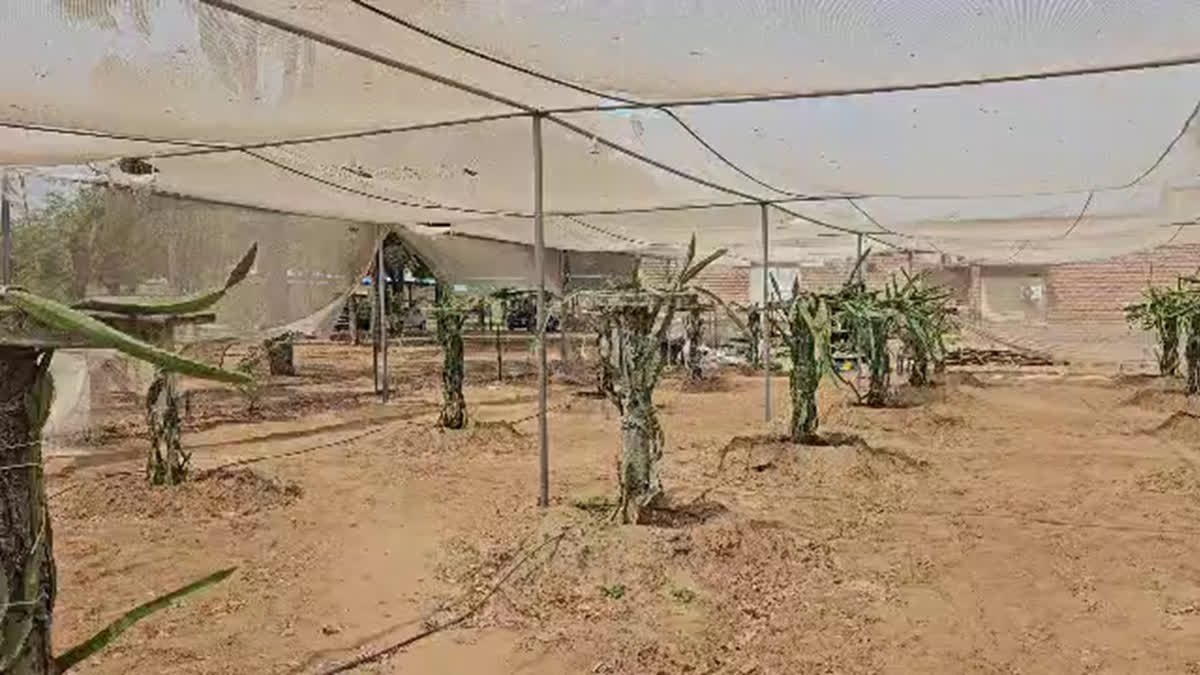

Jodhpur: The ‘foreign’ dragon fruit has made an entry in the semi-arid regions of Rajasthan. Following successful experiments by the Jodhpur based Central Arid Zone Research Institute (CAZRI), farmers of the Marwar region are abandoning traditional crops and shifting towards the cultivation of the fruit.
Its cultivation has already started successfully in Jodhpur’s Bilara and several blocks of Pali district.
CAZRI Director, Dr. SPS Tanwar disclosed, “We have standardized dragon fruit for the Thar region. It gives better yields in semi-arid regions and does not thrive in completely arid regions. We have also made efforts to reduce its price. The area under its cultivation will increase in the future.”
He said the institute installed 120 pillars on its campus to conduct trials on two major dragon fruit varieties. One, with both its outer covering and pulp being pink, is the most sought-after variety in the market. The other has a pink outer covering and white pulp.
Despite being a cactus, the dragon fruit does not grow successfully in extremely arid areas like Jaisalmer or Barmer. Dr. Tanwar said it requires at least 400 mm of rainfall and moisture in the air. That is why it is giving excellent production in semi-arid areas.
It was related that some farmers are successfully producing it under the supervision of CAZRI in several blocks of Pali and Bilara.

Reinforced cement concrete (RCC) pillars and a cement ring on top account for the main cost of dragon fruit cultivation. To reduce these costs, farmers are now using old tires instead of cement rings. Four plants are grown on one pillar, yielding an average of 25 kg to 30 kg. A dragon fruit weighing 300 grams to 350 grams is considered good.
The biggest advantage of dragon fruit is that it starts bearing fruits from the second year of planting and becomes a source of income for the next 10 years. Currently, its price is up to Rs 100 per fruit, but with increased production, it can come down to Rs 50, making it affordable for the common people.
Odisha has a very good crop this time that is available for Rs 60 to Rs 70 per kg. There are three to four fruits in 1 kg which means that one fruit costs Rs 15 to Rs 20. It is being said that if its cultivation increases in the semi-arid areas of western Rajasthan on the lines of Gujarat, then the price will come down.
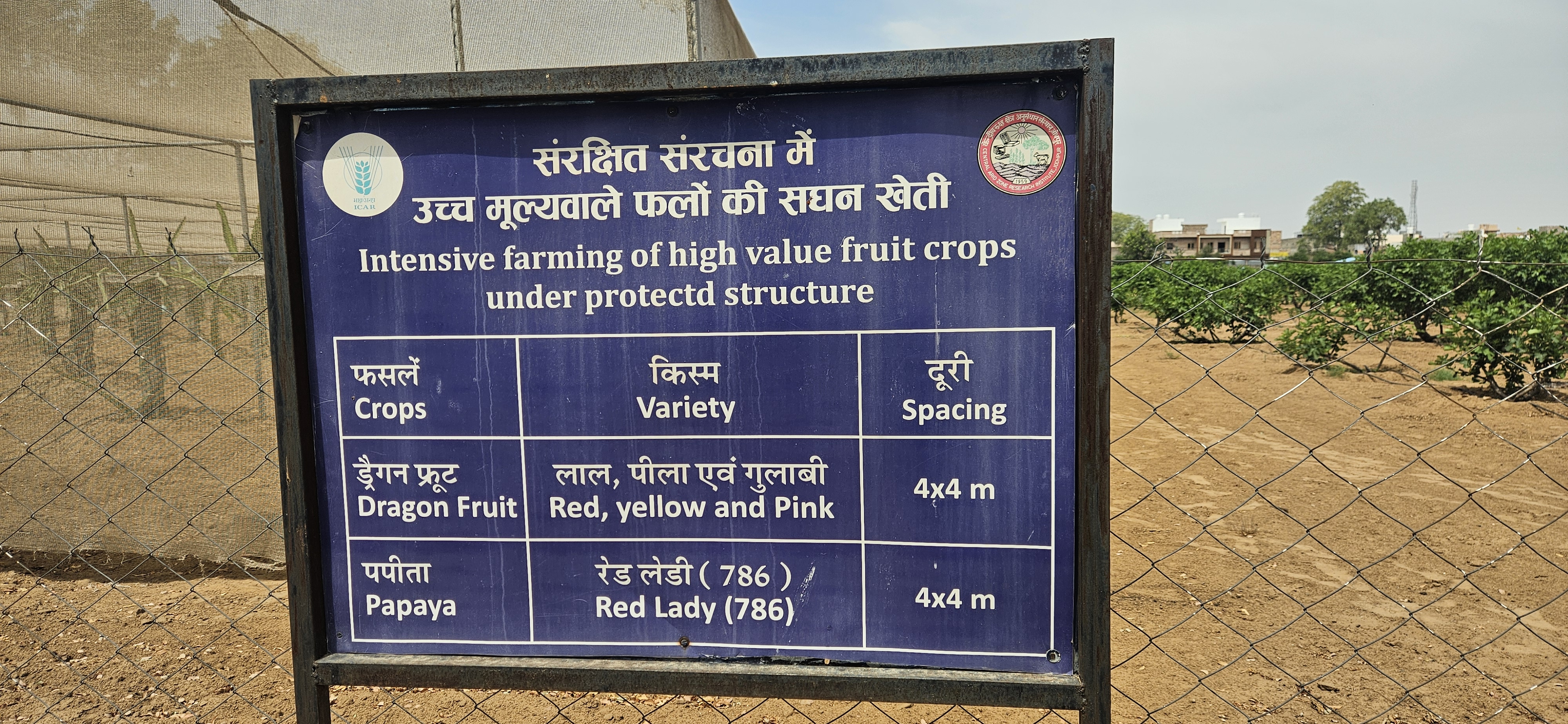
CAZRI officials disclosed that although dragon fruit can be cultivated outdoors, it is advisable to grow it in a covered farm while using drip irrigation. This is recommended for farmers with limited space. With the plant needing regular watering, it is advisable to lay water pipelines both on the ground as well as above the structure so that the water flows from both sides to maintain moisture. This provides the plants with the necessary nutrients and environment.
Essentially considered to be a Chinese fruit, it is cultivated in abundance in Southeast Asia or countries affiliated to the Association of Southeast Asian Nations (ASEAN). Vietnam is a major producer along with Thailand, Brunei, Malaysia and the Philippines. In India, it is mainly cultivated in the semi-arid regions of Gujarat and Maharashtra with Rajasthan joining in now.

