

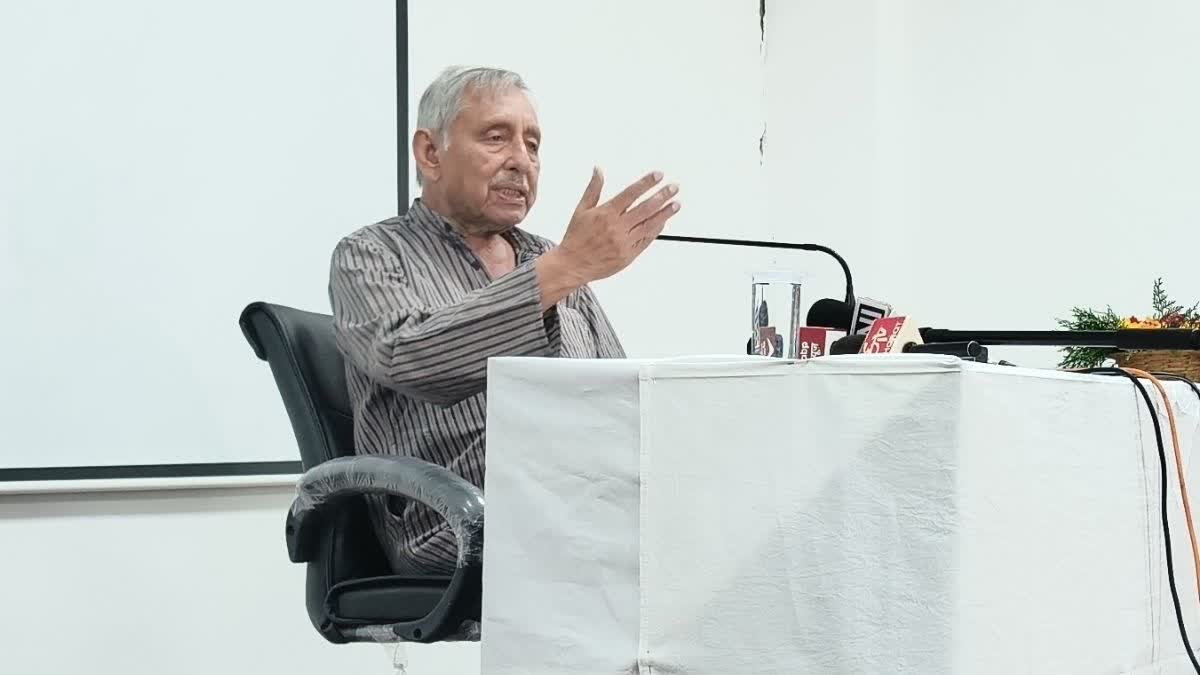

Jaipur: India’s true identity lies in its diversity, tolerance, and secularism; however, today, the politics of division based on religion is being promoted within the country. This assertion was made by former Union Minister Mani Shankar Aiyar. While presenting his views during a lecture titled ‘India’s Future: Pseudo-Hindutva or Secular India?’ held at Kanodia College in Jaipur, he launched a scathing attack on PM Modi and communal politics.
**Taking Aim at PM Modi:** Taking a jibe at Prime Minister Narendra Modi, Aiyar remarked, “He claims that I am a ‘child of Macaulay’ simply because I speak English; but does Modi know Tamil?” PM Modi accuses him of having called him ‘*neech*’ (low-born); however, Aiyar clarified that he did not use the word ‘*neech*’ in that specific sense, but rather stated that Modi is a person of ‘*neech*’ (vile/base) mentality—that his character is vile. Aiyar further noted that he was also falsely accused of having said, “A tea-seller cannot become Prime Minister,” whereas he had never made any such statement. What he actually said was: How can a person—who is unaware that Alexander never reached Pataliputra, or that while Nalanda is in India, Taxila is in Pakistan—possibly step into Nehru’s shoes to become the Prime Minister? Modi, he asserted, became Prime Minister solely by telling lies and spreading false rumors. **Go to Islamabad Instead of the White House:** Aiyar remarked that, today, Shashi Tharoor is dispatched to Columbia to tell the world how “filthy” the Pakistanis are; subsequently, he arrives at the White House and reiterates the same sentiment—that Pakistanis are a “filthy” people. Yet, neither of them possesses the courage to go to Islamabad and tell the Pakistanis directly to their faces: “You are a very filthy people.” They visit neither Nepal, nor China, nor Russia. Instead, they go to America—and not just to America, but specifically to Columbia—merely to create the impression that they are engaging with the world stage. **Questioning the Concept of ‘Love Jihad’:** Raising questions regarding the issue of ‘Love Jihad,’ Iyer stated that by conflating terms like ‘love’ and ‘jihad,’ an atmosphere of hatred is being fostered within society. He asserted that such concepts are fabricated for political gain and serve to divide society.
**India’s Diversity is its Strength:** Iyer remarked that India is a land of a continuous civilization that has endured for thousands of years. Hindus constitute 80 percent of the population in this country, while the remaining 20 percent belong to other communities. Among these minorities, Muslims form the largest group. There are 200 million Muslim Indian citizens, alongside 50 million people belonging to other faiths. This—precisely this—is India (*Bharatvarsh*). If we were to lay a foundation based on labeling this India as a “Hindu country,” striving to establish a “Hindu Nation,” or declaring that Muslims are our enemies, India could not possibly survive; the nation would disintegrate. Whether viewed through the lens of religion, culture, or any other perspective, this country is characterized by immense diversity—and that very diversity constitutes our identity. **Questioning the Politics of Sending Artists to Pakistan:** Iyer observed that a narrative is now emerging which suggests that one can remain an Indian (*Hindustani*) only if one is a Hindu; conversely, if one belongs to any other community, one is merely a guest. The implicit threat is: “If you do not heed our words, we will evict you from our home.” Such a mindset, he warned, would inevitably tear our country apart. He noted that, on numerous occasions, Muslim artists—such as Shah Rukh Khan, Aamir Khan, and Salman Khan—are advised to leave for Pakistan. Iyer condemned this as fundamentally wrong, pointing out that during the Partition, their families made a conscious decision to remain in India and dedicate their lives to this very nation. Such individuals deserve to be accorded respect, rather than being advised to abandon their country.
**Comments on the Ram Temple Event:** He stated that there is no religion in India that does not embrace diversity; however, certain groups are now propagating the notion that the “true” Hindu religion—and the “true” Hindu—is one who was born within this land, who looks inward rather than outward, and who directs their worship solely within this geographical sphere. According to this view, only such a person can be considered a “true” Hindu and a legitimate inhabitant of India; conversely, since Muslims look toward Mecca and Christians look toward Rome, they are deemed incapable of being “true” Indians. One can merely be a guest in this country, and they must adhere to Hindu discipline. Referring to the inauguration of the Ram Temple in Ayodhya, Iyer remarked that when religious preceptors of the stature of the Shankaracharyas are present in the country, it raises several questions when the political leadership takes the lead in conducting religious rituals.
**Citing the Spirit of the Constitution:** Towards the conclusion of his address, Iyer stated that the Constitution of India explicitly stipulates that the State has no religion of its own. He asserted that conflating religion or creed with nationality runs counter to both India’s history and its Constitution. He emphasized that India’s true strength lies in its diversity, coexistence, and secular framework, and that preserving these elements is essential for the country’s future.

