

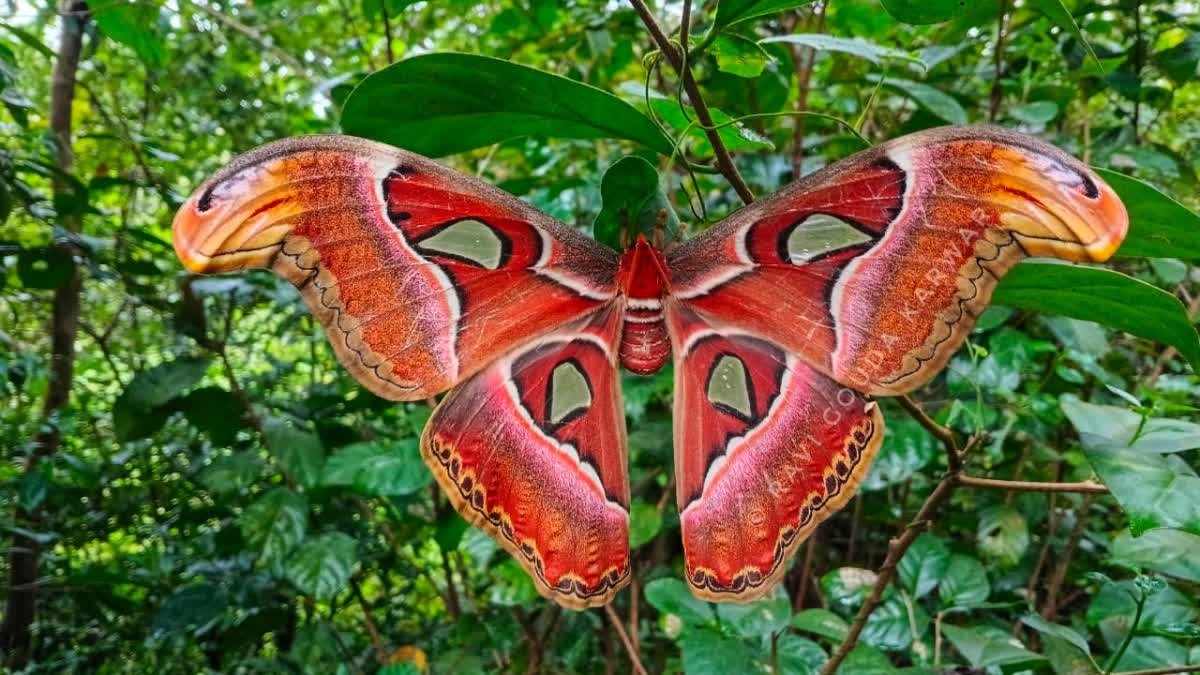

Karwar: The world’s largest butterfly, the Atlas Moth, has been discovered in Karwar, Karnataka. This rare species was found in Guddehalli, Karwar, in Davangere district. Local photographer Ravi Gowda captured the insect on camera.
According to entomologists, this species, often mistaken for a butterfly, is a special moth belonging to the order Lepidoptera. Scientifically known as Attacus atlas, this moth has a wingspan of approximately 24 centimeters. This Atlas moth lacks a mouth or digestive system and is found in coastal and mountain forests.
Entomologists say that the female moth lays eggs on specific trees, and the larvae feed on those leaves, providing energy for their entire life. After storing energy, it spins a cocoon (a covering of fine threads) and emerges as a fully developed moth. Since the moth has no mouth or digestive system, it doesn’t eat any food during its short lifespan. It survives solely on the energy stored as an insect.
He explained that after breeding, both the female and male moths die. He explained that the male moth actually dies immediately after mating, and the female dies after laying eggs. Entomologists explained that the moth weakens as the days pass, becoming an easy prey for predators like birds, ants, or wasps.
Forester Gopalkrishna explained, “The Atlas moth lives only 14-18 days. It is huge and always keeps its wings spread. Most of the time it rests or breeds. It is seen in coastal and mountainous areas during the rainy season.”
1300 Species of Butterflies in India
Around 1300 species of butterflies are found in India. Uttarakhand has the highest number of butterflies, with 500 species. Many of these butterflies are rare species. The Atlas Moth and the Luna Moth are considered rare. Their wings are extremely beautiful.
Characteristics of the Atlas Moth
According to entomologists, the common misconception is that the Atlas Moth is a butterfly, but it is a giant moth scientifically known as Attacus atlas. Its lifespan is very short, lasting only a week. They explained, “During the day, the Atlas Moth rests, while at night it goes out in search of a mate. The female emits a pheromone that the male can detect from a great distance thanks to its feathery antennae.”
The Atlas Moth derives its name from its large size and the serpentine edges of its wings. Interestingly, despite its enormous size, this moth is unable to feed after emerging from its cocoon. Instead, it relies on fat reserves accumulated during its caterpillar stage. After spending approximately a month in its cocoon, Atlas moths do not survive for more than a week.
This magnificent species is found in various tropical and forest habitats in Asia and is renowned for its reddish-brown wings, which are marked with striking triangular patterns in black. Furthermore, the life journey of the Atlas moth, from its amazing caterpillar stage to the construction of its intricate silken cocoon, is a captivating marvel of nature.

