

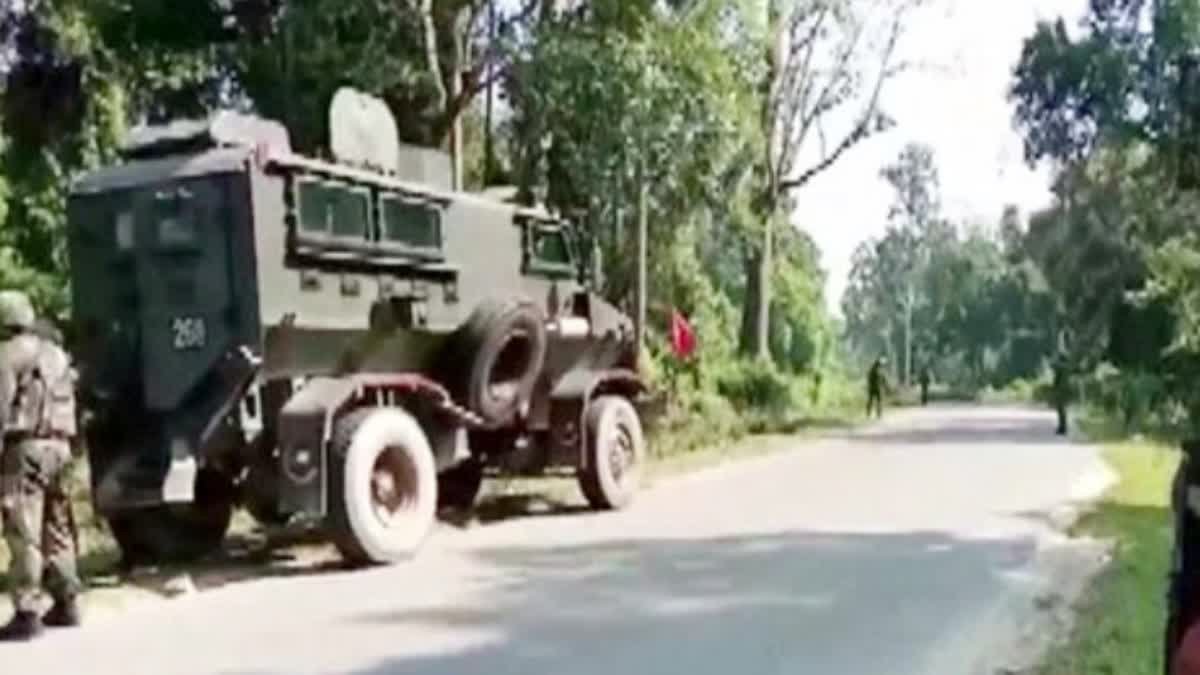

New Delhi: A day after four police commandos were injured in an attack allegedly carried out by suspected United Liberation Front of Assam (Independent) militants in Upper Assam’s Tinsukia district, the Centre for North East India Security Studies (CNEISS), a New Delhi-based security think tank, on Monday warned of more deadly attacks in Assam ahead of the upcoming assembly elections.
The Centre for North East India Security Studies said, “If the alliance of the United Liberation Front of Assam (Independent), the Parbatya Chattagram Jana Samhati Samiti (PCJSS), a tribal armed group from Bangladesh’s Chittagong Hill Tracts (CHT), the Arakan Rohingya Salvation Army (ARSA), and the Rohingya Solidarity Organisation (RSO) is not properly dealt with, more dangerous attacks are likely.”
On March 22, at around 2:30 am, suspected ULFA (I) militants attacked the 4th Assam Police Commando Battalion camp at Jagun in Tinsukia with a rocket-propelled grenade, injuring four Assam Police commandos, including Robi Garg, Jimbus Marak, Debashish Bora, and Chittaranjan Mili.
“The ULFA (I)’s first major attack on the Assam Police since 2021 indicates a shift in its policy following a two-day marathon meeting between the ULFA, PCJSS, ARSA, and RSO in Cox’s Bazar, Bangladesh, on December 9-11, 2025. This meeting was jointly facilitated by Bangladesh’s Directorate General of Military Intelligence (DGFI) and Pakistan’s ISI.
Swapan Debbarma, Senior Advisor to the CNEISS, told ETV Bharat, “If security is not tightened in the state, more dangerous attacks could occur before the elections scheduled for April 9, 2026.”
According to Debbarma, the unchecked use of Indian soil by the PCJSS, a newly formed coalition of anti-India forces, poses the greatest threat to India’s security. PCJSS President Santu Larma has been serving as the Chairman of the Chittagong Hill Tracts (CHT) Regional Council for the past 28 years, without elections, as an asset of the DGFI. Debbarma further stated, “India failed to anticipate the security threat posed by the PCJSS, a DGFI asset, and this allowed the PCJSS to allegedly establish 15 camps in India. These include Tipraghat village, Salmur village, Malsuri village, and Nunsuri village in Lunglei district in Mizoram; Borapansuri village, Lodisora village, Nakukchera, and Dewasora South villages in Lawngtlai district; Rajivnagar village in Mamit district; and 10 camps in Kamalkha (Korolichari), Mog Para, Sonamura, and Garithanhola villages in Dhalai district in Tripura; and Mitingachari village in North Tripura district.”
Citing a larger global conspiracy to destabilize India’s Northeast, the CNEISS stated that Myanmar armed groups supplied a large cache of sophisticated weapons to the PCJSS in the last week of February 2026.
These groups were reportedly trained by American mercenary Matthew Aaron Van Dyke and Ukrainian nationals, who were arrested by India’s National Investigation Agency (NIA).
The PCJSS managed to transfer these weapons from Paletwa in Myanmar to Thekamukh on the Mizoram-Bangladesh border via Mizoram.
Debbarma said, “Earlier on February 26, 2026, MLA Chakma, the PCJSS representative in Cox’s Bazar, allegedly purchased 50 sophisticated weapons from Rohingya armed groups, which were to be sent forward to foment trouble in the Northeast.”
The Gauhati High Court, in its judgment dated September 5, 2024, declared the Parbatya Chattogram Jana Samhati Samiti (PCJSS) a terrorist organisation in connection with a 2013 arms seizure case in Mizoram. Thirty-one AK-47 rifles, one light machine gun, one Browning automatic rifle, and a large quantity of ammunition were recovered.

