

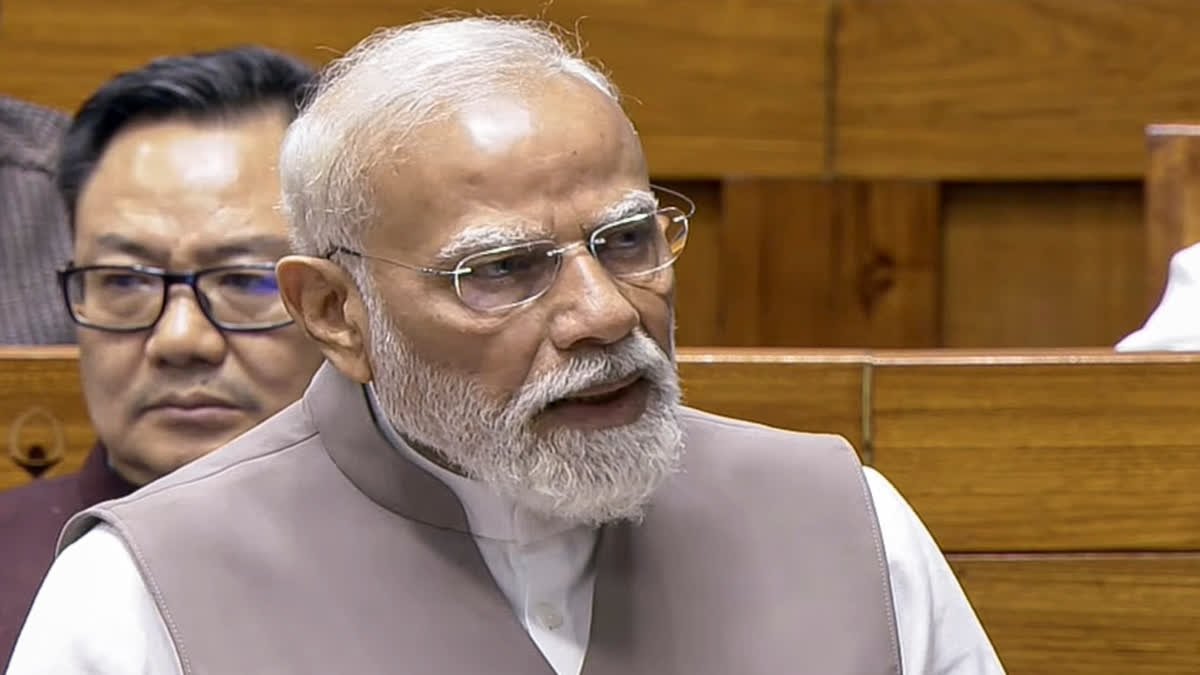

New Delhi: Prime Minister Narendra Modi has described the war in West Asia as an unprecedented global crisis, similar to the coronavirus pandemic. He said that the impact of this conflict will be long-lasting, and to overcome it, citizens must remain prepared and united, just as they did in the face of the coronavirus. Prime Minister Modi was speaking in the Lok Sabha on Monday about the ongoing conflict in West Asia and the challenges it poses to India.
The Prime Minister said, “The impact of the situation created in the world due to this war is likely to last for a long time. Therefore, we must be prepared and united. We have faced such challenges with unity even during the Corona period. Now we need to be prepared again in the same way. We must face every challenge with patience, restraint, and a calm mind. This is our identity.” Modi said that despite the challenges in the movement of ships carrying crude oil, gas, and fertilizers through the Strait of Hormuz, the government is trying to ensure that the supply of petrol, diesel, and gas in the country is not significantly affected. He said that LPG production is being increased in the country and work has been done to ensure a smooth supply of petrol and diesel. Regarding the agricultural challenges, the Prime Minister said that the government will continue to support farmers in every possible way.
He said that the region where the war is taking place is an important route for India’s trade with other countries and supplies a large portion of the country’s crude oil and gas. He said that the ongoing war in West Asia for more than three weeks is having a profound impact on the global economy and the lives of people. This war has also posed unprecedented challenges for India.
Modi noted that this region is crucial because 10 million Indians live and work in the Gulf countries. He noted that Indians constitute a significant number of crew members on commercial vessels operating in the region, so India’s concerns are naturally high. He said, “Therefore, it is essential that a unanimous and unified message regarding this crisis be sent to the world from the Indian Parliament.”
The Prime Minister stated that since the crisis erupted, he has personally spoken to most of the heads of state in West Asia twice over the phone. They have all assured the safety of Indians there. He added that unfortunately, some people have died and others have been injured during this period. Modi stated that all Indian missions in the affected countries are continuously engaged in assisting Indians, and that every possible assistance is being provided to Indians working there and tourists.
He said that the safety of Indians at home and abroad has been a top priority for India during such crises. Modi said, “Since the war began, approximately 375,000 Indians have returned safely to the country. Nearly 1,000 Indians have returned safely from Iran alone. These include over 700 young medical students.” He added that the CBSE is taking appropriate steps to ensure uninterrupted education for Indian children in Gulf countries.
He said that over the past decade, India has prioritized crude oil storage to deal with such times of crisis. Today, India has strategic reserves of over 5.3 million metric tons of crude oil, while work is underway to store over 6.5 million tons.
He said that recently, several ships stranded in the Strait of Hormuz have returned to India. Modi said that the preparations made in the country over the last 10-11 years in the field of ethanol production and blending are proving very useful during times of crisis. Modi said that if the railways were not electrified on such a large scale today, an additional 1.8 billion liters of diesel would be consumed every year. He said that the 1,100-kilometer metro network in the country, the central government’s provision of 15,000 electric buses to the states, and the ongoing work on alternative fuels will further secure India’s future.
The Prime Minister said that the current West Asia crisis is affecting economies worldwide and continuous efforts are being made to minimize its impact on India. Modi said that an inter-ministerial group meets daily on this crisis and is working to discuss and find solutions to the problems faced in imports and exports. He said, “I am confident that with the joint efforts of the government and industry, we will be able to better cope with the situation.”
The Prime Minister stated that India opposes attacks on civilians and transport routes during this conflict. He said, “The blockade of Hormuz and attacks on commercial ships are unacceptable. India is striving to ensure the continued movement of Indian ships through diplomacy in this war-like situation. India has always advocated for peace and the interests of humanity. I reiterate that a solution to this problem is possible only through diplomacy and dialogue.”
Modi said, “Endangering anyone’s life in this war is not in the interest of humanity. Therefore, India’s efforts are to encourage all parties to seek a peaceful solution as soon as possible.” He added that some elements attempt to exploit such crises, so all law and order agencies have been put on high alert.
PM Modi stated that coastal security, border security, cybersecurity, and the security of strategic installations are being further strengthened. He added that state governments have been called upon to take action against black marketers and hoarders. Modi said, “When all the state governments and citizens of the country work together, we can challenge every challenge.”

