

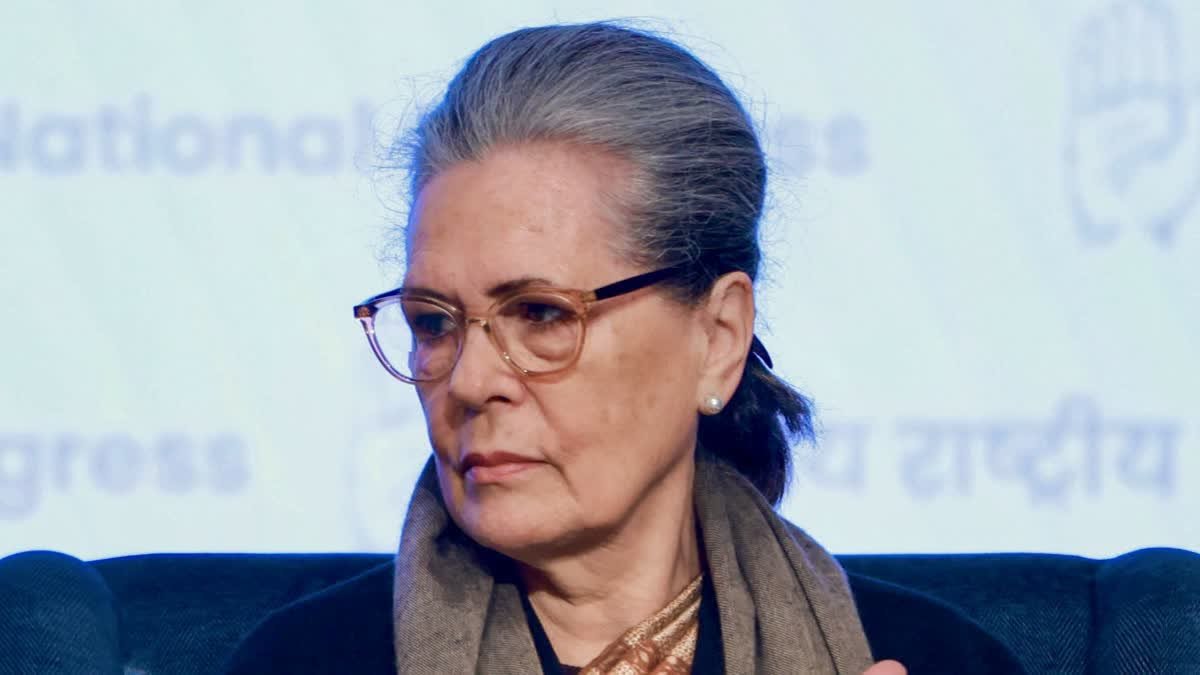

New Delhi: Congress Parliamentary Party Chairperson Sonia Gandhi on Thursday criticized the Modi government’s stance, saying India needs to show leadership on the Palestine issue. She described the government’s response as “deafening silence” and an abandonment of both humanity and morality.
She said the government’s actions appear to be primarily motivated by the personal friendship between Prime Minister Narendra Modi and his Israeli counterpart Benjamin Netanyahu, rather than India’s constitutional values or its strategic interests.
In her article published in The Hindu, Gandhi said, “This style of personal diplomacy is never acceptable, nor can it guide India’s foreign policy. Attempts to do so in other parts of the world, especially in the United States, have failed in the most painful and humiliating ways in recent months.”
This is Gandhi’s third article on the Israel-Palestine conflict, published in a national daily in recent days, in which he sharply criticized the Modi government’s stance on the issue.
India’s position on the world stage cannot be confined to the personal glorification of any one individual, nor can it depend on its historical achievements. In his article titled “India’s Muffled Voice, Its Alienation from Palestine,” he stated that this requires sustained courage and a sense of historical continuity.
Gandhi pointed out that France, along with the United Kingdom, Canada, Portugal, and Australia, recognizing the Palestinian state, “marks the first step towards fulfilling the legitimate aspirations of the long-suffering Palestinian people.” He added that more than 150 of the 193 UN member states have now done so.
Gandhi emphasized that India has been a leader in this matter, formally recognizing the Palestinian state on November 18, 1988, after years of support for the Palestine Liberation Organization (PLO).
He cited how India raised the issue of apartheid in South Africa even before independence, and during the Algerian War of Independence (1954-62), India was one of the strongest voices for an independent Algeria.
He pointed out that in 1971, India strongly intervened to prevent genocide in then-East Pakistan, which led to the birth of modern-day Bangladesh.
The former Congress president said that India has long taken a delicate but principled stance on the crucial and sensitive issue of Israel-Palestine, emphasizing its commitment to peace and the protection of human rights.
Gandhi emphasized that India needs to demonstrate leadership on the Palestinian issue, which is now a fight for justice, identity, dignity, and human rights.
He said that over the past two years, since the outbreak of hostilities between Israel and Palestine in October 2023, India has virtually abandoned its role.
He said, “Israel’s response following Hamas’s brutal and inhumane attacks on Israeli civilians on October 7, 2023, has been nothing short of genocide. As I have stated before, over 65,000 Palestinian civilians have been killed, including 17,000 children.”
Gandhi stressed that the Gaza Strip’s residential, school, and health infrastructure has been destroyed, as well as agriculture and industry.
He said, “The people of Gaza have been pushed into a famine-like situation, with the Israeli army brutally obstructing the delivery of vital food, medicine, and other aid. This is a ‘drop-by-drop’ supply of aid amidst a sea of despair.”
He pointed out that in one of the most heinous acts of inhumanity, hundreds of civilians were shot while trying to obtain food. Gandhi said that the world has delayed its response, thereby implicitly legitimizing Israeli actions.
He said that the recent steps taken by several countries to recognize Palestine as a sovereign state are a welcome and long-overdue departure from the policy of inaction.
He said, “This is a historic moment and an affirmation of the principles of justice, self-determination, and human rights. These steps are not merely diplomatic gestures; they are an affirmation of the moral responsibility that nations bear when confronting long-standing injustice. It is a reminder that in the modern world, silence is not neutrality, but complicity.”
Gandhi targeted the Modi government, saying that here, India’s voice, once so steadfast in its support for freedom and human dignity, has remained “conspicuously silent.”
Meanwhile, he said, it is appalling that just two weeks ago, India not only signed a bilateral investment agreement with Israel in New Delhi, but also hosted its highly controversial right-wing finance minister, who has drawn global condemnation for repeatedly inciting violence against Palestinian communities in the occupied West Bank.
Gandhi argued that India should view the Palestine issue not merely as a foreign policy issue, but as a test of India’s moral and civilizational heritage.

