

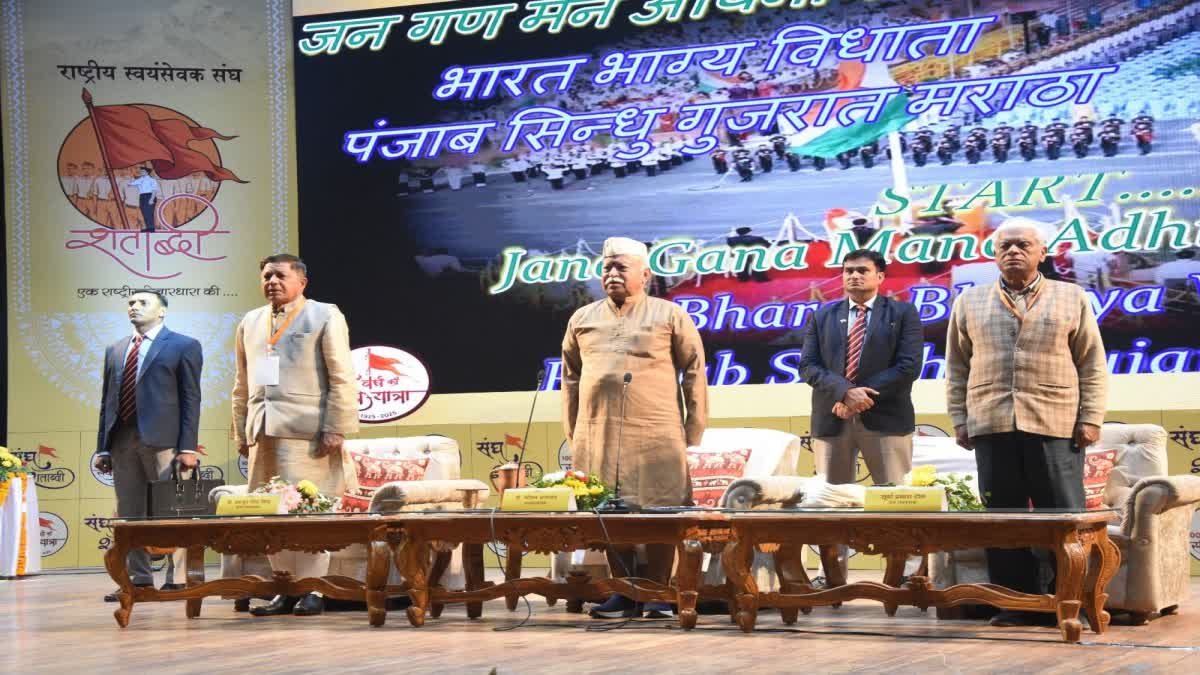

Dehradun: Rashtriya Swayamsevak Sangh (RSS) chief Mohan Bhagwat returned from Dehradun after a three-day visit to Uttarakhand. During his stay, he interacted with veterans, intellectuals, and various sections of society. He shared his views on issues such as national security, the Agniveer Yojana, the Uniform Civil Code (UCC), and social harmony.
During his three-day stay in Dehradun, RSS chief Mohan Bhagwat interacted with various sections of society. On the last day of his stay, a “Major Public Conclave and Multi-Sector Coordinated Dialogue Program” was organized with veterans and former army officers at the Himalayan Cultural Center in Garhi Cantt. Several senior military officers, including a Major General, Vice Admiral, DG Coast Guard, Brigadier General, and a large number of former soldiers, attended the event. They were welcomed with traditional honors. The strength of society is the protection of the nation: In his address, Bhagwat stated that society plays a central role in nation-building. If society is strong, the nation’s defense will also be strong. He emphasized the importance of leadership with character and discipline. Recalling the contributions of RSS founder Keshav Baliram Hedgewar, he said that the RSS’s primary objective is not electoral politics but personality development.
Speaking on the Agniveer Scheme: On the issue of veterans’ involvement in national security, Bhagwat described the Agniveer Scheme as an “experiment.” He said that the possibility of improvement and refinement should be considered based on experience. He emphasized the importance of excellent leadership and military preparedness. Views on neighboring countries and Kashmir: Responding to questions about Nepal, Bangladesh, and Kashmir, he stated that they have historically been part of a single cultural territory. Describing Kashmir as an integral part of India, he expressed the need for a strict policy against anti-national movements.
Hindu identity and social harmony: Bhagwat described “Vasudhaiva Kutumbakam” as the core of Indian thought. He said that Hindu society is liberal and inclusive. Public places like temples, water sources, and cremation grounds should be equally open to all. Social Media and Dialogue: He stated that the growing ideological acrimony on social media should be replaced by a tradition of debate and positive dialogue. He emphasized the need for feedback-based policymaking at the grassroots level.
UCC, Reservation, and Population Issues: He described the Uniform Civil Code (UCC) as a means of national integration. He emphasized the need for social consensus and patience on reservations. Regarding population imbalance, he cited conversion, infiltration, and birth rates as reasons and expressed the need for a comprehensive policy.
Migration and Local Development: To prevent migration in mountainous regions like Garhwal, he emphasized the need for special attention to education, health, and local entrepreneurship.

