

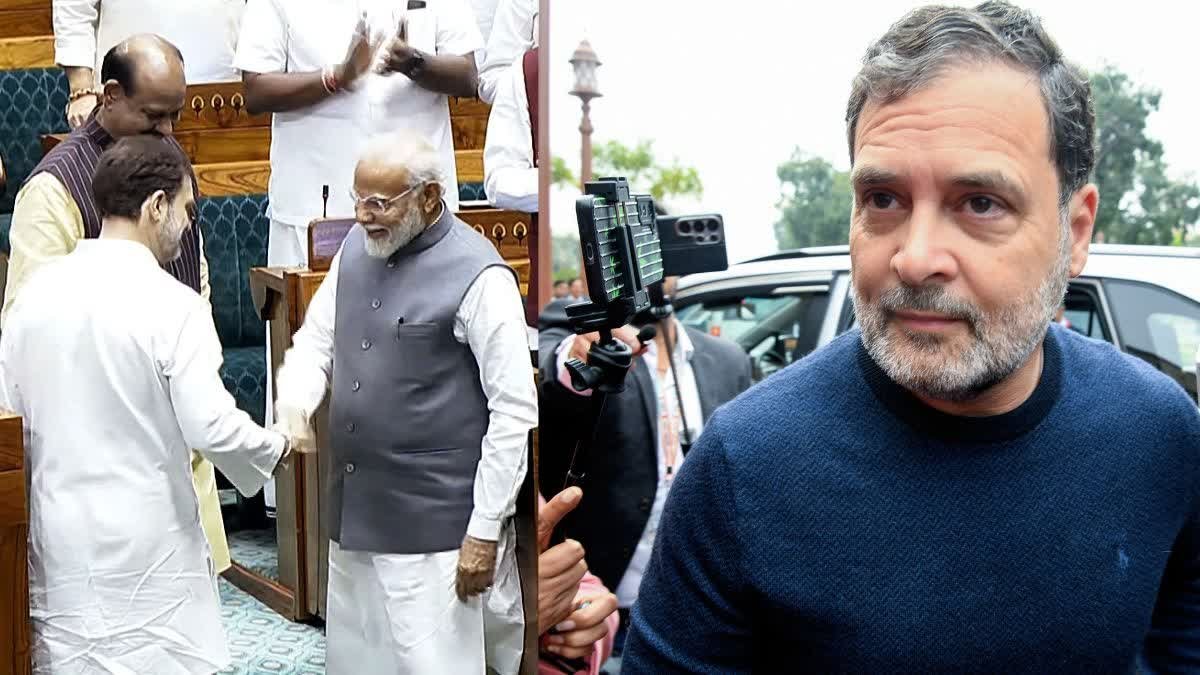

New Delhi: Leader of the Opposition in the Lok Sabha, Rahul Gandhi, is expected to launch a sharp attack on the Modi government’s policies during the debate on the President’s address on February 2. On January 28, the first day of the ongoing Budget Session of Parliament, President Droupadi Murmu addressed a joint sitting of both the Lok Sabha and Rajya Sabha to mark the beginning of the 2026 session.
In her address, the President highlighted the achievements of the Modi government, which the Congress-led opposition questioned. Notably, the ruling NDA strongly objected to the Congress’s demand to reinstate the old rural employment scheme, MGNREGA, during the President’s address. The NDA accused the opposition party of deliberately disrupting the President’s speech.
However, Congress leaders later justified their actions by stating that demanding the replacement of MGNREGA with the new scheme, Viksit Bharat – Guarantee Mission for Employment and Livelihood (Rural) (VBGRAMG), was in support of the country’s poor and therefore not wrong.
Even before Finance Minister Nirmala Sitharaman presented the Union Budget 2026-27 on February 1, the Congress had stated that it did not have high expectations from the Modi government, which it alleged was neglecting crucial issues raised by Rahul Gandhi, such as managing the economy, ensuring social justice, and foreign policy. After the budget presentation, the Congress’s reaction remained consistent, highlighting shortcomings in the government’s proposals.
Congress managers indicated that Rahul Gandhi, the Leader of the Opposition in the Lok Sabha, who has refrained from detailed criticism of the budget so far, may attack the central government’s policies during the debate on the motion of thanks to the President’s address on January 28 in the Lok Sabha on February 2. Congress whip in the Lok Sabha, Mohammed Javed, told ETV Bharat, “We all want Rahul Gandhi to speak during the major debate on Monday.”
According to the MP, many Congress MPs wanted to speak during the debate, but the party had to shortlist names based on the time allotted. The Lok Sabha Speaker has allocated a total of 18 hours for the debate, which begins on Monday. Prime Minister Modi will respond at the end of the discussion.
Javed said, “We didn’t have high expectations from this government, and the budget has shown that we were right.” He added that there is nothing in the budget that addresses the issues our leader has raised in the last few months. He said that this budget offers nothing for the common man, small traders, and farmers. Javed said that the Congress wants to ask the government many questions and get answers.
The proposed passage of the VBGRAMG 2025 in the winter session of Parliament, replacing the MGNREGA scheme passed in 2005 during the previous UPA government, has become a major political battle between the Congress and the NDA. Under Rahul Gandhi’s leadership, the grand old party is mobilizing its workers and support base across the country to protest against the new rural jobs scheme.
Besides the plight of the rural poor, Rahul has also been raising concerns about the impact of US tariffs on the manufacturing sector and exporters, unemployment among the youth, inflation affecting middle-class families, lack of clean air and water for the people, removal of names through the controversial SIR, threats from China and Pakistan at the borders, and growing economic inequality, to target the government. Insiders say he will reiterate these points during the debate on Monday.
Congress Working Committee member Jagdish Thakor told ETV Bharat that the President’s address, prepared by the government, stated that millions of youth have received permanent jobs through job fairs. The Developed India Employment Scheme will create more than 3.5 crore jobs, and more than one crore youth have found employment in IT services, electronics manufacturing, and global capability centers. However, labor reports showed a reverse trend: between 2017-18 and 2023-24, the share of manufacturing in employment decreased from 12.1 percent to 11.4 percent, while that of services declined from 31.1 percent to 29.7 percent.
Simultaneously, during the same period, the share of agriculture increased from 44.1 percent to 46.1 percent, self-employment rose from 52.2 percent to 58.4 percent, and regular salaried employment decreased from 22.8 percent to 21.7 percent. This indicates a shift towards more informal and less secure forms of work for people, especially the youth.
According to AICC functionary B.M. Sandeep, while the President’s address claimed that the government’s policies prioritized the poor and marginalized, several surveys revealed that the top 10 percent of the population held approximately 58 percent of the country’s income, while the bottom 50 percent received only 15 percent.
Sandeep told ETV Bharat that the surveys also showed that the top 10 percent of the population owned approximately 65 percent of the country’s wealth, while the bottom half possessed only 6.4 percent. Furthermore, the top 1 percent held nearly 40 percent of the nation’s wealth. If income and wealth inequality are historically so high, how can the claim of standing with the poor truly hold water?

