

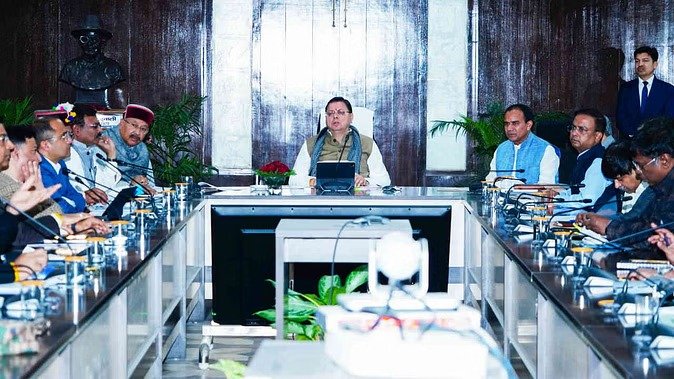

Dehradun: After the mobilization of the Chief Ministers of five states of South India regarding Dehradun delimitation, there is a stir on this issue in Uttarakhand as well. However, the Delimitation Commission has not been formed yet and the census has to be done first. Therefore, there is still a lot of time in this. But unlike South India, the Himalayan state of Uttarakhand has its own concerns.
The population is shifting from the nine hill districts of Uttarakhand, formed on the concept of a hill state, at the same pace, the population is increasing in the four plain districts of the state. The voter lists of the Election Commission confirm these facts. The number of voters has increased much faster in the plain districts than in the hills.
More than five lakh people migrated
This is the main reason for the concern of the politicians associated with the concerns of the hill state. In 2018, the Migration Commission had reported that more than five lakh people migrated from Uttarakhand. Among these, more than three lakh people temporarily left their homes in search of work or due to lack of basic facilities. Since then, the state government has been taking measures to stop migration and reverse migration.
Garhwal MP Anil Baluni is motivating people who have temporarily migrated to cast their votes in their villages through the Mera Vote-Mera Gaon campaign. According to Baluni, the campaign has been effective in his village. But according to experts, all these measures are not so effective that they can bridge the population gap between the mountains and the plains.
Hope from connectivity and means of livelihood
Economic improvement is expected in the mountainous areas due to the Chardham All-Weather Road, Rishikesh-Karnprayag Rail Project, expansion of air connectivity. It is believed that with the expansion of rail, air and road connectivity, development in the mountains will pick up pace and people will get means of livelihood. Efforts are also being made to reverse migration through schemes related to solar, home stay and horticulture.
In 2002, there were 5.4 percent more voters in plain districts than hill districts
The first assembly election was held in 2002. The total number of voters then was 5270375. There were 3779523 voters in the four plain districts of Dehradun, Nainital, Udham Singh and Haridwar, which was 52.7 percent of the total voters. Whereas in the nine hill districts there were 2490852 lakhs i.e. 47.3 percent of the total voters. In this way, there was a slight difference of 5.4 percent between the number of voters in the hill and plain districts.
Voter growth rate in plain districts in the last decade is 72 percent
In 2012, the total number of voters was 6377330, which increased to 8266644 in 2022. In a decade, 1889314 voters increased and the number of voters increased by 31 percent. In 2012, there were 3658842 voters in the four plain districts, which is 57.4 percent of the total voters. In 2022, the number of voters in the plain districts increased to 5010881, which is 60.6 percent of the total voters. In two decades, 1352039 voters increased in the plain districts and this growth rate reached 72 percent.
Votes increased only 21 percent in nine hill districts
In 2012, there were 2718488 voters in the nine hill districts, which is 42.6 percent of the total voters. In 2022, voters in the hill districts increased to 3255763 but the total voter share slipped to 39.4 percent. In a decade, voters increased at the rate of 21 percent in the hills. 1352039 voters increased in the plain districts and 537275 voters in the hills. That is, the number of voters in the plain districts increased much faster than in the hill districts.
Voters kept increasing in the plains like this
2002 2012 2022
2779523(52.7 per cent) 3658842(57.4 per cent) 5010881(60.6 per cent)
Picture of voters in hill districts
2490852(47.3 per cent) 2718488(42.6 per cent) 3255763(39.4 per cent)
If we look at the voters, the gap between the hills and the plains has increased a lot. Reverse migration or any other solution is like a drop in the ocean. Therefore, to save the concept of a hill state, delimitation on the basis of area seems to be the only option. Politicians, political thinkers and thinkers will have to seriously consider this. -Anup Nautiyal, social worker and analyst
Delimitation is still far away. First there will be a census and then there will be delimitation. To strengthen political representation, it is necessary that the number of voters in the hills increases. An attempt can be made to strike a balance by running a campaign to connect people to their roots along with the increase in resources through development, livelihood and employment and expansion of facilities. -Anil Baluni, MP Garhwal
This problem is not only of Uttarakhand but of the rural areas of the entire nation. Due to lack of facilities and employment, the population has migrated from the villages. To keep the concept of a hill state alive, the governments will have to seriously consider the development of the hills and increasing the livelihood resources. -Anil Joshi, Padma Bhushan, environmentalist and social thinker

