

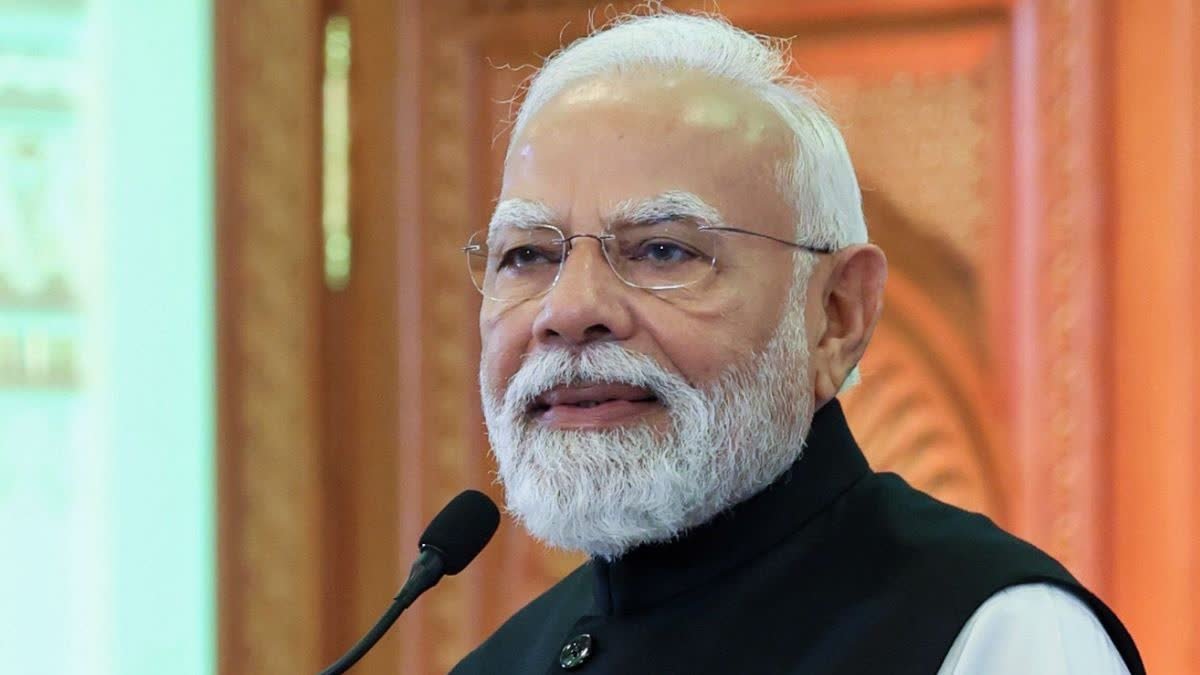

New Delhi: Prime Minister Narendra Modi on Wednesday strongly endorsed the newly introduced VB-G RAM G Act, 2025. He emphasized that the new law reimagines rural employment by treating income support, asset creation, and agricultural sustainability as interconnected priorities rather than trade-offs.
The Prime Minister’s Office (PMO) shared an article written by Union Agriculture Minister Shivraj Singh Chouhan on X (formerly Twitter). The article explains the rationale and objectives of the new law, which replaces the Mahatma Gandhi National Rural Employment Guarantee Act (MGNREGA).
The PMO tweeted, “In this insightful article, Union Minister Shivraj Singh Chouhan explains how the VB-G RAM G Act, 2025 views income support, asset creation, agricultural sustainability, and long-term rural productivity as a continuum rather than a trade-off.” It further stated that the bill was preceded by “extensive consultations with state governments, technical workshops, and multi-stakeholder discussions.”
In his post on X, Chouhan launched a scathing attack on the Congress-led UPA government, alleging that MGNREGA failed to deliver positive results. He claimed that under the guise of MGNREGA, the UPA government offered nothing but widespread corruption. He further asserted that the new Act attempts to “rectify the serious shortcomings left behind by the Congress.”
Meanwhile, the VB-G RAM G Act has already sparked political opposition. The DMK-led alliance held a protest against the law in Chennai. Several opposition leaders have accused the central government of undermining the spirit of employment guarantee and weakening federalism by altering funding and implementation mechanisms.
According to the provisions of the new Act, every rural household is guaranteed wage employment for 125 days in a financial year, an increase from the existing 100 days. This is for those willing to do unskilled manual labor. The government has described it as a major boost to social security for rural families.
Section 22 of the Act outlines a revised fund-sharing pattern, with the central and state governments contributing in a 60:40 ratio. For the northeastern states, Himalayan states, and Union Territories such as Uttarakhand, Himachal Pradesh, and Jammu and Kashmir, the central government’s share will be 90 percent, with the remaining 10 percent contributed by the states.
Another important provision, Section 6, allows state governments to specify up to 60 days a year during peak agricultural seasons, such as planting and harvesting, when employment under this scheme can be regulated.

