

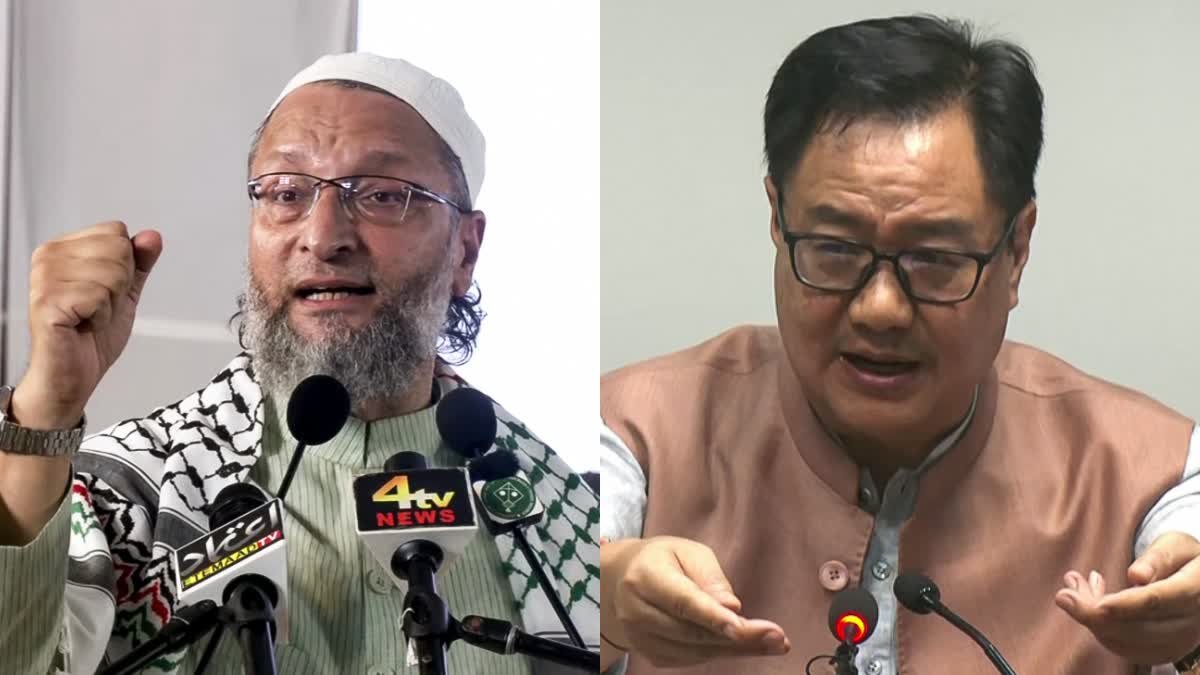

New Delhi: Union Minority Affairs Minister Kiren Rijiju took to social media to a heated debate with All India Majlis Ittehadul Muslimeen (AIMIM) president Asaduddin Owaisi over pre-matric scholarships and other schemes for the welfare of minority students.
Responding to the criticism made by Owaisi on Tuesday that the NDA government has limited scholarships to classes 9 and 10, while dropouts among Muslims start from class 5.
Rijiju said in an X-a post that pre-matric scholarships have been banned because the Right to Education (RTE) Act makes it mandatory to provide free and compulsory early education for students of classes 1 to 8. The Union Minister also said that the Maulana Azad National Fellowship Scheme has been closed as it overlaps with similar schemes of other ministries and departments.
“Moreover, UGC and CSIR fellowship schemes are open to candidates from all social categories and communities, including minorities,”” Rijiju said.” Schemes like PMJVK, PM Vikas are being implemented for maximum inclusiveness and socio-economic upliftment.
Asaduddin Owaisi hits back at Kiren Rijiju
Asaduddin Owaisi on Wednesday hit back at Kiren Rijiju, alleging that the Right to Education Act (RTE) is being used as a trick to limit pre-matric scholarships, which helps reduce dropout rates.
Also banned pre-matric scholarships for new communities?
“Owaisi replied on X, “”The purpose of the pre-matric scholarship was to reduce dropout rates, which start much earlier than classes 9th-10.” This helped reduce the financial burden on minority families. RTE is only being used as a deception. The Modi government had also banned pre-matric scholarships for other communities, right? On the closure of the Maulana Azad National Fellowship Scheme, he said that the aim was to increase the representation of minorities in scholarships and higher education as the representation of minorities is low. He claimed that having an open category does not reduce the need for this scheme. He also claimed that the Ministry of Minority Affairs’ budget saw a major reduction in 2023-24 and has remained almost the same since then despite inflation.

