

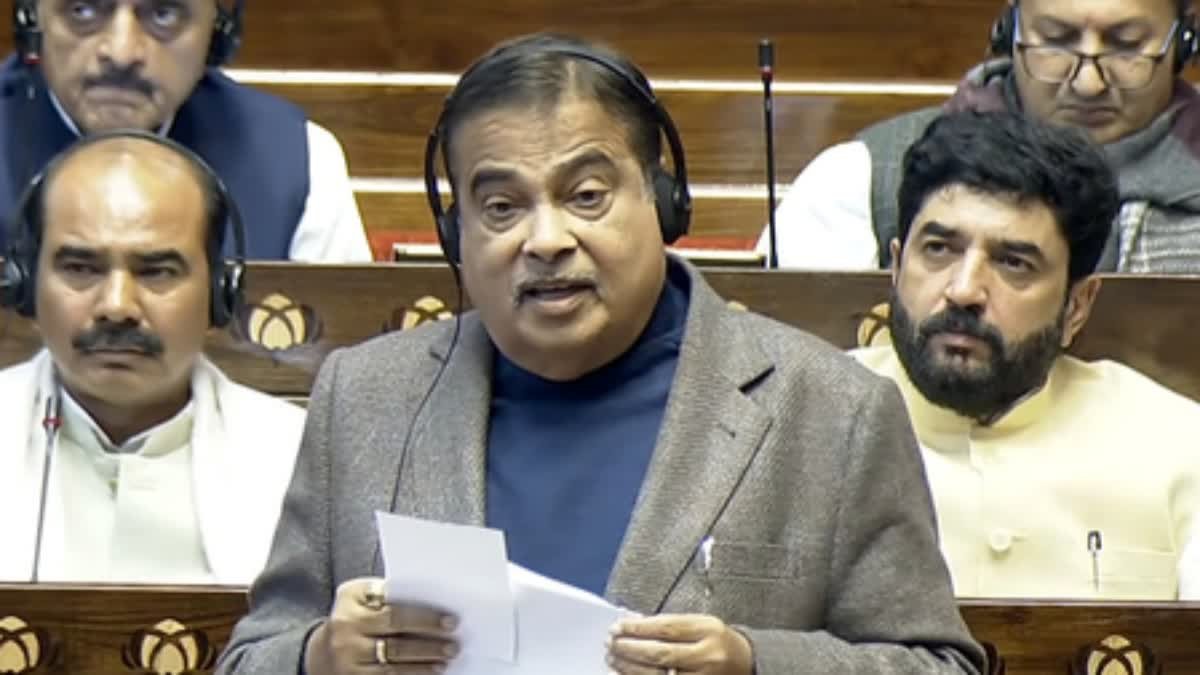

New Delhi: Union Minister for Road Transport and Highways Nitin Gadkari informed the Rajya Sabha on Wednesday that the Multi-Lane Free Flow (MLFF) toll system and AI-powered highway management will be fully implemented across the country by the end of 2026. He said that after the implementation of this technology, commuters will no longer have to wait at toll plazas.
Responding to supplementary questions during Question Hour, Road Transport Minister Gadkari said that the new technology will be AI-based. Commuters will no longer have to wait at toll plazas, and this will save Rs 1,500 crore in fuel and generate Rs 6,000 crore in revenue for the government. He said, “Multi-lane free flow tolling is a very good facility. Earlier, we had to pay at the toll, and it took 3 to 10 minutes; then, with FastTag, this time was reduced to 60 seconds or less. Our revenue increased by at least Rs 5,000 crore. After the introduction of MLFF, which will replace FastTag, vehicles can now cross the toll at a maximum speed of 80 km per hour, and no one will be stopped at the toll.” He further added, “Our aim is to bring it down to zero minutes, and this will involve AI and number plate recognition via satellite along with FastTag.”
Revenue to Increase by Rs 6,000 Crore
Nitin Gadkari told the House, “By 2026, we will complete this work 100 percent, and when this work is completed, we will save Rs 1,500 crore, and our revenue will increase by another Rs 6,000 crore, and toll evasion will be eliminated. There will be no problems, and people will not have to stop at toll plazas.”
Gadkari said that this new technology will definitely help people, and travel time will also be significantly reduced. He clarified that the government is only responsible for National Highways, not State Highways or city roads. However, he said that sometimes problems on state and city roads are portrayed on social media as if they occurred on national highways. The Road Transport Minister said, “We are trying to make the system transparent and corruption-free.” Medical facilities up to Rs 1.5 lakh for road accident victims
Nitin Gadkari also provided information in the Rajya Sabha about the expansion of the cashless treatment program for road accident victims. He said that victims will receive cashless medical facilities up to Rs 1.5 lakh per person per accident for the first seven days of hospitalization, with the government facilitating immediate payment to remove financial barriers to treatment.
He announced that the government is working on a model that will enable specialized ambulances to reach accident sites within 10 minutes. He outlined plans for a centralized emergency helpline integrated with upgraded ambulance services. He said that through agreements with states, modern ambulances will be deployed to reach accident sites quickly, aiming for a response time of up to 10 minutes in key areas.
Gadkari informed the House that under the ‘Rah-Veer’ scheme, launched earlier in 2025, those who take accident victims to hospitals will be honored with the title of ‘Rahveer’ and a cash reward of Rs 25,000 (previously Rs 5,000). This initiative aims to encourage bystanders to come forward and help during the crucial ‘golden hour’ after an accident.

