

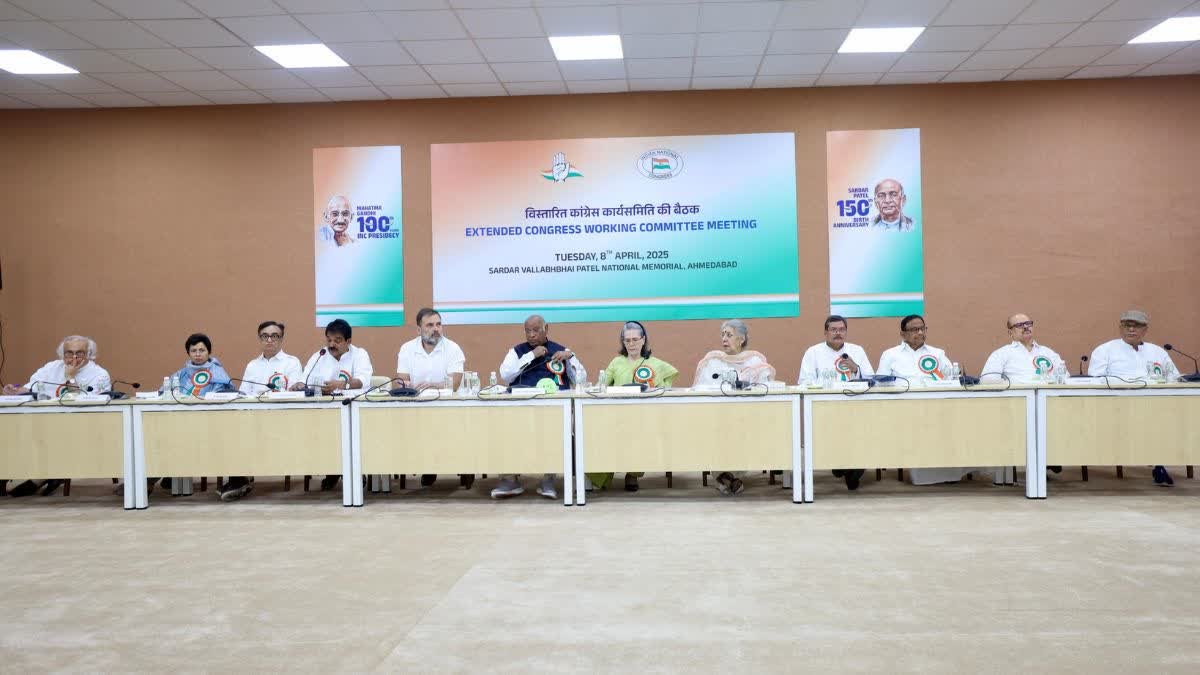

New Delhi: The Congress Working Committee (CWC) meeting was held today, Saturday. All senior party leaders and numerous party workers participated in this meeting. According to reports, the current political situation and the party’s action plan against the government were discussed. A strategy was also formulated against the new law, VB ‘G Ram Ji’, which replaces MGNREGA. The Congress will hold nationwide protests against this new law.
UPA Chairperson Sonia Gandhi, Congress President Mallikarjun Kharge, Leader of the Opposition in the Lok Sabha Rahul Gandhi, MP from Wayanad Priyanka Gandhi, and many other leaders attended the meeting. The Chief Ministers of the Congress-ruled states of Karnataka, Telangana, and Himachal Pradesh, along with the presidents of the Pradesh Congress Committees (PCCs), were also present at the Congress Working Committee (CWC) meeting. In his opening remarks at the Congress Working Committee meeting, Kharge said that in the recent monsoon session, the Modi government abolished MGNREGA, leaving millions of poor and vulnerable people helpless. The Modi government has not only kicked the poor in the stomach but also stabbed them in the back. Abolishing MGNREGA is an insult to the Father of the Nation, Mahatma Gandhi. As Sonia Gandhi recently wrote: ‘MGNREGA fulfilled Mahatma Gandhi’s vision of Sarvodaya (‘welfare of all’) and provided the constitutional right to work. Its demise is our collective moral failure — one that will have financial and human consequences for crores of working people in India for many years to come. Now more than ever, it is essential that we unite and protect the rights that protect us all.’
He also urged party members to ‘formulate a concrete plan’ for a nationwide movement against the central government’s decision to replace the Mahatma Gandhi National Rural Employment Guarantee Act (MGNREGA) with the Viksit Bharat Guarantee for Employment and Livelihood Mission (Rural) Act (VB-G RAM-G) 2025. He criticized the Prime Minister Narendra Modi-led NDA government for the ‘Jai Ram Ji’ law and accused it of attacking the right to work.
Calling for a nationwide movement against the ‘dismantling’ of MGNREGA, Kharge recalled past Congress-led movements that forced the BJP to backtrack on its decisions. He said that formulating a concrete plan on MGNREGA and building a people’s movement across the country is our collective responsibility. We will win this fight. In these difficult times, vulnerable people across the country are looking to the Congress.
“This violates the rights enshrined in Article 41 of the Directive Principles of State Policy (DPSPs) of the Constitution, on which the UPA government had taken major steps such as the right to work, the right to food, the right to education, and the right to health. I am deeply saddened that the Modi government has launched a premeditated and ruthless attack on the right to work. The Modi government is not concerned about the poor, but only about the profits of a handful of big capitalists,” he said.
It is worth noting that this is also the first CWC meeting after the defeat in the Bihar elections. This meeting is also significant because it is taking place before the assembly elections in Assam, Kerala, West Bengal, Tamil Nadu, and Puducherry in 2026, where its strategy is also expected to be discussed. In this context, it is expected that the opposition party will finalize its plan for a movement against the government regarding the repeal of the Mahatma Gandhi National Rural Employment Guarantee Act, 2005 (MGNREGA). The ‘Vikasit Bharat – Guarantee for Employment and Livelihood Mission (Rural)’ bill, which is intended to replace the MGNREGA from the UPA era, was passed in the recently concluded Monsoon Session of Parliament in 2025 and has also received the assent of President Droupadi Murmu. The Congress and other opposition parties have strongly objected to the new law replacing MGNREGA, calling it an insult to Mahatma Gandhi because his name has been removed. The new law guarantees 125 days of wage employment in a financial year to every rural household whose adult members are willing to do unskilled manual work. However, instead of being a centrally funded scheme, the new law stipulates that the funding for the scheme will be shared between the Centre and the states in a 60:40 ratio.
States are required to formulate a scheme in accordance with the rules of the new law within six months of the date of its implementation.

