

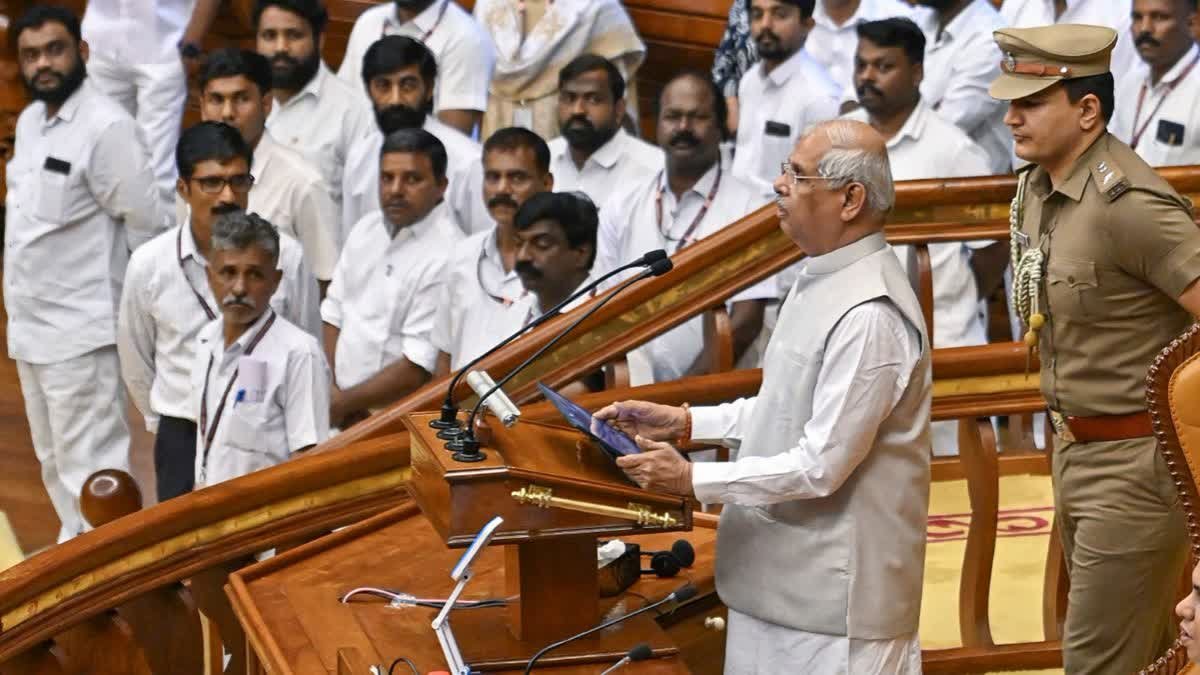

Thiruvananthapuram: In his address to the budget session of the Kerala Legislative Assembly, which commenced on Tuesday, Governor Rajendra Vishwanath Arlekar read out the policy document of the Left government, claiming that the state is under “financial strain” due to “economic restrictions” imposed on it.
Launching a sharp attack on the central government’s financial policies and strongly defending the state’s economic management, Governor Rajendra Vishwanath Arlekar inaugurated the 16th session of the 15th Kerala Legislative Assembly on Friday.
In his policy address at the beginning of the session, Arlekar said that restrictions on the state’s borrowing limit and adjustments in the Integrated Goods and Services Tax (IGST) have deprived it of Rs 17,000 crore in the 2025-26 financial year. The Governor highlighted Kerala’s progress in social development over the past decade, while also accusing New Delhi of undermining federal principles through a “financial blockade.”
Furthermore, he said that the state has suffered an additional “loss” of Rs 4,250 crore due to the “Gross State Domestic Product (GSDP) methodology,” which differs from the recommendations approved by the 15th Finance Commission. Arlekar said that these concerns have been raised with the central government.
He said that the concerns raised by Kerala also include “excessive centralization of powers” and the central government’s “interference” in subjects falling under the state’s jurisdiction. Addressing the House, Arlekar said that extreme poverty has been almost completely eradicated in the state. He drew attention to Kerala’s health index, noting that the infant mortality rate is lower than that of many developed countries.
The Governor presented a report card of the LDF government’s economic performance over the past ten years, stating that the Gross State Domestic Product (GSDP) has increased from Rs 5.26 lakh crore to Rs 12.49 lakh crore. During the same period, per capita income has almost doubled. Responding to critics who attributed the state’s financial difficulties to profligacy, he cited data from the Comptroller and Auditor General (CAG) to show that 56.9 percent of borrowings in the 2023-24 fiscal year were utilized for capital expenditure. Furthermore, the government has successfully reduced the debt-to-GSDP ratio from a pandemic-era high of 38 percent to 34 percent by the end of the current fiscal year.
However, the central point of the policy address was a strong critique of the central government’s approach to fiscal federalism. The Governor argued that the Centre’s decision to classify borrowings by entities like KIIFB and the pension company as state debt has severely curtailed Kerala’s borrowing limits, hindering development and welfare initiatives. He highlighted the impact of these policies, noting that the reduction in borrowing limits and changes in IGST devolution have cost the state approximately ₹17,000 crore this year alone.
Arlekar stated that the Centre has withheld over half of the necessary funds, approximately ₹6,000 crore, without proper justification during the crucial last quarter of the fiscal year. He also criticized the Centre’s reduction of its contribution to the Mahatma Gandhi National Rural Employment Guarantee Scheme (MGNREGS) from 100 percent to 60 percent and the reduction in guaranteed workdays, a move that has significantly impacted the rural poor.
In his address, Arlekar also emphasized the adverse effects of shifts in global trade, particularly the impact of US import duties, which have resulted in a loss of ₹2,500 crore for Kerala’s export sectors such as rubber, spices, and marine products. The Governor affirmed the state’s intention to explore all constitutional and legal avenues to safeguard its fiscal autonomy.
On the development front, the Governor presented a picture of a robust Kerala model. He highlighted the distribution of over 4.1 lakh land titles in the last ten years, bringing the state closer to its goal of providing housing for all.
The Governor’s address also touched upon the uninterrupted power supply maintained over the past decade and the significance of the Vizhinjam International Seaport, which is poised to connect Kerala to global maritime trade. The speech also outlined welfare measures, including the disbursement of ₹4,500 crore under the Karunya Benevolent Health Scheme and an increase in the honorarium for ASHA workers.
According to the Assembly calendar, the 16th session will run for 32 days, from January 20 to March 26. The discussion on the motion of thanks for the Governor’s address will take place on January 22 and 27. Kerala Finance Minister K.N. Balagopal will present the annual budget in the House on January 29.

