

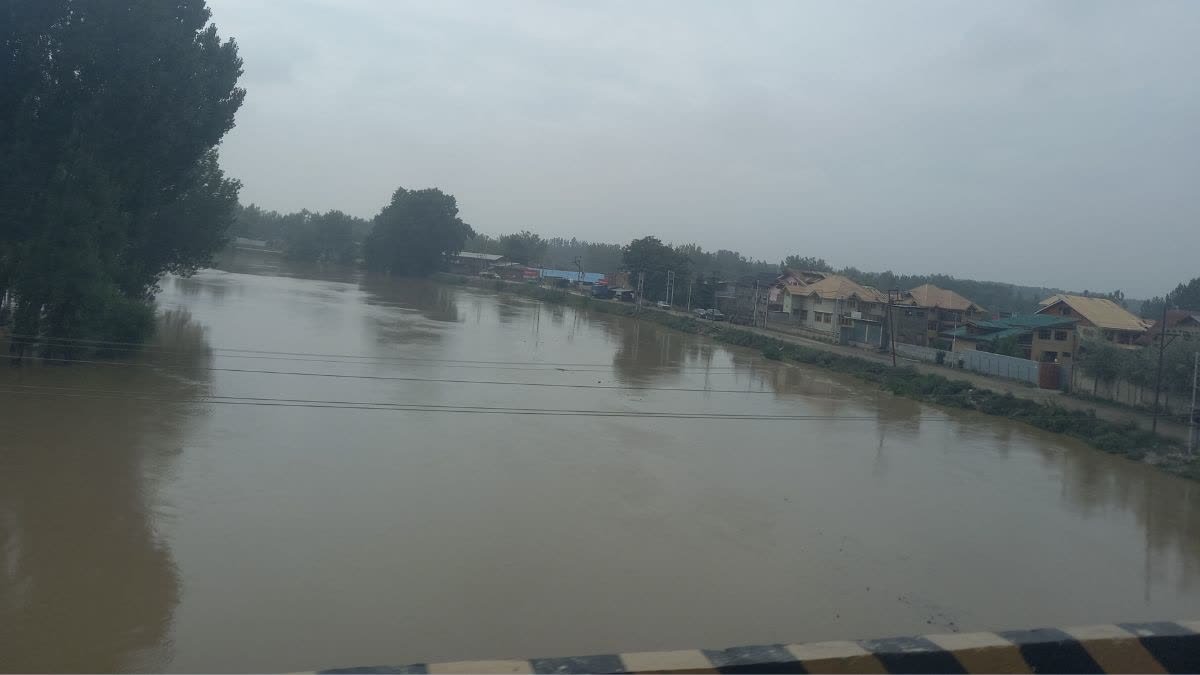

Srinagar: After two days of heavy and continuous rain in Jammu and Kashmir, the river crossed the danger mark. On Wednesday night, the residents of Shalina village stayed awake to protect the fragile embankment of Jhelum river with sand bags.
Local people told that on Tuesday evening, the alertness of a boy saved the village from flood, which could have submerged dozens of nearby villages and paddy fields. Shalina resident Sameer Ahmed said, “The boy had seen flood water seeping through a small crack in the embankment. The villagers immediately filled the crack with sand bags without any government help.”
This embankment of Jhelum in a village of 2,000 residents on the outskirts of Srinagar was part of the Comprehensive Flood Management Plan (CFMP). It was approved under the Prime Minister’s Development Package after the devastating floods of September 2014. He further said, “The floods of 2014 devastated Kashmir and our village. Since then we have been demanding strengthening of the Jhelum embankment. However, nobody is listening to our demands. Rising water levels increase the risk of flooding in the village.
In September 2014, a massive flood hit the Kashmir Valley, killing more than 300 people and destroying homes, markets and agricultural crops, and washing away roads and bridges. Prime Minister Narendra Modi visited the flood-ravaged valley and later announced a Rs 80,000 crore Pradhan Mantri Vikas Package for rehabilitation and reconstruction of the flood-affected area.
The CFMP was a component of this package and focused on flood control and strengthening of embankments of the Jhelum river, its four main tributaries Visho, Rambiara, Lidder and Sindh, as well as its only flood leakage channel at Srinagar and 103 water streams that drain into the Jhelum river.
The Jhelum and its flood leakage channels, which flow into the Jhelum river from Srinagar, are the major flood-control areas of the Jhelum. The dredging of the stretch from Padshahi Bagh to Sopore in Baramulla district was carried out by M/s Reach Dredgers, a Kolkata-based company. The project was outsourced by the Jammu and Kashmir Flood and Irrigation Control Department, following recommendations made by the Central Water and Power Research Station (CWPRS) in 2018.
The flood control department claimed that by 2020, it had excavated the flood seepage channel of the Jhelum river and cleaned 670 km of irrigation channels connected to the river. As a result, the water-carrying capacity of the river between Sangam in Anantnag district and Padshahi Bagh in Srinagar increased from 31,800 cubic feet per second (cusecs) to 41,000 cubic feet per second (cusecs).
At Ram Munshi Bagh in Srinagar, the capacity increased from 27,000 to 32,000 cusecs. At Sopore, it was 31,000 in 2014. The flow of water is estimated to increase from 10,000 cusecs to 35,000 cusecs by 2025. This data was revealed in response to an RTI earlier this year, which also revealed that 31 projects were approved for flood mitigation under the CFMP. However, only 16 were completed at a cost of Rs 114.293 crore.
Despite this, the threat of embankment breach in Shalina and other settlements persists, increasing the risk of flooding in five districts along the river. Rafiq Ahmad, a resident of Asham in Bandipora, said that people in the area stayed awake the whole night fearing the breach of the weak embankments along the river in Sonawari. He said, “Even after the devastating floods of 2014, the embankments were not strengthened nor proper measures were taken to deal with the floods. We are at risk after every heavy rainfall.”
Out of the ten districts of Kashmir valley, the Jhelum river flows through five districts, Anantnag, Pulwama, Srinagar, Bandipora and Baramulla, and covers an area of 175 sq km of the valley. These districts are particularly vulnerable to floods as a large population lives in low-lying areas along the river.
Though the department touts dredging for flood control as its major achievement, experts warn that dredging of the river and its waterways alone cannot prevent floods. That is because global scientific panels like the UN’s Intergovernmental Panel on Climate Change (IPCC) are stressing that climate-induced disasters like floods are likely to become more frequent.
Senior environment journalist Athar Parvez stressed the need for an integrated approach to flood prevention. He said, “This includes controlling soil erosion, controlling construction in flood valleys and flood-prone areas, improving the water quality of the river and its tributaries, and improving the quality of water resources.” These include restoring catchment areas, preventing deforestation and stopping clay mining from the Karewa rivers that surround the valley.”
Parvez said that after the 2014 floods, both the public and the government have often blamed nature for disasters without addressing their shared responsibilities in reducing vulnerability to extreme weather events. This attitude must change urgently, he said.
“It is imperative to develop effective preventive strategies to reduce loss of life and economic damage during extreme weather events. These include impact-based and localised early warning systems, issuing travel advisories when disasters are imminent, an appropriate housing policy and treatment of river catchment areas. All development projects must undergo environmental impact assessment and be considered before construction,” he added.
Social activist and lawyer Naveed Bukhtiar said large-scale mining in water bodies, unregulated and unscientific construction, and poor implementation of environmental laws have made Jammu and Kashmir vulnerable to both natural and man-made disasters. “Minerals have been mined from water bodies and construction work is going on in full swing in flood buffer zones; both by the people and the government. No lessons have been learnt from the 2014 floods. The government must formulate a comprehensive disaster management policy and implement environmental protection laws to protect the region,” he said.
Jammu and Kashmir Chief Minister Omar Abdullah said his government would take steps to ensure that people in the region no longer live in constant fear of floods and disasters. He said, “We are out of danger now because the weather has improved. But if the rain had continued for four more days, we could have faced a situation worse than 2014. I will sit with the officials and understand what measures were taken after the 2014 floods and where the money went wrong. We cannot live in fear (of floods) year after year.”

