

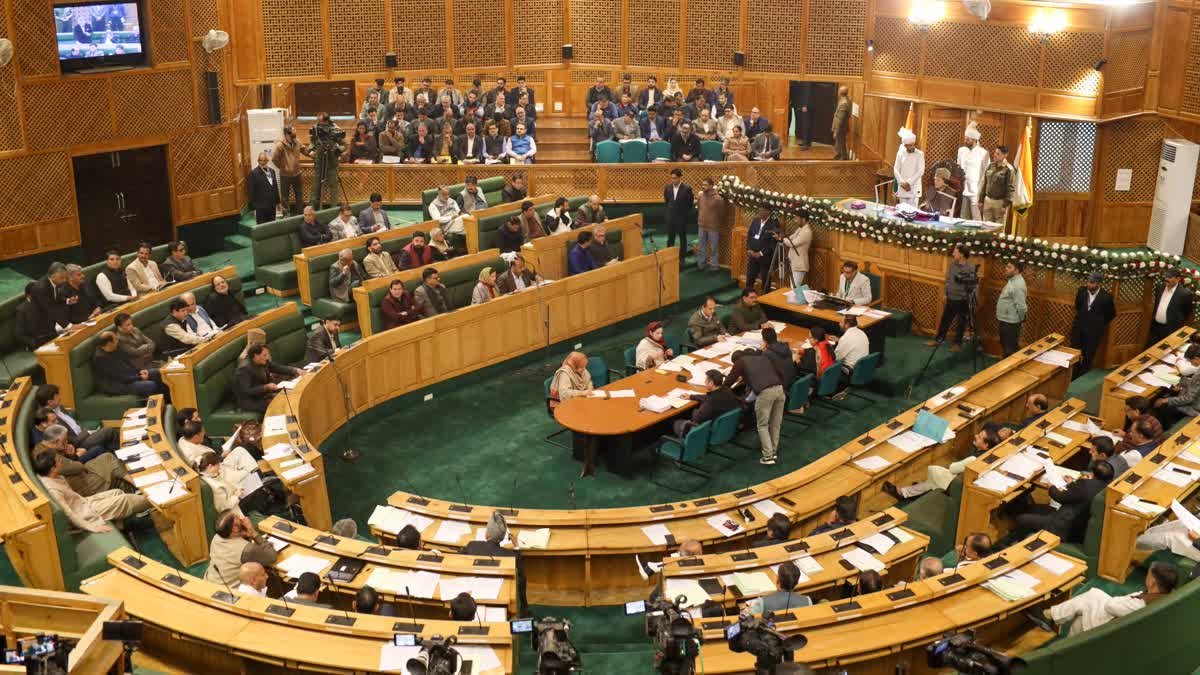

Srinagar: An MLA from Jammu and Kashmir’s ruling National Conference party is set to introduce a bill during the upcoming second session of the Legislative Assembly, aimed at restoring land rights to the underprivileged people of the Union Territory.
The Budget Session of the Legislative Assembly is scheduled to resume on March 27. The session had been adjourned for a month in observance of the holy month of Ramadan; it had originally commenced in February. Tanvir Sadiq—Chief Spokesperson for the National Conference and the MLA representing the Zadibal constituency in Srinagar district—stated that he would introduce the ‘Land Grants Bill 2025,’ the objective of which is to restore land rights to people belonging to the economically weaker sections of society.
He argued that the amendments made to the Land Grants Act by the administration in 2022 were insufficient and had adversely impacted the land rights of the poor. Sadiq added that his bill would seek to reverse the changes introduced through the 2022 amendments to the land laws.
“I have a very crucial bill—the Land Grants Act 2025,” he said. “This is an extremely important piece of legislation because it will restore the land rights of the poor, which were stripped away during the 2022 amendments.”
“We must give the poor back their land and their rights,” he asserted. Reacting to the National Conference MLA’s proposed bill, Waheed Para—an opposition MLA from the Peoples Democratic Party (PDP)—reminded him of his own bill, which had previously been rejected by the Legislative Assembly.
The government had rejected Para’s bill, which he had introduced during the August 2025 session of the Assembly in Kashmir. At the time, the ruling party had argued that Para’s bill would primarily benefit the elite and land grabbers. Para stated, “The Jammu and Kashmir National Conference rejected the bill—which sought to grant ownership rights to people residing on state land—in the Legislative Assembly. Now, they claim they will introduce a bill of their own—we shall see. *Insha’Allah* (God willing), if it truly serves the people, we will support it.”
He emphasized that the primary concern lies in addressing the plight of the people—particularly the poor—who are currently residing on government land, be it pastureland, *Nazool* land, or forest land. These impoverished individuals deserve to be granted ownership rights over the land they have occupied for years, especially given that their homes—built on government property—are currently being demolished.
Para remarked, “They argue that this bill would benefit ‘land grabbers,’ but that is simply not true. When homes were demolished in Jammu, these very same individuals went there to express their solidarity; yet, those homes have still not been regularized. In the Legislative Assembly, Mir Fayaz (a PDP MLA) raised a question regarding the demolition drive—noting that approximately 1,500 homes have been demolished this year alone.”
He added, “Despite this, the government has failed to take any concrete decision to grant ownership rights to common citizens, thereby enabling them to live peacefully in their own homes.” He asserted that a consensus must be reached within the Legislative Assembly regarding the treatment of people residing on state land—whether it be pastureland, *Nazool* land, or forest land. He argued that these individuals—regardless of whether they hail from Jammu, Kashmir, the Chenab Valley, or the Pir Panjal region, and irrespective of their religious affiliation, be it Hindu or Muslim—deserve to be treated fairly.
He concluded, “Those who have been residing on such land for 15, 20, or 25 years—individuals who possess no land of their own and have constructed modest homes on plots of 10, 20, or 25 *marlas*—should have their homes regularized. They must be granted ownership rights.” He stated that people should be granted ownership rights over the land on which they have built their homes and where they have been residing for years. He added, “But if those who already possess homes on government land are also facing the threat of demolition, then what is the purpose of this? The demolition drive must cease, and forced evictions must stop.”

