

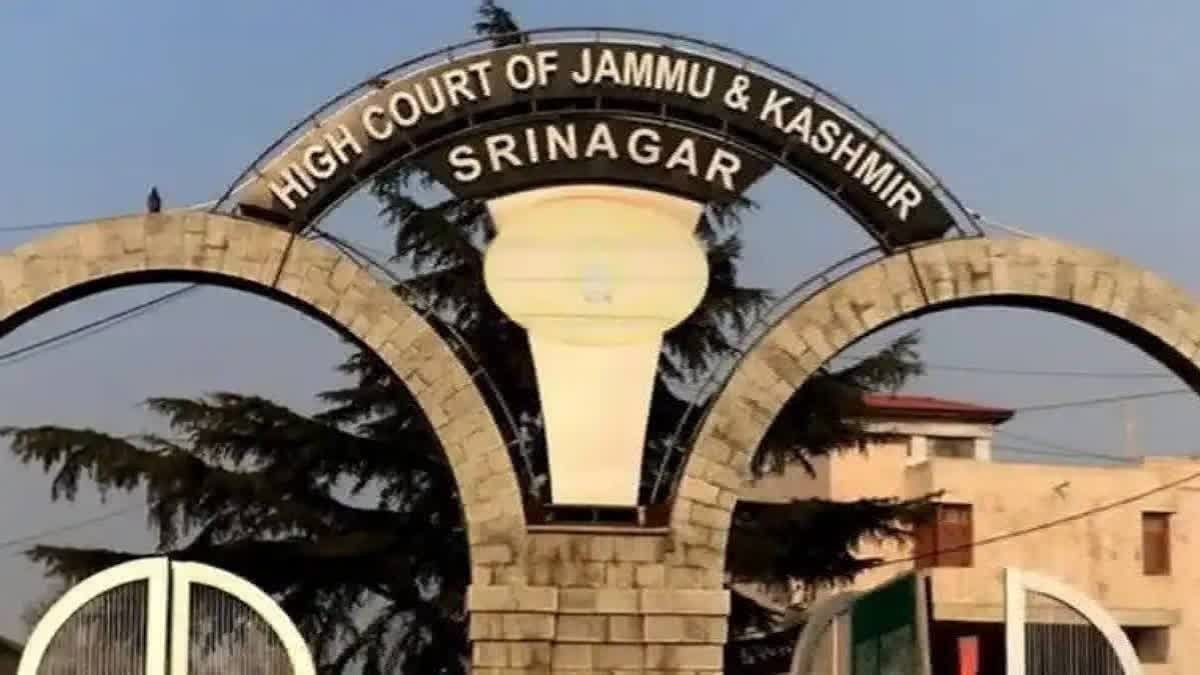

Srinagar: The Jammu and Kashmir and Ladakh High Court has dismissed 45 writ petitions filed by the Union of India. The 260-page judgment strengthens the rights of veterans, clearly defines pension entitlements under military law, and strictly limits the powers of the Principal Controller of Defence Accounts (Pensions), Allahabad (PCDA(P)).
On November 3, a division bench of Justices Sanjiv Kumar and Sanjay Parihar delivered the judgment in the main case, WP(C) No. 3173/2023 (Union of India and others vs. Nirmal Singh Jamwal), and 44 other connected cases. All the petitions challenged orders of the Armed Forces Tribunal (AFT) that had ruled in favor of veterans seeking disability pensions.
Justice Sanjiv Kumar, writing for the bench, stated that the PCDA (P) has no authority to overrule or re-evaluate the opinion of expert medical boards constituted under military law.
The bench stated, “Once the medical authorities comprising medical experts have given their opinion, whether it is regarding enhancements due to or attributable to military service, the PCDA (P), which lacks such expertise, cannot stand by its opinion and cannot take any view contrary to the opinion expressed by the experts.”
The judges cited extensively the Supreme Court’s landmark decision in Former Sapper Mohinder Singh v. Union of India (1993), which reiterated that pension authorities cannot encroach upon the powers of medical professionals.
The judgment stated, “We are unable to understand how the Accounts Branch dealing with pensions can ignore the judgment of experts in the medical field and comment on the extent of disability without referring to a detailed or higher medical board, which may be constituted by the Director General of the Army Medical Corporation under the relevant instructions and rules.”
The court then underlined, “The power and scope of the PCDA (P), Allahabad, are very limited and cannot generally be vested with the authority to overrule the opinion of the medical board. Only in exceptional cases, and as provided in the Army instructions, can the PCDA (P) refer the case back for reconsideration by the Appellate Medical Board.”
In the main case, Lieutenant Colonel (Retired) Nirmal Singh Jamwal was retired in 2017 with a 30 percent disability for life due to primary hypertension.
Although the release medical board declared that the disease was “neither caused by nor aggravated by military service,” the Armed Forces Tribunal (AFT), Regional Bench, Srinagar, Jammu, accepted his claim for disability pension and directed that the disability be rounded off to 50 percent. The High Court found no fault in the tribunal’s reasoning.
Justice Kumar stated, “Although the disease is not related to military service, the role of service stress and strain in its onset and aggravation cannot be denied.” He stated that the medical authorities failed to consider the impact of service conditions on such diseases. They neither considered these aspects nor categorically stated that service stress and strain played no role in the onset or aggravation of the disease.
This important judgment presents a comparative analysis of the Army Pension Regulations, 1961, the Eligibility Rules for Accidental Pension Awards, 1982, and their updated versions issued in 2008. The Court observed that although some procedural changes have been made in the new regulations, the underlying principle remains constant—that disability caused or aggravated by service entitles a person to pension benefits.
Explaining the interplay between the two sets of rules, the bench wrote, “Reading the relevant regulations and the eligibility rules together, it is clear that if a serviceman enters service in good physical and mental health and is subsequently discharged on medical grounds, any deterioration in his health will be attributable to military service. It is clear that invalidation from service due to disability attributable to or aggravated by military service and assessed to be 20% or more is a mandatory condition for eligibility for disability pension.”
After examining the arguments in the various AFT orders, the bench found no “illegality or error” that required interference under Article 226 of the Constitution. The judgment stated, “For the reasons stated above and in view of the clear legal position applicable to the case, we do not find any illegality or error in the AFT order. Therefore, the petition is found to be infructuous in any respect and is accordingly dismissed.”
With this, all 45 related petitions, including those filed against former servicemen Jagdish Lal, Karan Singh, Das Ram, Pawan Kumar, and Pushpa Devi, were dismissed. The bench clearly observed that modern service in the armed forces exposes personnel to extreme psychological and environmental stress, which must be acknowledged when assessing health conditions.
The court said, “Although the disease is not related to military service, the role of the stress and strain of service in its onset and aggravation cannot be denied. The medical authorities have neither considered these aspects nor categorically stated that the stress and strain of service played no role in the onset or aggravation of the disease.”
Justice Kumar said, “The claimant will not be called upon to prove the eligibility conditions. He will be given the benefit of any reasonable doubt, which will be liberally construed in his favor, especially in cases arising during field service.”

