

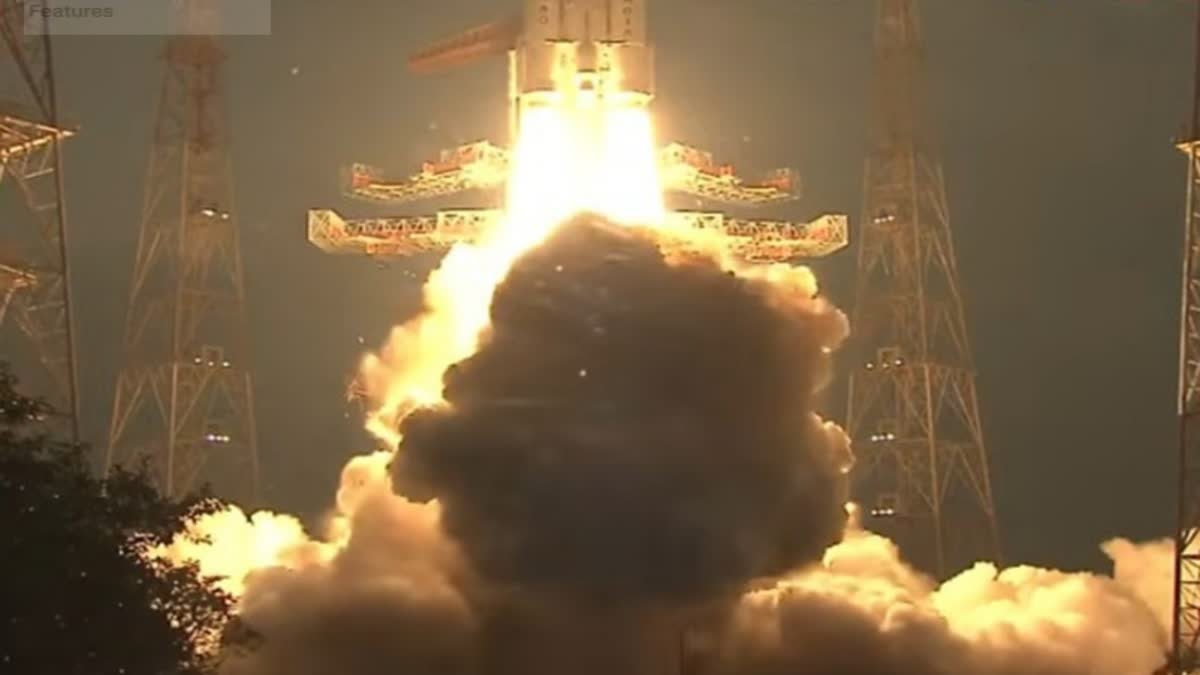

Sriharikota (Andhra Pradesh): Indian Space Research Organization (ISRO) on Sunday launched Indian Navy’s communication satellite GSAT 7R (CMS-03). This indigenously built satellite is India’s heaviest communication satellite so far, weighing approximately 4,400 kg.
The launch took place at 5:26 pm from the second launch pad of the Satish Dhawan Space Station in Sriharikota, Andhra Pradesh. The satellite will enhance the Navy’s space-based communications and maritime domain awareness capabilities with indigenous, state-of-the-art components specifically developed to meet the operational requirements of the Indian Navy.
The Indian Navy said, “This satellite is India’s heaviest communication satellite to date, weighing over 4,400 kg, and comprises a number of indigenous state-of-the-art components, specifically developed to meet the operational requirements of the Indian Navy.”
According to ISRO, CMS-03 is a multi-band communication satellite that will provide services over a wide maritime area including the Indian landmass. This satellite was launched by the famous LVM3 launch vehicle, which successfully landed India on the south pole of the Moon under the Chandrayaan-3 mission. This will be the fifth operational flight of this vehicle. ISRO said in a statement, “CMS-03, weighing approximately 4400 kg, will be the heaviest communication satellite to be launched from Indian soil into Geosynchronous Transfer Orbit (GTO). The previous mission of LVM3 had launched Chandrayaan-3 mission, in which India became the first country to successfully land near the south pole of the Moon.”
The launch vehicle was prepared in advance and was on the launch pad since 26 October for pre-launch operations. The LVM3-M5 had eight launch sequences, with CMS-03 separating from the vehicle at an altitude of approximately 179 kilometers at a speed of approximately 10 kilometers per second. The height of the launch vehicle was 43.5 meters and its total weight was 642 tonnes. The vehicle uses three stages of propellant to deliver the satellite to a geosynchronous transfer orbit (GTO).
This is a shining example of self-reliant India: ISRO chief Narayanan
On the launch of CMS-03 communication satellite by ISRO’s LVM3-M5, ISRO chief V. Narayanan said, “The CMS-03 satellite is a multi-band communication satellite, with coverage over a wide maritime area, including the Indian landmass, and is designed to provide communication services for at least 15 years.”
He said, “This satellite incorporates many new technologies and is another shining example of self-reliant India. I congratulate the entire satellite team working at various ISRO centers for realizing this important, complex satellite for the communication capability of the country. During the launch campaign, we faced difficult and challenging times. The weather was not that favourable. But still, I take this opportunity to appreciate all of you that even in these difficult weather conditions, we were able to successfully complete this mission in a grand and successful manner… I would also like to announce an important experiment that we have conducted.
ISRO chief said, “Indigenously developed C-25 cryogenic stage. For the first time, we have successfully ignited the satellite, after successfully placing it in orbit and reorienting the stage. Thrust Chamber…This is going to be a great experiment, which will provide data to restart the cryogenic stage in the future, enabling mission flexibility to place multiple satellites in different orbits using the powerful rocket LVM-3…”
PM Modi congratulated
Prime Minister Narendra Modi congratulated ISRO on the successful launch of India’s heaviest communication satellite CMS-03. He tweeted, “Our space sector continues to make us proud. Congratulations to ISRO on the successful launch of India’s heaviest communication satellite CMS-03. Thanks to our space scientists, our space sector has become synonymous with excellence and innovation, it is commendable. Their successes have advanced national progress and empowered countless people.”

