

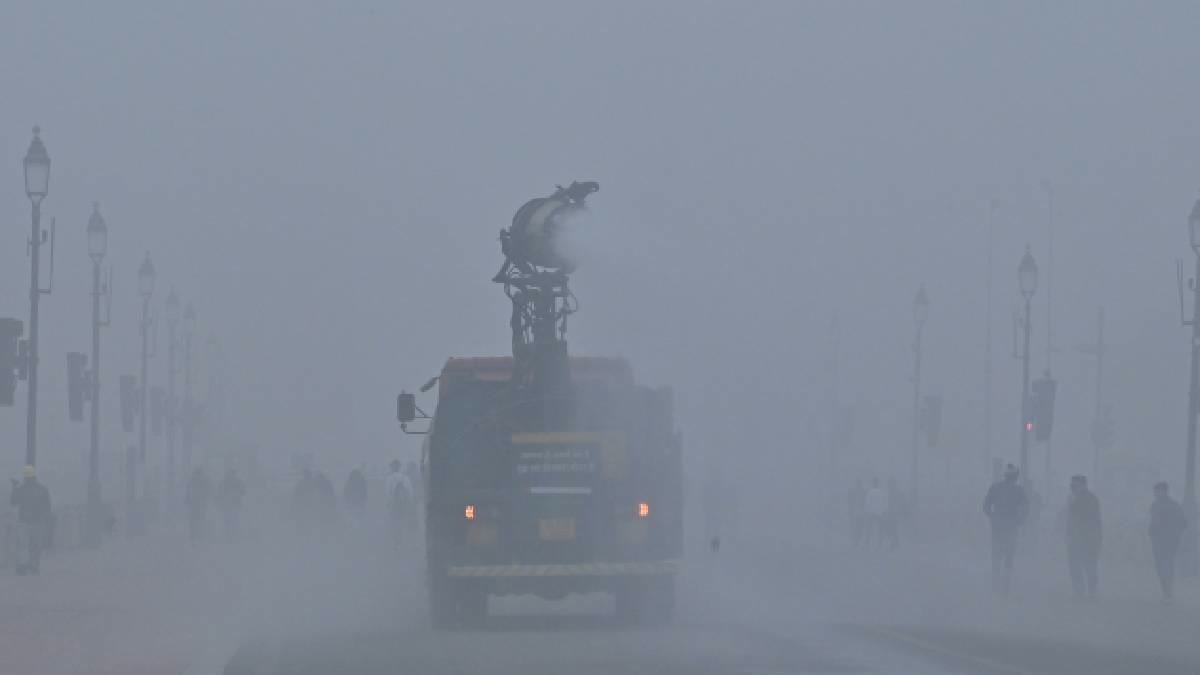

Air Pollution: A Public Health Emergency
The numbers are stark, and they tell a story that can no longer be ignored. According to the 2025 IQAir World Air Quality Report, India is the 6th most polluted country in the world, with a national average PM2.5 concentration of 54.4 µg/m³—more than ten times the World Health Organisation’s safe limit of 5 µg/m³. Thirteen of the world’s twenty most polluted cities are in India. Delhi remains the most polluted capital on the planet.
The causes are well known: vehicle emissions, industrial pollution, biomass burning, and the annual scourge of agricultural stubble burning that chokes northern India every winter. The solutions—investment in clean energy, enforcement of emissions standards, support for farmers to transition away from crop burning—are equally well known. What is lacking is the political will to act with the urgency the crisis demands.
When Byrnihat, a town on the Assam-Meghalaya border, tops the global list of polluted cities, and when citizens from Mumbai to Lucknow to Patna breathe air that is officially classified as hazardous, it is clear that incremental measures are no longer sufficient. India’s pollution crisis is not merely severe—it is out of control. And until it is treated as the national emergency it has become, millions will continue to pay the price with their health, their livelihoods, and their lives.
Deep-Rooted Failures in Delhi’s Water Governance
A recent report titled ‘Functioning of the Delhi Jal Board’, tabled in the Delhi Assembly on March 23, has laid bare the systemic failures underpinning the capital’s water crisis. The findings are alarming – of the 16,234 groundwater samples tested by the Delhi Jal Board’s (DJB) eight zonal laboratories between 2017–18 and 2021–22, 8,933—fully 55%—were found unfit for potable use.
That more than half of the groundwater sampled was sub-standard for drinking is not merely a statistic; it is a public health emergency unfolding in real time. In a city where millions depend on groundwater to meet their daily needs—whether through borewells, hand pumps, or private water tankers—this contamination translates directly into disease, suffering, and preventable deaths.
Systemic Failures, Not Isolated Gaps
The Comptroller and Auditor General (CAG) report identifies the root causes not as isolated lapses but as systemic shortcomings. The key issues cited include:
Absence of a comprehensive water policy to guide long-term planning and regulation
Regulatory gaps that allow contamination to go unchecked
Weak infrastructure, including ageing pipelines and inadequate distribution networks
Ineffective treatment facilities, with plants operating below capacity or failing to meet quality standards
Acute staff shortages are hampering monitoring, maintenance, and enforcement
Together, these failures point to an overarching shortcoming on the part of the water supplier—a systemic inability to fulfil the most basic obligation of any urban administration: safe, potable water for its citizens.
The CAG report adds to a growing body of evidence—from pollution data, from judicial interventions, from repeated public health crises—that Delhi’s water governance (as in many other major cities in India) is in a state of chronic dysfunction. The question it leaves unanswered is not what needs to be fixed, but why, year after year, the necessary reforms remain unimplemented.
Until that question is confronted, the capital’s water will remain a source of risk rather than sustenance—and the health and environment of its citizens will continue to pay the price.
The Unending Cycle of Yamuna Pollution
In March 2026, the Yamuna River in Delhi once again became a visible symbol of the capital’s unaddressed water pollution crisis. Thick layers of toxic froth—occasionally tinged with an alarming pinkish-white hue—accumulated near Kalindi Kunj, drawing public outrage and renewed scrutiny of the river’s deteriorating condition.
Approximately 57 million peopledepend on the Yamuna’s waters, which account for more than 70% of Delhi’s water supply. Yet this lifeline—revered as a sacred river—is today more commonly referred to as “Delhi’s dying holy river.”
The irony could not be more profound. A river that sustains millions, holds deep spiritual significance, and forms the very bedrock of the capital’s survival is being poisoned by the very population it serves. Industrial effluents, untreated sewage, and unchecked urban expansion have reduced vast stretches of the Yamuna to little more than a drainage channel.
To call it dying is to understate the crisis. The Yamuna is not merely dying—it is being killed, slowly and systematically, by the failure of the institutions tasked with its protection.
Biochemical Oxygen Demand (BOD)—a critical indicator of organic pollution—has risen sharply across multiple monitoring points in New Delhi. In several stretches of the river, BOD levels have been recorded far above the prescribed standard of 3 mg/L for bathing-quality water. Alarmingly, some locations have reported levels exceeding 30 mg/L—a tenfold violation of the permissible limit.
These numbers are not merely technical metrics. They represent a river in which organic waste—much of it untreated sewage—is consuming oxygen at a rate that suffocates aquatic life and renders the water hazardous for human contact. A BOD of 30 mg/L speaks to systemic failure: of treatment plants, of regulatory enforcement, and of the political will to protect a water source upon which millions depend.
The 22-kilometre stretch of the Yamuna flowing through Delhi continues to account for a disproportionately high share of the river’s total pollution load. Despite decades of policy attention and repeated promises of restoration, this relatively short urban segment remains the epicentre of the river’s ecological decline.
Persistent Sewage Inflow
Data consistently points to persistently high sewage inflow as a central driver of rising pollution. Although Delhi is equipped with a network of sewage treatment plants (STPs), significant infrastructure gaps and persistent operational inefficiencies severely limit their effectiveness. In many instances, untreated or only partially treated waste continues to enter the river directly, rendering the treatment infrastructure largely symbolic.
Compounding the issue is the reduced water flow in the Yamuna during non-monsoon months. Lower flow volumes weaken the river’s natural ability to dilute pollutants, leading to higher concentration levels and a noticeable decline in water quality indicators. This seasonal change transforms the river from a flowing body of water into a stagnant channel for urban waste.
For the cities and farmlands of northern India, the cost is mounting. The Yamuna’s reduced non-monsoon flow—a key factor in its pollution crisis—is directly linked to hydrological changes in its Himalayan catchment. The Ganga faces similar pressures. As glaciers retreat and natural springs dry up, the perennial nature of these rivers is increasingly compromised.
A Structural Flaw in India’s Pollution Control Governance
India’s water and air pollution crisis is not primarily a failure of technology or resources. It is a failure of governance architecture. Until institutional fragmentation is replaced with clear lines of authority, shared accountability, and mechanisms for coordinated action, no amount of short-term measures—odd-even schemes, temporary bans on construction, or sporadic sprinkling of water—will yield the sustained improvements that citizens deserve. What is required now is the political will to redesign a system that, by its very structure, was never built to deliver clean air.
The recurring pattern of short-term, piecemeal interventions points to a fundamental structural flaw: India’s institutions—scientists, governments, concerned departments, regulatory bodies, cities, and communities—operate largely in isolation. With no clear ownership of the problem and no shared authority to enforce solutions, lasting progress remains persistently elusive.
Unlike countries such as Japan or China—where strong national laws and empowered regulators have driven consistent, ongoing progress—India’s system has been fragmented from the outset, not only in maintaining the air quality but also in safeguarding our water resources.
Furthermore, the careless implementation of so-called developmental projects in the Himalayas—hasty road building, unregulated hydropower dams, indiscriminate hill cutting, and unchecked tourism infrastructure—has consequences that reach far beyond the mountains. The very source of the river systems that nourish the plains is at risk.

