

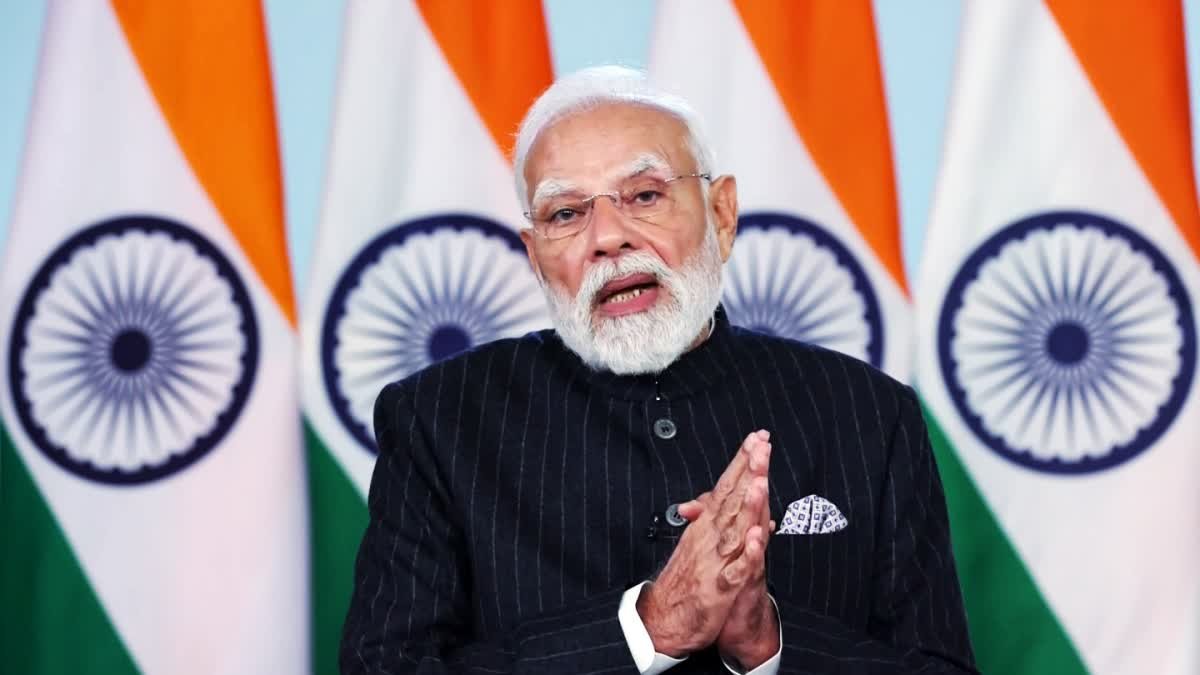

New Delhi: Prime Minister Narendra Modi said on Sunday that India has set a historic record by producing 357 million tons of food grains in 2025. This will be an important milestone in the development of the country’s agriculture.
Addressing the nation in the 128th episode of his monthly radio program, Mann Ki Baat, PM Modi said that India’s food grain production has increased by 100 million tons in the last ten years. This reflects the country’s steady progress towards self-reliance in agriculture.
PM Modi said, “India has achieved great success in the agricultural sector. India has set a historic record by producing 357 million tons of food grains. Compared to 10 years ago, India’s food grain production has increased by 100 million tons.” Recalling the natural farming exhibition in Coimbatore, Tamil Nadu, the Prime Minister praised the youth who have adopted natural farming.
He said, “I went to Coimbatore to attend a major conference on natural farming. I was very impressed by the efforts being made to promote natural farming in South India. Many young, highly qualified professionals are now adopting natural farming.” Earlier, on November 19, PM Modi released the 21st installment of the PM-Kisan Samman Nidhi to beneficiaries in Coimbatore, Tamil Nadu, and also inaugurated a natural farming exhibition. He participated in the South India Natural Farming Summit in Coimbatore.
He met and interacted with local farmers, and visited the exhibition, which showcased various agricultural products, including a corner showcasing plant and crop growth. Tamil Nadu Governor R.N. Ravi also accompanied the Prime Minister.
The South India Natural Farming Summit 2025, held from November 19-21, was organized by the Tamil Nadu Natural Farming Stakeholders. The conference aimed to promote sustainable, environmentally friendly, and chemical-free agricultural practices. Additionally, the focus was on promoting environmentally friendly and chemical-free agricultural practices and adopting economically sustainable models. Emphasis was also placed on accelerating the transition to natural and farmland fertility restoration as a viable option.

