

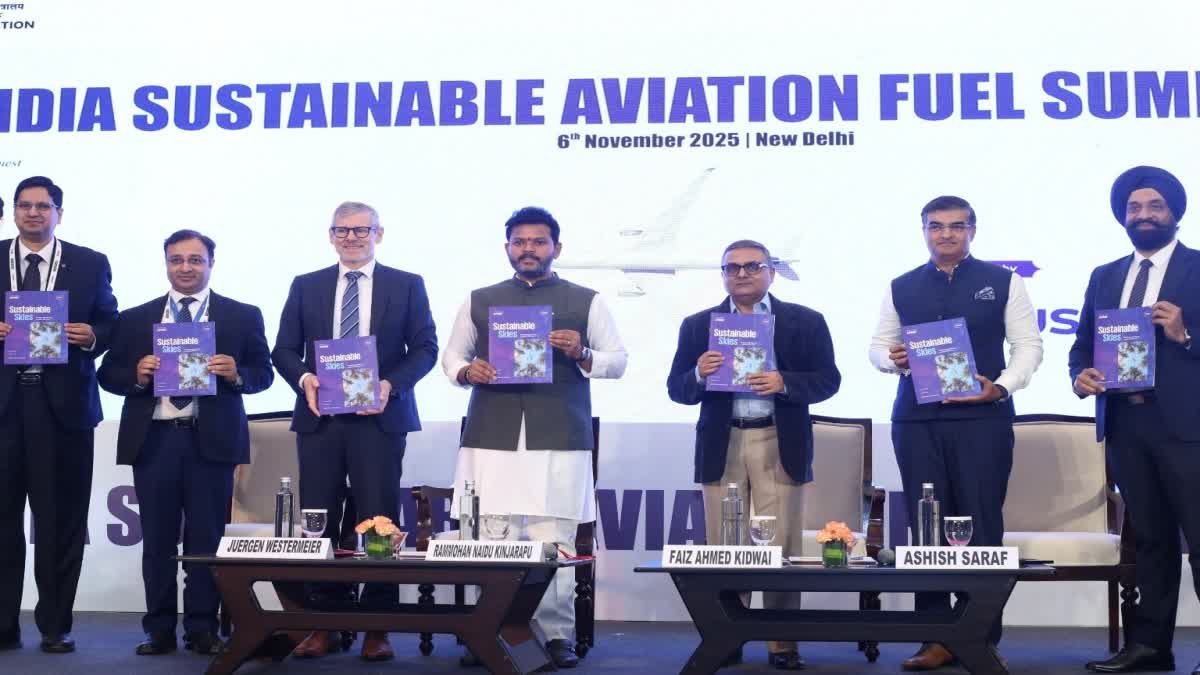

New Delhi: Aviation today is a key driver of global connectivity and fuel of international economic growth. It contributes nearly 4 percent to the world’s GDP. However, this comes at a significant environmental cost, as the aviation sector contributes more than 2 percent of global CO₂ emissions, which, if not controlled, could triple by 2050.
With the aviation industry at this juncture, Sustainable Aviation Fuel (SAF) is being seen as a revolutionary change that can be used to decarbonize our skies. During the India Sustainable Aviation Fuel Summit, Civil Aviation Minister Rammohan Naidu Kinjarapu indicated that SAF is “a transformative opportunity to reduce emissions while supporting India’s development ambitions.”
He remarked, “Aviation is now growing faster than any other transport sector, but we must ensure it is a sustainable expansion of our industry. SAF gives us an opportunity to develop our industry while combating climate change.”
Naidu highlighted India’s progress on climate change issues, noting that the country has achieved 40 percent renewable electricity nine years ahead of the 2030 target year, ranks fourth globally in installed renewable capacity, and has set a target of net-zero emissions by 2070. He said, “As the world’s most populous country, India must play a leadership role in the global response to the climate crisis.”
The Promise of Sustainable Aviation Fuel
Sustainable aviation fuel is a bio-based fuel that can reduce lifecycle greenhouse gas emissions by up to 80 percent compared to conventional jet fuel. Best of all, it works seamlessly with existing aircraft and refueling infrastructure, eliminating the need for costly fleet modifications.
Globally, the International Air Transport Association (IATA) has urged that 5% of aviation fuel be SAF by 2030, while the International Civil Aviation Organization (ICAO)’s Carbon Offsetting and Reduction Scheme for International Aviation (CORSIA) will mandate carbon-neutral flights from 2027.
However, India’s approach goes beyond compliance. It views SAF as a strategic path to self-reliance, which will reduce its crude oil import bill and establish itself as a global producer of clean aviation energy.
Aviation’s Carbon Challenge
India’s aviation sector is growing rapidly. Passenger numbers are increasing at a rate of 6.7% annually, and nearly 10 million passengers are expected this year. India is set to increase the number of airports from 150 to 350 over the next two decades, aiming to serve 500 million passengers annually, but this growth also has environmental consequences.
Naidu also highlighted how the government’s UDAN scheme has connected remote areas, expanded accessibility, and strengthened inclusivity, a core tenet of India’s civil aviation policy.
He said, “Over the past decade, we have added 90 airports and over 400 aircraft, leading to a 78 percent increase in scheduled flights.” He further said, “We plan to expand our airport network to 350 over the next 20 years, serving approximately 500 million passengers annually.”
India’s aviation-related emissions are projected to increase by 5 to 10 percent of total transport emissions by 2030. Additionally, aviation fuel consumption will increase from 15 million tons in 2030 to 31 million tons by 2040. This could lead to 95 million tons of CO₂ emissions, a fivefold increase compared to 2021.
Naidu warned, “Without sustainable fuel, this will reverse climate progress, but I see this as an opportunity rather than a challenge. Sustainable aviation fuel is our direct path to reducing aviation’s carbon footprint.”
India’s Sustainable Aviation Fuel Roadmap
India has set ambitious targets for international flights, aiming for 1 percent by 2027, 2 percent by 2028, and 5 percent by 2030. Naidu explained, “SAF can revolutionize aviation without the need for new engines or refueling systems. It is a drop-in fuel, ready for use today.”
India’s unique advantage lies in its agricultural potential and abundant biomass, which is generated annually from crop residues, sugarcane by-products, and forestry waste, exceeding 750 million tons. “From farm to flight, India has the potential to convert agricultural waste into green aviation fuel,” he said. “This could empower farmers, reduce stubble burning, and create a new rural-to-global value chain.”
Naidu explained, “SAF could revolutionize aviation without the need for new engines or refueling systems. It is a drop-in fuel, ready for use today.”
The benefits of biomass in India extend from farmers to air travelers.
India’s unique strength lies in its agricultural potential and abundant biofuel, which is produced annually from crop residues, sugarcane by-products, and forest waste, exceeding 750 million tons. He said, “From farms to flights, India has the potential to convert agricultural waste into green aviation fuel. This can empower farmers, reduce stubble burning, and create a new value chain from rural areas to the global level.”
Indian Oil Corporation (IOC) has made history by becoming the first Indian producer of SAF certified for production at its refinery. It will produce 35,000 tons annually using used cooking oil from major restaurant chains like Haldiram’s, setting a leading example of converting everyday waste into clean aviation fuel.
Furthermore, Koteka Inspection India Private Limited is now India’s first SAF certification service provider, addressing a major bottleneck in the SAF production and approval process.
To this end, the Indian Sugar and Bioenergy Manufacturers Association (ISMA) has partnered with Deloitte, The Energy and Resources Institute (TERI) to conduct a life cycle assessment (LCA) of sugarcane-based SAF using molasses, syrup, and bagasse. This will help determine costs, emissions benefits, and scalability.
Similar progress is underway globally. Researchers at the University of Illinois, Urbana-Champaign, have developed a process to convert food waste into biocrude oil using high-temperature and high-pressure hydrothermal liquefaction. This biocrude can then be refined into SAF that meets aviation control standards.
Economic and Environmental Benefits
SAF currently costs three to four times more than conventional jet fuel. However, its price is expected to decline rapidly as production increases and the technology matures. According to IATA, global SAF production is projected to reach 1 billion liters in 2024, double in 2023, and reach 2 billion liters by 2025.
By 2040, the aviation industry could require 183 million tons of SAF annually, representing a significant opportunity for countries like India. He emphasized, “But SAF adoption requires more innovation, investment, and collaboration. Currently, global consumption is less than 0.1 percent. We must work together to accelerate this transformation.”
SAF Policy and Global Alliance
The Ministry of Civil Aviation is finalizing a national SAF policy, which is expected to be announced soon. A dedicated working group has also been formed to coordinate with airlines, OEMs, oil refineries, research institutes, and airport operators to create a unified SAF ecosystem.
Naidu said, “We are integrating all aspects from research to production and regulation. I can assure you that the Ministry is taking strong steps to accelerate India’s SAF campaign. The SAF policy will be announced very soon.”
India is using its role in the Global Biofuels Alliance, launched at the G20 Summit in 2023, to build international partnerships. The alliance aims to accelerate global adoption of biofuels and support SAF production and certification.
At the 42nd ICAO Assembly, India also pushed for regional SAF production hubs and faster certification processes for developing countries, proposals that received widespread global support.
Fuel prices underscore the urgency
India is advancing its green fuel agenda. At the same time, airlines are grappling with rising aviation turbine fuel (ATF) prices. ATF in Delhi rose by ₹777 per kiloliter this month to ₹94,543.02, the second consecutive monthly increase after a 3.3 percent increase in October.
Prices in Mumbai rose to ₹88,444.87 per kiloliter, while in Chennai and Kolkata they were ₹98,089.68 and ₹97,549.18 per kiloliter, respectively. Fuel costs account for nearly 40 percent of airline operating costs, putting significant pressure on financials.
“High ATF prices highlight the need to shift to bio-based fuels,” Naidu said. “SAF can protect airlines from price fluctuations and provide energy security.”
Passing the flight path by 2070
For India, SAF is not just about reducing emissions, but also about improving the future of flying with innovation, inclusivity, and sustainability. In the coming months, the SAF policy is expected to address production incentives, certification schemes, and blending requirements.
With the commitment of IOC, ISMA, and private innovators, the country is taking significant steps towards becoming a global SAF producer. The Minister summarized, “We keep reminding ourselves that we are one planet and this requires a lot of effort. Sustainable aviation fuel is the bridge between increasing our production and being responsible, flying high and caring deeply.”

