

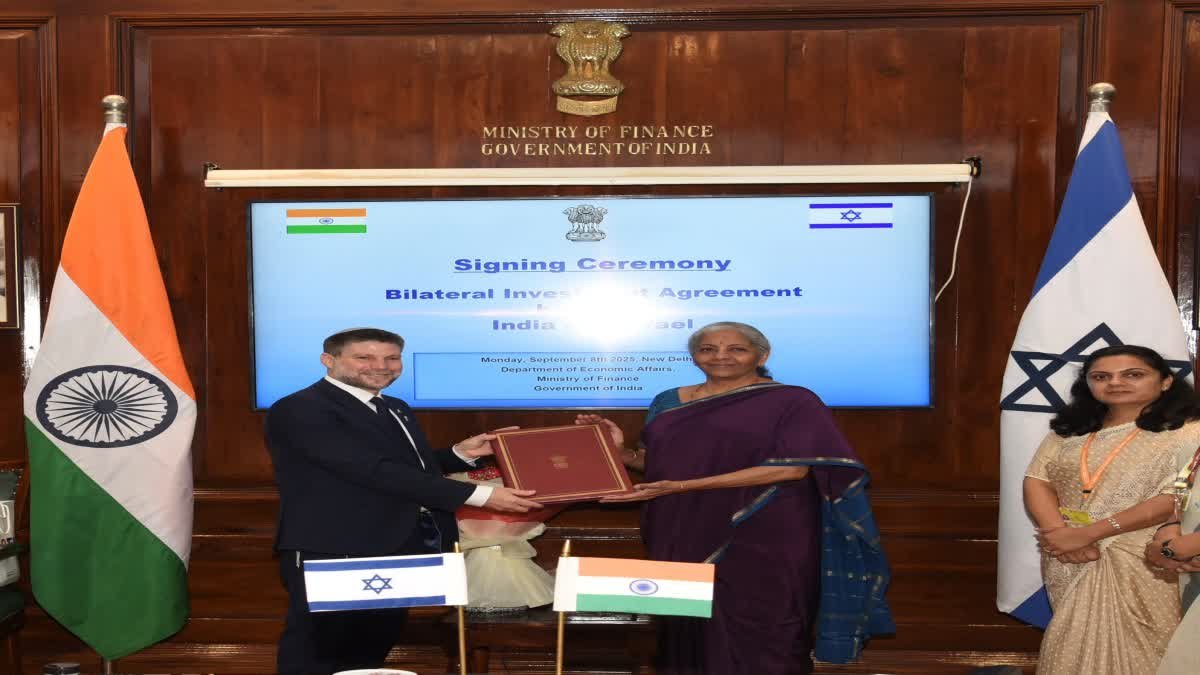

New Delhi: India-Israel are preparing to write a new chapter in their mutual relations. Both countries have become very close to the bilateral investment treaty. Reached New Delhi today
The Government of India and the Government of Israel signed a Bilateral Investment Agreement (BIT) in New Delhi today. Union Finance and Corporate Affairs Minister Nirmala Sitharaman and Israel’s Finance Minister Hon. Bezalel Smotrich signed the Bilateral Investment Agreement (BIT).
If you look, India and Israel are strategic partners. The bilateral trade between the two countries is about US $ 4 billion annually. At the same time, Israeli Finance Minister Bezalel Smotrich is leading a delegation on his three-day visit to India today.
A Bilateral Investment Treaty (BIT) is expected to be signed between India and Israel during this visit. The BIT will lay a common ground for a free trade agreement (FTA) to boost trade between the two countries.
He is expected to meet his Indian counterpart Nirmala Sitharaman, Commerce and Industry Minister Piyush Goyal and Housing and Urban Affairs Minister Manohar Lal Khattar. Apart from Delhi, the Israeli finance minister will also visit Mumbai and GIFT City in Gandhinagar.
“The aim of the visit is to deepen Israel’s economic and financial ties with India through bilateral meetings and lay a common ground for some key agreements including a bilateral investment treaty and a free trade agreement (FTA),” PTI reported, quoting sources in the national capital.
“The two countries are negotiating a draft bilateral investment treaty and have completed the negotiations. The bilateral investment agreement (BIT) is expected to be signed by the finance ministers during the visit,” he said.
The bilateral investment agreement (BIT) between the two countries assures appropriate protection to Israeli investors in India and Indian investors in Israel in the light of relevant international precedents and practices.
This is expected to increase the comfort level and confidence of investors as minimum standard practices and non-discrimination will be ensured. Also, an independent forum for dispute settlement through arbitration will be provided.
The BIT also provides for protection of investments from seizure, transparency, transfer and compensation for losses, sources said. Israel has signed BITs with more than 15 countries since 2000. These include the United Arab Emirates, Japan, the Philippines, Thailand and South Africa.
“The BIT reflects the shared commitment of both countries to enhance economic cooperation and create a more robust and resilient investment environment. The BIT is expected to pave the way for increased bilateral investments. This will benefit the businesses and economies of both countries,” a source said.
This is the fourth visit by any Israeli minister to India this year. Tourism Minister Haim Katz, Economy and Industry Minister Nir Barkat and Agriculture and Food Security Minister Avi Dichter visited India earlier this year.
India and Israel are strategic partners and bilateral trade between the two countries is around US$4 billion annually. Total investment from India to Israel during 2000-2025 was US$443 million and Israel’s contribution to India’s foreign direct investment (FDI) during April 2000 to March 2025 was US$334.2 million.
Israel excels in high-tech innovation. On the other hand, India offers unmatched scale and market potential, making them natural partners for development and cooperation. Smotrich is also expected to visit GIFT IFSC, India’s global financial services centre in Gandhinagar.
The International Financial Services Centre (IFSC) provides world-class infrastructure and services for financial institutions operating in sectors such as banking, insurance, capital markets and fund management. This includes state-of-the-art infrastructure, liberal tax regime, financial incentives and a strong regulatory and legal environment.
India and Israel also have strong potential for cooperation in the fintech sector, driven by complementary strengths – India’s large-scale digital infrastructure and financial inclusion platforms such as UPI, and Israel’s global leadership in cybersecurity, blockchain and payment technologies.
Sources said this collaboration will not only promote financial innovation but also promote secure, inclusive and scalable fintech ecosystems in both countries.
Being active members of institutions such as the World Bank and the Asian Development Bank, the two countries can co-finance multilateral development bank (MDB)-backed projects or support joint initiatives in third countries, especially in the global South. (With agency inputs)

