

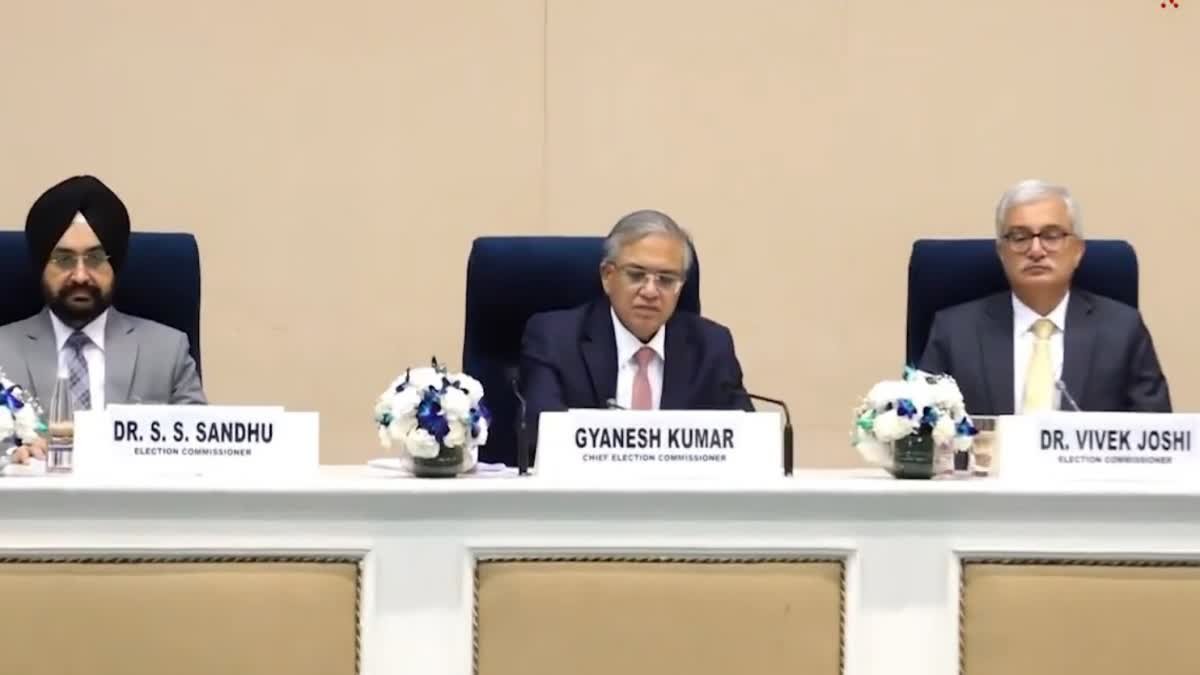

New Delhi: The Election Commission has announced the dates for the upcoming assembly elections in Assam, Kerala, West Bengal, Tamil Nadu, and Puducherry.
1. Assam – Polling Date: April 9; Counting Date: May 4
2. Tamil Nadu – Polling Date: April 23; Counting Date: May 4
3. West Bengal – Polling Dates: April 23 (Phase 1), April 29 (Phase 2); Counting Date: May 4
4. Kerala – Polling Date: April 9; Counting Date: May 4
5. Puducherry – Polling Date: April 9; Counting Date: May 4
Chief Election Commissioner Gyanesh Kumar, along with Election Commissioners Sukhbir Singh Sandhu and Vivek Joshi, provided this information. The Chief Election Commissioner stated, “This festival of democracy—which is a source of pride for us—is set to take place in Assam, Kerala, Tamil Nadu, West Bengal, and the Union Territory of Puducherry. The total number of voters stands at 17.4 crore, and there are 824 assembly constituencies. There are approximately 2.19 lakh polling stations, and the electoral machinery will involve the participation of around 25 lakh personnel.”
The Chief Election Commissioner further added, “The approximately 17.4 crore voters include people from continents such as Australia, France, South Africa, Germany, and Canada. Representatives from the Election Commissions of over 20 countries are also arriving to participate in these elections, coming to witness the festive, transparent, and efficient conduct of elections in India. The Commission, along with lakhs of election officials and security personnel, is committed to ensuring free, fair, transparent, accessible, and peaceful elections. The Election Commission of India is also prepared to welcome every voter at their respective polling stations and provide them with a pleasant and comfortable voting experience.” “I wish to make a special appeal to our youth and first-time voters—my dear friends, you are about to exercise one of the most significant responsibilities of your lives: your democratic right—the right to vote. I urge you to participate enthusiastically in this great democratic process and to cast your vote with pride, responsibility, and confidence. Your vote represents your choice in shaping the future of your state and nation.”
The Chief Election Commissioner stated, “The Commission also felicitated the BLOs who have performed outstanding work for the SIR. Furthermore, the Commission interacted with young and first-time voters, as well as with our SVEEP icons engaged in voter awareness activities. As you are all aware, these five states and Union Territories represent the distinct geographical and cultural landscapes of India.” “These elections not only represent a democratic process but also showcase India’s cultural richness and truly reflect the unity and diversity of our nation.”
The tenure of the Assam Legislative Assembly is set to expire on May 20, while that of the Kerala Legislative Assembly will conclude on May 23. The tenure of the Tamil Nadu Legislative Assembly ends on May 10, and that of the West Bengal Legislative Assembly on May 7.
The announcement of the elections is taking place following the completion of a visit to West Bengal by the Full Bench—led by the Chief Election Commissioner—along with other Election Commissioners. The Election Commission’s Full Bench visited Assam, Tamil Nadu, Puducherry, and Kerala to review the preparations for the upcoming assembly elections.
Election Commission sources had informed ETV Bharat that, with the exception of West Bengal, assembly elections in Assam, Tamil Nadu, Kerala, and Puducherry would likely be held in a single phase.
In West Bengal, the number of polling phases will be fewer compared to the 2021 assembly elections. They indicated that the elections are likely to be conducted in two phases. In 2021 and 2016, the Election Commission conducted assembly elections in Assam in three and two phases, respectively, whereas elections in Kerala, Tamil Nadu, and Puducherry were held in a single phase. In West Bengal, the elections were conducted in seven and eight phases, respectively.
It is pertinent to note that the Election Commission had conducted a Special Intensive Revision (SIR) of the electoral rolls in West Bengal, Kerala, Tamil Nadu, and Puducherry with the objective of purifying the voter lists. In Assam, a Special Revision (SR) of the electoral rolls was carried out.
The revision of electoral rolls (SIR), which commenced in June of last year, has so far been conducted in 11 states and three Union Territories, including West Bengal, Tamil Nadu, Kerala, and Puducherry.
Under this process, the electoral rolls were prepared afresh; all registered voters were required to submit enumeration forms, while certain categories of voters were required to submit additional documents and appear for hearings to prove their eligibility, including their citizenship status. While announcing the second phase of the SIR in October of last year, the Chief Election Commissioner stated: It was noted that Assam has been excluded from the national process because the National Register of Indian Citizens (NRIC) has not yet been published in the state.
Taking a jibe, the Congress stated that since 2014, the Model Code of Conduct (MCC) has become synonymous with “Modi’s Election Campaign Code,” and that this code would be rife with “defamation, abuse, intimidation, fear-mongering, and the spreading of the virus of lies.”
The opposition party also claimed that ‘G1’ must have completed its round of “inaugurations, ribbon-cutting ceremonies, and flag-offs,” and therefore, ‘G2’ must have given the green signal for the announcement of the election schedule. The Congress party frequently uses the term ‘G2’ to take aim at Prime Minister Narendra Modi and Home Minister Amit Shah. Both the Prime Minister and the Home Minister hail from Gujarat.
In a post on the social media platform ‘X’, Congress General Secretary Jairam Ramesh stated, “The Election Commission will announce the schedule for the 2026 Assembly elections at 4 PM today. G1 must have completed its round of inaugurations, ribbon-cutting ceremonies, flag-offs, and the launch of various schemes; therefore, G2 must have given the green signal for this.”
Ramesh added, “The Election Commission’s Model Code of Conduct (MCC) is set to come into force shortly; however, since 2014, it has become synonymous with Modi’s ‘Election Campaign Code of Conduct’—one characterized by defamation, abusive language, intimidation, fear-mongering, and the propagation of the ‘virus of lies’.”

