

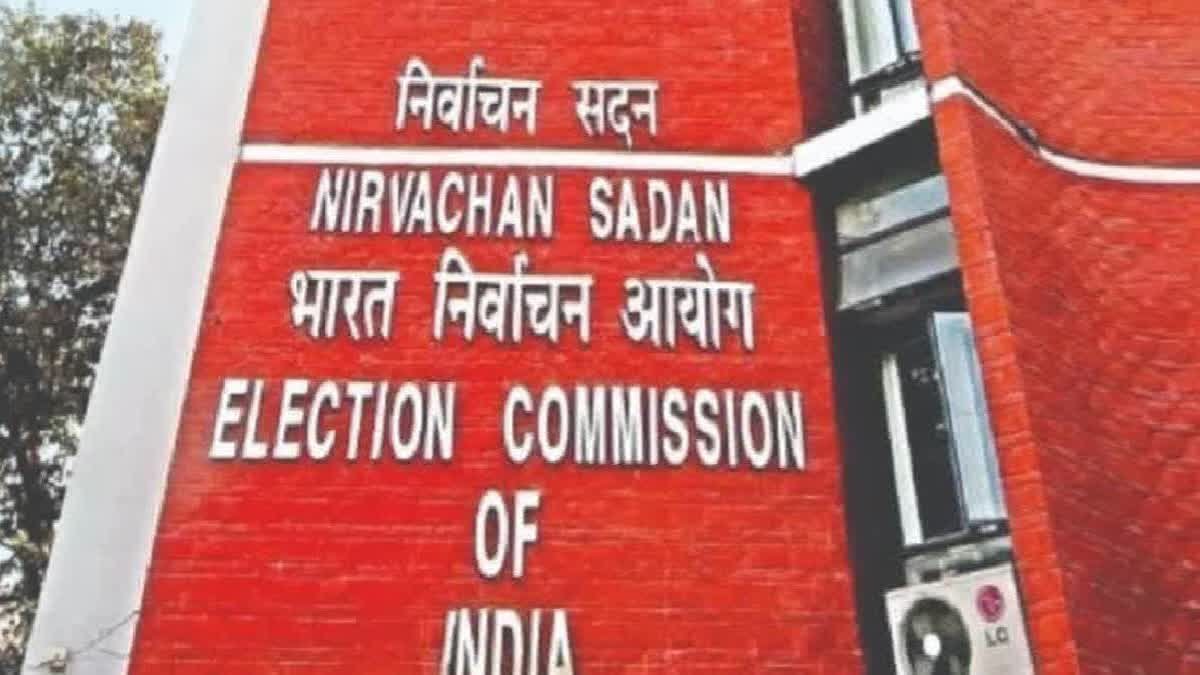

New Delhi: The Election Commission of India (ECI) has imposed a ban on the release of any new funds intended for Local Area Development (LAD) in the states of Kerala, West Bengal, Puducherry, Tamil Nadu, Karnataka, and Maharashtra. The Election Commission issued this directive in light of the Model Code of Conduct (MCC), which came into force following the announcement of Assembly elections and by-elections in these states and Union Territories.
The Commission has directed that no new funds be allocated under the Local Area Development Schemes of Members of Parliament (including Rajya Sabha members), Members of Legislative Assembly (MLAs), or Members of Legislative Councils until the entire election process is concluded. Prafulla Awasthi, Under Secretary to the Election Commission, has written a letter to this effect to the Cabinet Secretary, Secretaries to the Government of India, Chief Secretaries, and the Chief Electoral Officers of the concerned states and Union Territories.
An official stated that works for which work orders had been issued prior to the release of this letter—but where actual work on the ground has not yet commenced—cannot be started at this time. These works may only commence after the election process has been completed. However, if a project has already physically begun, it may continue, and there shall be no restriction on making payments for the completed portion of the work, subject to the satisfaction of the concerned officials.
The official further added that in instances where schemes have already been approved, funds have been received, and construction materials have arrived at the site, the work may proceed to completion in accordance with the scheduled timeline.
Meanwhile, the Election Commission has announced that, for the upcoming elections and by-elections, special facilities will be provided to enable senior citizens, persons with disabilities (PwD), service voters, and voters deployed on election duty to cast their votes via postal ballots. Citing Section 60(c) of the Representation of the People Act, 1951, the Commission has notified that voters aged 85 years and above, as well as persons with disabilities registered in the electoral rolls, are eligible to cast their votes through the postal ballot system. The Election Commission stated that eligible voters can avail themselves of this facility by filling out Form 12D and submitting it to the Returning Officer through their respective BLOs (Booth Level Officers) within five days of the issuance of the election notification. Polling teams will visit their homes according to a scheduled itinerary to collect their votes—a process of which the contesting candidates will also be duly informed.
The Commission further added that employees deployed in essential services on the day of polling may also apply for a postal ballot through the nodal officers of their respective departments. This category encompasses services such as the Fire Department, Health Services, Electricity, Traffic Police, Ambulance Services, Civil Aviation, and long-distance government bus services, among others. Additionally, media personnel authorized to cover the elections on polling day have also been accorded the facility of a postal ballot by being included under the ‘essential services’ category.
According to the Commission, employees assigned to election duty will receive their postal ballots, cast their votes, and deposit them at designated facilitation centers. The Commission has issued strict directives ensuring that the secrecy of the voter’s ballot is fully maintained during the voting process at these facilitation centers.
The Election Commission clarified that Service Voters (such as personnel deployed in the Armed Forces or other services) will have their ballots dispatched to them by the Returning Officer via the Electronically Transmitted Postal Ballot System (ETPBS) as soon as the final list of contesting candidates is finalized. Service Voters will not be required to pay any fees for these postal services.
It is pertinent to note that, alongside the Assembly elections in Assam, Kerala, Tamil Nadu, West Bengal, and Puducherry, by-elections have also been announced for constituencies in Goa (Ponda), Gujarat (Umreth), Karnataka (Bagalkot and Davanagere South), Maharashtra (Rahuri and Baramati), Nagaland (Koridang), and Tripura (Dharmanagar). The upcoming Assembly elections in Kerala, Assam, Tamil Nadu, and Puducherry will be conducted in a single phase, whereas in West Bengal, the elections will be held in two phases.
Furthermore, by-elections for eight seats across six states—including two seats each in Karnataka and Maharashtra—are scheduled to take place on April 9 and April 23. These by-elections are being held for seats that fell vacant due to the demise of incumbent members.

