

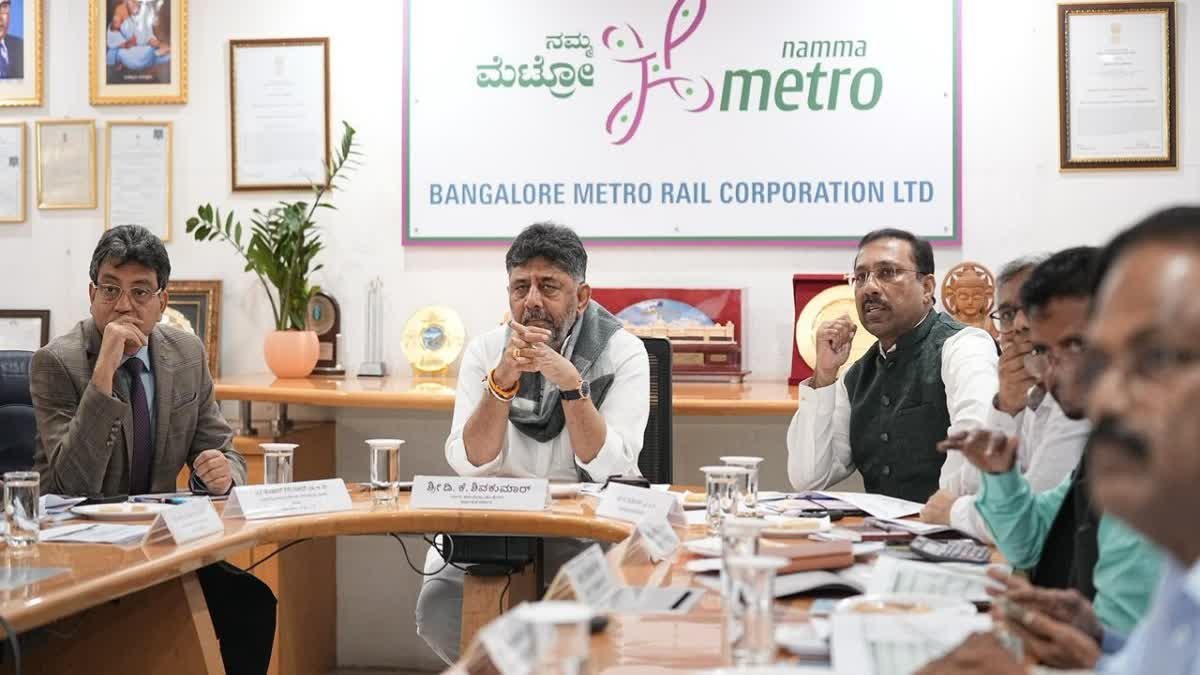

Bengaluru: Karnataka Deputy Chief Minister DK Shivakumar today reviewed the progress of Bengaluru Metro Rail projects and outlined the government’s roadmap for expanding the city’s public transport network over the next three years. He held a review meeting at the BMRCL office.
Senior officials, including Additional Chief Secretary of the Urban Development Department Tushar Girinath, BBMP Chief Commissioner Maheshwar Rao, BMRCL Managing Director J Ravishankar, and DCM Secretary Rajendra Cholan, attended the meeting. Following the meeting, Shivakumar spoke to the media and shared details about the current status of metro expansion, future plans, and challenges.
Deputy CM Shivakumar said that Bengaluru currently has 96 km of operational metro lines, with 24 km added since the current government came to power. He said, “Our focus is on expanding the metro network to reduce traffic congestion and make daily travel easier for people.” He added that the Electronic City line alone serves approximately 100,000 commuters daily.
“About 30% reduction in traffic”
He said that according to traffic police data, traffic on roads along the new metro corridor has decreased by approximately 30%. The Deputy Chief Minister said that the government plans to add 41 kilometers of metro lines by December this year, including both elevated and underground lines.
He said, “Between June and December, 27 kilometers will be completed, bringing the total number of new lines this year to 41 kilometers.” Another 38 kilometers, including the airport line, are expected to be completed by December 2027. “Once all these phases are completed, Bengaluru will have approximately 175 kilometers of metro service,” Shivakumar said.
New Corridors and Phase 3 Plans
The Deputy Chief Minister said that work is being planned to connect areas like Tavarekere, Hoskote, Bidadi, and Nelamangala. Detailed project reports are being prepared, and work has already begun in some stages. He said that tenders for approximately 100 kilometers of metro under Phase 3 will be issued soon.
This phase will also include an elevated corridor and double-line tracks. He said, “We are planning approximately 50 kilometers of elevated corridors, which will be the first of its kind in the country. This will benefit both metro and train commuters and ease road traffic.” Shivakumar said that tenders worth more than ₹25,000 crore have already been issued for Phase 3. A loan of ₹9,700 crore has been approved from the Japan International Cooperation Agency.
Parking, Land Issues, and Funding Models
The Deputy Chief Minister said the government has directed officials to improve land use and promote commercial development around metro stations. He emphasized the need for multi-level parking facilities for two-wheelers and cars at metro stations due to increased usage.
He also acknowledged the difficulties in acquiring land in some areas due to court cases and heavy traffic. Regarding funding, Shivakumar said the government will stick to the agreed cost-sharing model. He said, “We will not go beyond the agreed percentage. Contractors will have to invest under the build-operate-transfer model.” Shivakumar further stated that he will review the cost of the metro project compared to other cities, including Mumbai, to ensure transparency and efficiency.

