

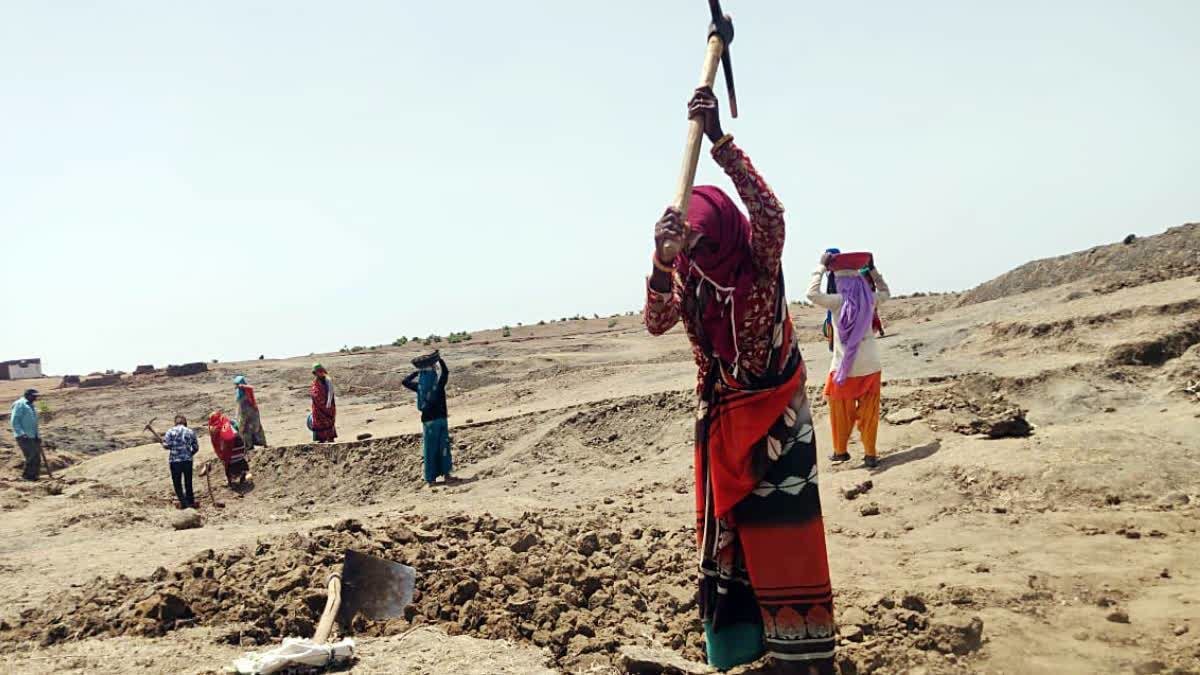

New Delhi: The Congress party is planning a massive mobilization of workers, aiming to get over 2.5 lakh Gram Sabhas (village assemblies) across the country to pass resolutions against the new rural employment scheme, which it says undermines the previous Mahatma Gandhi National Rural Employment Guarantee Act (MNREGA).
One of the Congress’s main allegations is that the central government has curtailed the powers of Gram Panchayats (village councils) in determining the nature of work and distributing work under MNREGA, which had guaranteed rural poor the right to demand work when needed.
Under the new scheme passed by the central government, the government will decide when the scheme will be opened to the rural poor, effectively taking away the right to work granted by the previous UPA government. The old party says that its governments had previously worked to strengthen Panchayati Raj institutions in the country, but the new scheme will weaken them.
According to Congress insiders, the AICC has instructed all state units to take the protests against the new MNREGA scheme to the villages. A key objective of this movement is to get over 2.5 lakh Gram Sabhas to pass a resolution demanding the reinstatement of the old law guaranteeing the right to work.
Sunil Panwar, Chairman of the Rajiv Gandhi Panchayati Raj Sangathan, told ETV Bharat, “Congress workers are present in almost every village of the country. There are approximately 22 crore MNREGA workers in the villages of the country. We will contact them and the members of the Gram Sabhas and urge them to pass resolutions in favor of the old law. The Gram Sabhas will certainly give importance to the concerns of the MNREGA beneficiaries. This resolution will send a strong message from the villages to the central government and the entire country.”
He added, “This is going to be the largest gathering of workers across the country after a long time. It is a huge challenge, but not impossible. The difference between the old law and the new scheme is that MNREGA was a right to work, while the new scheme is a program that curtails the powers of the Gram Panchayats.” According to Congress insiders, the high command was unhappy with the central government’s move during the last winter session of Parliament to replace the old law with a new scheme and remove Mahatma Gandhi’s name from it. Accordingly, at a Congress Working Committee meeting on December 27, 2025, a nationwide ‘Save MNREGA’ campaign was approved, to be held from January 8 to February 10, 2026, to protest against the central government’s move. On January 8, various state units, under the direction of a special coordination committee headed by AICC Treasurer Ajay Maken, discussed their specific plans to take the MNREGA protests to the villages.
Since the Congress wants to make this a high-impact campaign, the AICC has shared a document with the state units listing the key points to be raised during the protests. It has also instructed the state units to translate this document into local languages and distribute the material among the local population for wider dissemination.
Party functionaries will also contribute by conducting outreach programs targeting MNREGA beneficiaries as well as ordinary villagers to raise awareness about the changed rural employment law. Additionally, several protests will be held in front of government offices to register the opposition party’s views on the issue.
According to Congress Working Committee member Jagdish Thakor, the new rural employment scheme, VBG Ramji, goes against the decentralization ensured under MNREGA. Thakor told ETV Bharat, “Earlier, Gram Sabhas and Panchayats had the right to plan work based on local needs.
The new scheme gives the central government the power to make all decisions, including those related to funds, work, and assets, thus giving the center complete control over the management of the scheme. Many panchayats will receive zero funds, and this will eliminate local planning and the authority of village bodies. From now on, panchayats will only implement schemes formulated by the center. Furthermore, wages under MNREGA were linked to inflation, but the new scheme removes this certainty.” According to Congress Working Committee member Kamleshwar Patel, MNREGA was designed to address the problems of the rural population, but the new scheme ignores them. Patel told ETV Bharat, “MNREGA was one of the best demand-driven rural employment schemes in the country and was praised even abroad. This scheme helped reduce poverty. Every year, crores of rural families got work in their own villages.
As a result, hunger decreased, migration to cities reduced, rural wages increased, and durable assets like ponds, roads, canals, and check dams were created. During droughts, floods, and the COVID-19 pandemic, the old law acted as a safety net for the poor. Women’s participation in total workdays was approximately 60 percent, and in the process, they received equal wages, income security, and social respect.”
He added, “The new scheme has changed all this. Under the new scheme, demanding work is no longer a right for the poor. Work will only be provided in the panchayats notified by the central government. If a panchayat is not selected, the villagers there will have no right to work, even if they are affected by poverty or in distress. The new scheme transforms a constitutional promise into a matter of government discretion.”gives

