
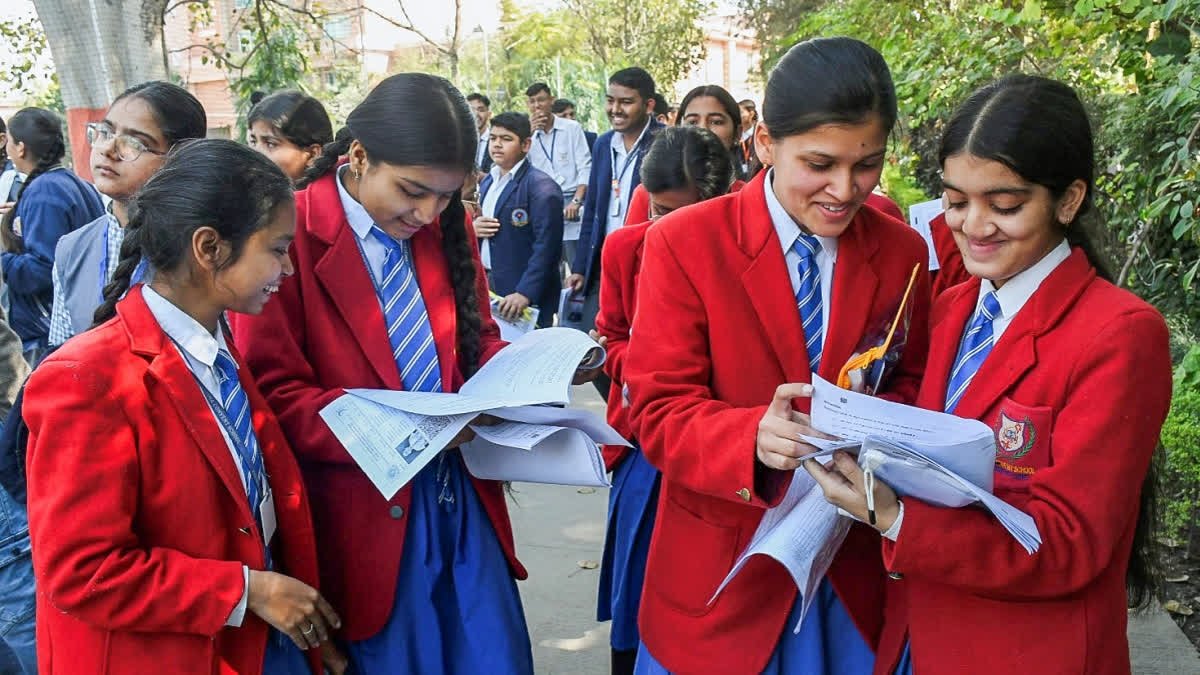

New Delhi: The Central Board of Secondary Education (CBSE) on Friday has unveiled a new curriculum framework to be implemented from the 2026–27 academic session, introducing a phased three-language formula from Class 6 and a two-level system for mathematics and science at the Class 9 level.
According to board officials, the revised curriculum aligns with the National Education Policy 2020 and the National Curriculum Framework, aiming to strengthen multilingual learning and conceptual understanding among students.
Under the new structure, students from Class 6 onwards will mandatorily study three languages, with at least two being Indian languages. The framework allows some flexibility in cases of students returning from foreign schools, who may be exempted from the third language subject under prescribed norms.
A major academic shift will also be introduced in Class 9, where students will study standard mathematics and science courses and take a common 80-mark examination. Additionally, those seeking deeper subject proficiency can opt for an advanced level, comprising a separate 25-mark paper designed to test higher-order thinking skills. While the advanced paper is optional, students scoring 50 per cent or above will have this qualification separately reflected in their mark sheets. The first batch to take Class 10 board exams under this system will do so in 2028.
However, the new curriculum has drawn sharp criticism from Tamil Nadu Chief Minister M.K. Stalin, who termed the three-language formula a “covert mechanism” to impose Hindi on non-Hindi speaking states.
In a statement on Saturday, Stalin alleged that the curriculum was “not an innocent academic reform” but a “calculated and deeply concerning attempt at linguistic imposition.” He pointed out that under the guise of promoting Indian languages, the Union government was advancing a centralising agenda that privileges Hindi while marginalising India’s linguistic diversity.
“For students in southern states, this effectively translates into compulsory Hindi learning,” he said, questioning the absence of reciprocal requirements for Hindi-speaking states to adopt southern or other regional languages.
The Chief Minister also raised concerns over the feasibility of implementing the new framework, pointing to a lack of clarity on teacher availability, training capacity, infrastructure, and funding. He called the policy as “ill-conceived” and lacking accountability.
Stalin also issued a scathing rebuttal to Union Education Minister Dharmendra Pradhan, describing his recent statement on X as “deeply irresponsible” and accusing the Centre of “weaponising” education funds to coerce states into accepting “Hindi imposition.”
In a detailed post on X, Stalin firmly rejected the National Education Policy’s (NEP) three-language formula and accused the Union Government of “illegally” withholding Rs 2,200 crore under the Samagra Shiksha scheme to penalise Tamil Nadu.
“@dpradhanbjp Your remarks are deeply irresponsible and reckless, and reflect an entrenched disregard for India’s plurality, federal values, and respect for states. Tamil Nadu firmly rejects the three-language policy. This is not about opposing languages, but about resisting imposition and defending Constitutional rights,” Stalin stated.
The Chief Minister dismissed the Union Minister’s claim that there is no Hindi imposition as “plainly dishonest,” arguing that tying crucial education funding to policy compliance removes any element of choice.
“The claim that there is “no Hindi imposition” is plainly dishonest. When a policy structurally corners non-Hindi speaking states like Tamil Nadu into adopting a third language with little real choice, and when crucial education funding is tied to compliance, it ceases to be a matter of choice,” he said.
“It is nothing short of audacity to illegally withhold a humongous sum of Rs 2,200 crore under the ‘Samagra Shiksha’ Scheme, effectively penalising Tamil Nadu for refusing to accept Hindi imposition. These are not discretionary grants, but funds that rightfully belong to the people of Tamil Nadu, collected through taxes; they cannot be weaponised as a tool of coercion,” the CM added.

