

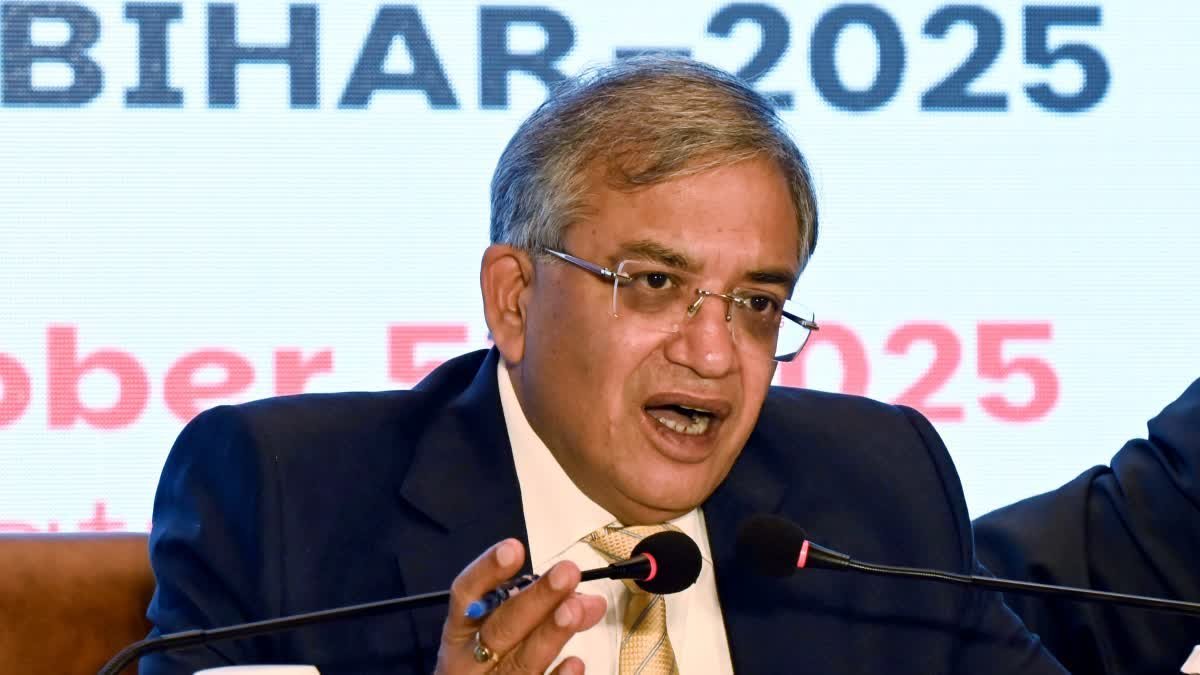

New Delhi: Amidst the ongoing Special Intensive Revision (SIR) in nine states and three Union Territories (UTs), Chief Election Commissioner (CEC) Gyanesh Kumar on Wednesday lauded Booth Level Officers (BLOs) and called them the bedrock of electoral democracy in India.
He said that the responsibility of voters and ensuring that all eligible voters are included in the electoral roll rests with the BLOs. Notably, more than 5.32 lakh BLOs and others are engaged in the second phase of the ongoing SIR exercise, which aims to purify the electoral rolls. In his inaugural address at the three-day International Conference on Democracy and Election Management (IICDEM) being organized by the Election Commission of India (ECI) at Bharat Mandapam, the Chief Election Commissioner called India the mother of democracy. He said, “In India, there are approximately 970 voters at every polling booth. The responsibility of voters and ensuring that all eligible voters are included in the voter list rests with the Booth Level Officer (BLO).
The BLO is the foundation and fundamental pillar of electoral democracy in India.” Referring to the Constitution, the CEC said, “According to our Constitution, Indian elections are divided into two broad segments. One is the preparation of the electoral roll and the other is the conduct of elections.” He said that a clean electoral roll, including every eligible voter as per the law, is essential for strengthening democracy, and added that all elections are conducted based on that electoral roll. Referring to the 2024 Lok Sabha elections, Kumar recalled how Indian elections have become one of the world’s largest electoral exercises year after year in terms of logistics, numbers, and transparency. He said, “In the 2024 Lok Sabha elections, more than 640 million people exercised their right to vote. This exercise involved more than one million polling stations and approximately two crore people. This is a huge achievement.” Referring to the 2025 Bihar assembly elections, the Chief Election Commissioner said, “Assembly elections were held in Bihar a few months ago. The first step was to purify the electoral roll by including eligible voters, and that stage has been completed. Under electoral law, there is a provision for any voter in any assembly constituency to file an appeal to ensure that no incorrect names are included and no correct names are left out.”
Kumar added, “The voter list in Bihar and across the country was finalized under the strict scrutiny of all citizens, and then the elections were held. Not a single re-polling was required. Our officials maintained such efficiency.” Speaking about the three-day conference, the Chief Election Commissioner said, “We are here to understand the future trajectory, challenges, and aspirations of voters and to make this process even simpler, more transparent, and fairer.”
He further stated, “We are also working on bringing out an atlas of democracy in the world. The draft is almost ready. It will be shared with member countries (international delegations) so that improvements and additions can be made if needed. This will be a unique feature of the electoral process and how democracy functions.” This three-day conference is the largest of its kind ever hosted by India in the field of democracy and election management, with heads of election management bodies from around the world participating.

