

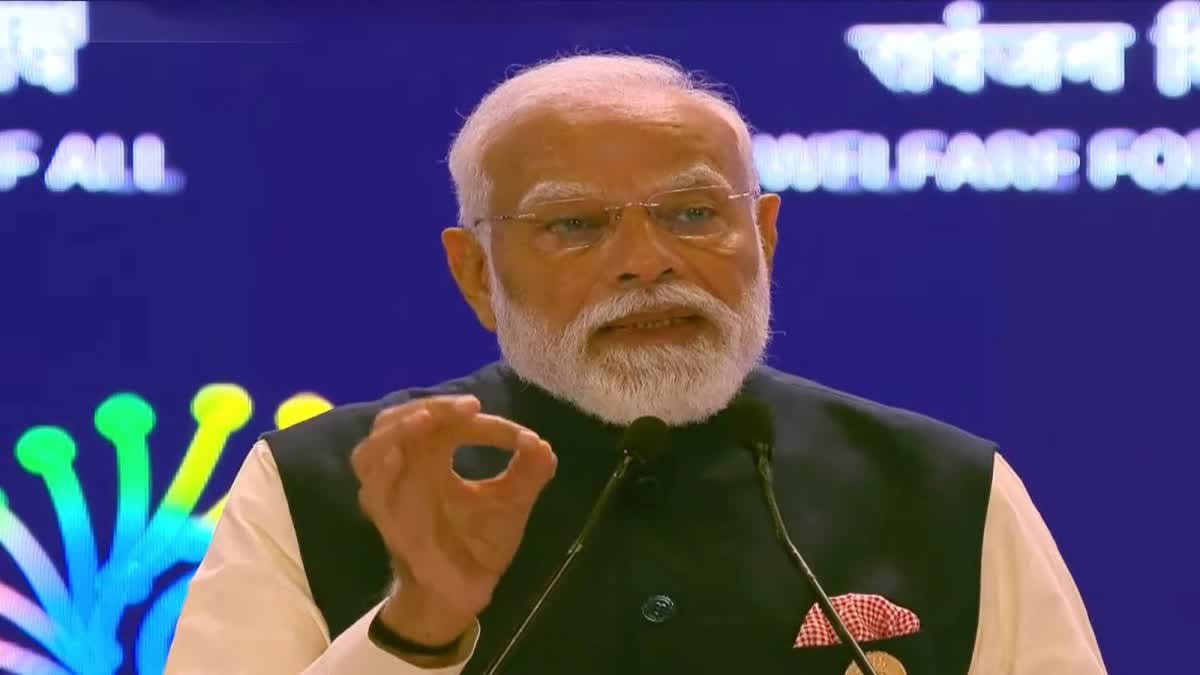

New Delhi: The India AI Impact Summit 2026 was formally inaugurated in India on Thursday. Prime Minister Narendra Modi addressed the inaugural session. More than 60 countries participated in the summit. AI governance, sovereignty, and international cooperation will be discussed at the AI Summit 2026.
Prior to this, PM Modi welcomed all the guests attending the summit. Global tech leaders including French President Emmanuel Macron, UN Secretary-General Antonio Guterres, Brazilian President Lula, Google and Alphabet CEO Sundar Pichai, Open AI CEO Sam Altman, Meta’s Chief AI Officer Alexander Wang, and Anthropic CEO Dario Amodei also attended the summit’s opening ceremony. In addition, the AI Summit 2026 will be attended by over 500 AI leaders, over 100 government representatives, heads of state from 20 countries, 60 ministers, over 150 academics, researchers, and hundreds of experts. Addressing the summit, Prime Minister Narendra Modi said, “I welcome you all to the world’s most historic AI Summit. India is home to the world’s largest tech pool. It’s a matter of pride for the Global South that the AI Summit is being held in India.” He further stated that the speed with which the world’s youth are adopting and taking ownership of AI is commendable. There is tremendous enthusiasm among the youth for the AI Summit. AI is making machines intelligent, but more than that, it is enhancing human capabilities exponentially. There’s just one difference: this time the speed is much greater, and the scale is greater than expected. Previously, it would take decades for the technology’s impact to be visible. Today, the journey from machine learning to learning machines is faster, deeper, and broader than ever before.
In his address, PM Modi said that when signals were first sent wirelessly, no one imagined that the entire world would one day be connected in real time. Artificial intelligence is a paradigm shift in human history. What we are seeing and anticipating today is just the beginning of its impact. The PM said that we must have a big vision and shoulder an equally big responsibility. Along with today’s generation, we must also worry about how we will pass on AI to future generations. Therefore, the real question today is not what artificial intelligence can do in the future, but what we should do with it today. Humanity has faced such questions before. Nuclear power is a prime example. We have witnessed its devastation and its positive contributions.
Prime Minister Narendra Modi said that for AI, humans are just data points. To ensure that humans are not reduced to mere raw material, AI must be democratized. It must be made a medium of inclusion and empowerment, especially in the Global South. We must give AI the open sky and, like GPS, take command in our own hands. GPS shows us the way, but the final decision on which direction we should take is ours. The direction we take AI today will determine our future.
He said that decades ago, when the internet began, no one could have imagined how many jobs it would create. The same is true for AI. Today, it is difficult to imagine what kinds of jobs will be created in this field. The future of work in AI is not predetermined. It will depend on our decisions, our path, and our way of working. I believe that the future of work is a new opportunity for us. This is the era of working together with humans and intelligent systems.
PM Modi said, “Today, at the New Delhi AI Impact Summit, I present the MANAV vision for AI.” MANAV stands for human, and the MANAV vision states: M – Moral and Ethical System: AI should be based on ethical guidance. A – Accountable Governance means transparent rules and strong oversight; N – National Sovereignty means whose data, their rights. A – Accessible and Inclusive means AI should be a multiplier, not a monopoly. V – Lawful and Legitimate means AI should be legal and verifiable. This MANAV vision of India will become an essential link for the well-being of humanity in the AI-driven world of the 21st century.
Prime Minister Narendra Modi said that we must be more vigilant about the safety of children. The AI space should also be child-safe and family-oriented. The PM said, “Let us pledge to develop AI for the common good of the world. Establishing global standards is a pressing need today. Deepfakes and fabricated content are destabilizing open societies.” In the digital world, content must also have authenticity labels to help people distinguish between real and AI-generated content. As AI generates more text, images, and video, the industry increasingly requires watermarking and clear-source standards. Therefore, it’s crucial to build trust into the technology from the outset.
Speaking about PM Modi’s day-long schedule, he will meet with several leaders. The evening also includes roundtable meetings with several CEOs. Union Minister Ashwini Vaishnav said on this occasion that India will work with everyone to fulfill PM Modi’s vision of promoting technology. He further said, “Welcome to the first AI Summit in the Global South and the largest AI Summit ever held. 118 countries participated in it. Thank you all for making this summit a success.” PM Narendra Modi believes that the true value of technology lies in ensuring its benefits reach the common people. Vaishnav said that our Prime Minister’s vision is to democratize technology, make it widely used, and make it accessible to everyone.
He said, “We consider computing a public good. In a public-private partnership, we have created a common compute platform where we are providing access to 38,000 GPUs at very affordable rates to our startups, academia, researchers, and students.” We will add another 20,000 GPUs to this common compute platform. While leveraging the benefits of AI, we must also jointly find solutions to mitigate its risks. By placing human safety and dignity at the heart of AI, we can move forward with confidence. Together, through this summit, through our collaborative efforts and the vision of our Prime Minister, let us build an AI future of humans, by humans, and for humans.
Addressing the inaugural session, French President Emmanuel Macron said, “Namaste, thank you very much for welcoming us to this wonderful city, this wonderful country. Prime Minister, it is great to be back after my state visit in 2024 for this Artificial Intelligence Impact Summit (AI Impact Summit 2026) organized by you.” Macron said that 10 years ago, a street vendor in Mumbai couldn’t open a bank account. No address, no documents, no access, and today that same vendor takes payments on his phone.
He said India has created something no other country in the world has. A digital identity for 1.4 billion people. A payment system that now processes 20 billion transactions every month. A health infrastructure that has issued 500 million digital health IDs. Here are the results. They call it the India Stack: Open, Interoperable, Sovereign. This is what this summit is about. We are clearly at the beginning of a huge boom, and you described it perfectly during your intervention.

