

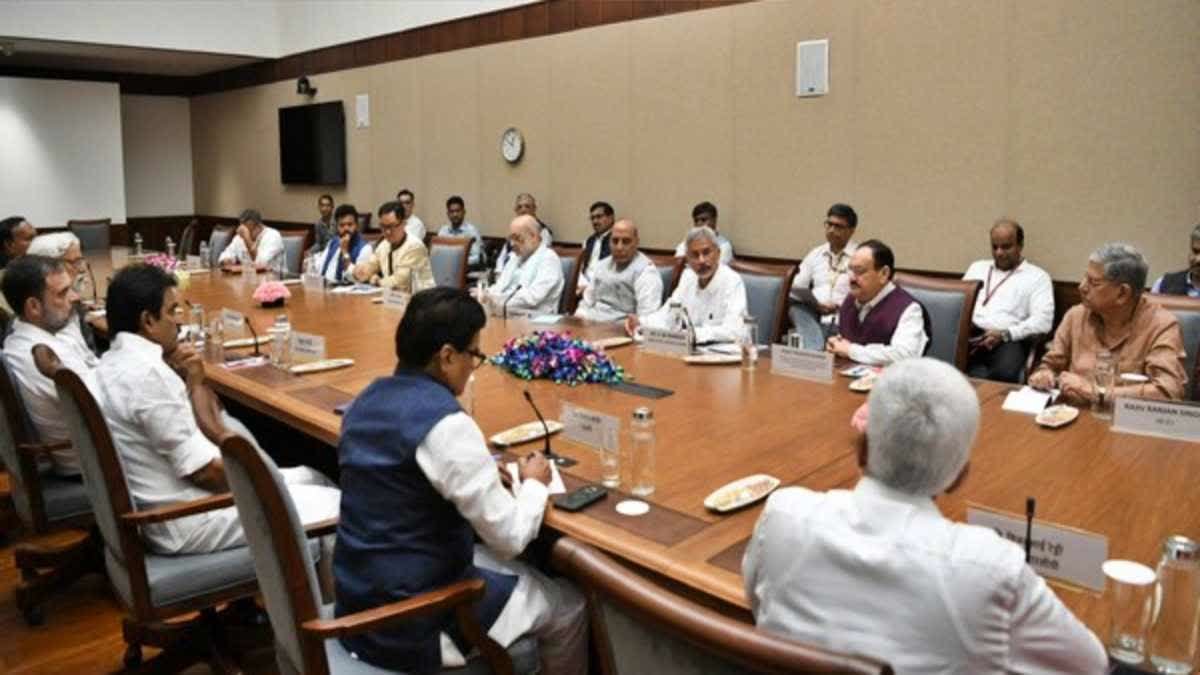

New Delhi: An all-party meeting was held within the Parliament complex on Wednesday evening to discuss the ongoing conflict in West Asia involving the US-Israel axis and Iran. Chaired by Defence Minister Rajnath Singh, the meeting was attended by a total of eight Union Ministers, most notably External Affairs Minister S. Jaishankar, Home Minister Amit Shah, Finance Minister Nirmala Sitharaman, Parliamentary Affairs Minister Kiren Rijiju, and Petroleum Minister Hardeep Singh Puri. The Foreign Secretary also provided a detailed briefing to the opposition representatives. Representing the opposition were Dharmendra Yadav of the Samajwadi Party, Asaduddin Owaisi of the AIMIM, John Brittas of the CPI(M), and other leaders.
During the meeting, the opposition questioned the government’s failure to condemn the assassination of Iran’s Supreme Leader, Ayatollah Ali Khamenei. Owaisi and Dharmendra Yadav asked why this “inhumane act” had not been condemned. External Affairs Minister S. Jaishankar gave a firm response regarding the question of Pakistan acting as a mediator. He stated, “India cannot be a broker nation.” Jaishankar clarified that since 1981, the United States has utilized Pakistan to serve as a mediator between Iran and itself. He emphasized that India has never remained silent—we have consistently offered our comments and responses. Jaishankar remarked, “We are good friends with everyone, but we maintain a relationship with the United States that yields tangible benefits.” Furthermore, he gave assurances that India’s relations with Iran remain cordial.
The government also presented certain statistics during the meeting, indicating that following the crisis, 420,000 (approximately 427,000) Indians have been safely repatriated. Currently, 18 ships carrying Indian crew members remain stranded in the Strait of Hormuz; efforts to evacuate all personnel are ongoing. Four ships have already arrived, and five more are expected shortly. The meeting also featured a serious discussion regarding fertilizer production. The opposition expressed concern that any disruption in the Strait of Hormuz could adversely affect fertilizer imports, thereby causing harm to farmers. The government stated that domestic production has been increased and import sources have been diversified. Oil imports from Russia currently account for approximately 20 percent of total imports, a factor that contributes to energy security. The opposition also demanded a detailed debate on the Iran crisis under Rule 190 in both houses of Parliament—the Lok Sabha and the Rajya Sabha.
Responding to questions raised regarding the economy, Jaishankar stated that the government has the situation completely under control. Reacting to the situation, Kiren Rijiju affirmed that the safety of every Indian citizen remains the government’s utmost priority. During the meeting, reference was made to the conversation held between Prime Minister Narendra Modi and US President Donald Trump, wherein India clearly articulated that it does not desire war.
The government appealed to all political parties for cooperation, assuring them that the safety of Indian citizens, energy security, and economic stability are being closely monitored. This meeting took place at a time when tensions in the Strait of Hormuz are impacting global trade, oil and gas supplies, and fertilizer production. Emphasizing the “broker nation” remark, the opposition asserted that India’s independent and balanced foreign policy must be upheld and strengthened. The meeting was cordial in tone, yet marked by numerous questions. It now remains to be seen when and how the debate under Rule 190 will take place in both houses of Parliament.
Speaking to ETV on this issue, Samajwadi Party MP Dharmendra Yadav stated that while the government did address all the questions raised, its responses were not satisfactory. He further noted that the opposition had also raised the question as to why India did not express any condolences following the assassination of Iran’s Supreme Leader, Ali Khamenei. He added that the government failed to provide a satisfactory explanation regarding this matter.

