

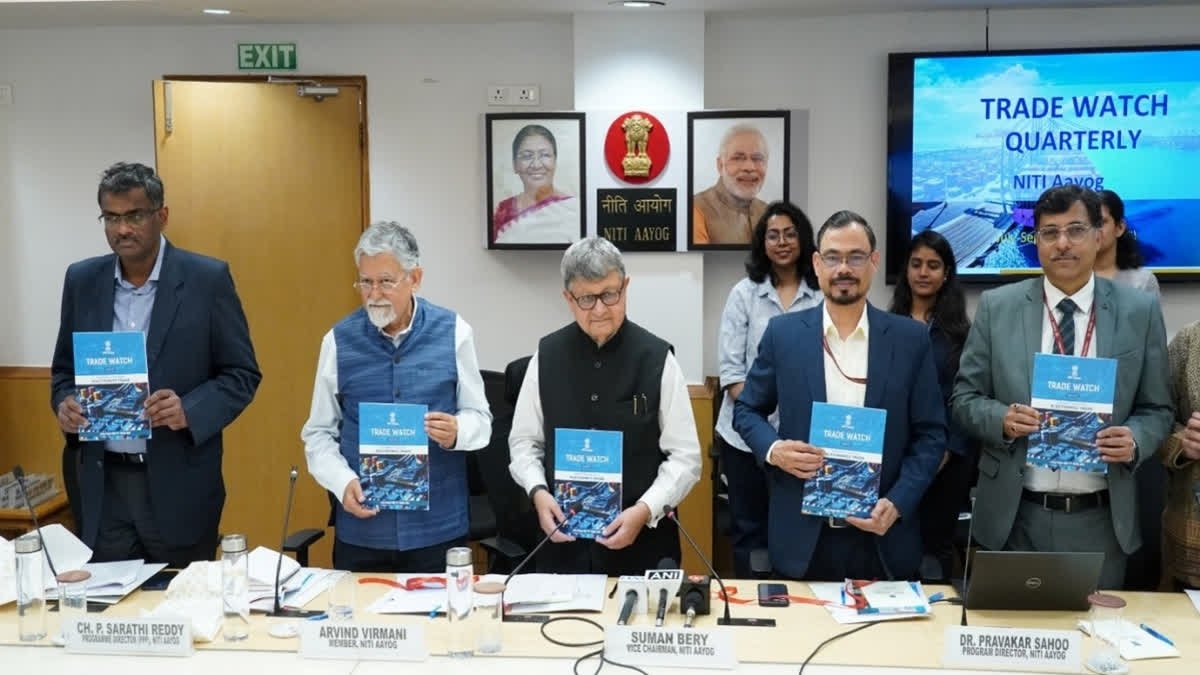

New Delhi: According to the latest ‘Trade Watch Quarterly’ report released by NITI Aayog Vice Chairman Suman Beri, India’s trade performance remained strong in the second quarter of FY 2025-26. Despite global instability, exports outpaced imports during this period. According to the report, India’s merchandise exports grew 8.4% year-on-year to $108 billion in the July-September period, while imports increased 5% to $196 billion.
Services exports grew by 8.7% to $102 billion. Services exports have consistently outpaced merchandise exports, resulting in a $50.9 billion trade surplus in the services sector. However, when goods and services are combined, the overall trade deficit was $37 billion.
These data show that even as the global economy’s performance remains uneven, India’s export-led growth strategy is supporting international trade growth.
Export Drivers and Import Trends
Electrical equipment, mineral fuels, and nuclear reactors were the three main drivers of export growth. In particular, exports of electrical equipment increased by 33% year-on-year, making it one of the fastest-growing categories.
On the other hand, fertilizer imports surged by a massive 239% due to a boost in agricultural demand due to a better monsoon. Meanwhile, mineral fuel imports recorded a slight decline of 0.9%, while optical and medical equipment imports declined by 8.7%.
While trade levels among India’s top 10 export destinations remained largely stable, eight of them recorded positive growth rates. Among these countries, Hong Kong had the highest growth rate compared to other competitors.
India’s imports remain heavily dependent on just four major partners, accounting for approximately 60% of total goods. While the economies of many countries, including Singapore, are experiencing declines, they are experiencing significant economic growth.
Changing Trade Patterns
Another important finding of the report is that trade between developing economies will remain crucial for future growth. South-South trade (mutual trade between developing countries) has increased by a staggering 400% between 2005 and 2024, from $1.8 trillion to $7.3 trillion.
A similar trend has been observed in India. India’s exports to developing countries have increased from $56 billion to $244 billion over the same 20-year period. Although India’s share of this trade remains relatively low at approximately 2%, the growing volume of trade is rapidly connecting India to new global trade routes.
This shift reflects the constantly changing balance of global trade, where developing economies are playing a greater role in defining the new landscape of suppliers and consumers.
For this reason, this quarter’s report focuses on electrical equipment, which will contribute to the growth opportunities of India becoming a manufacturing powerhouse.
As the second largest contributor to India’s total exports, electrical and electronic products account for 3.4% of India’s GDP and provide employment to approximately 25 million people.
Although India’s global share in this sector is still low at approximately 2%, current trends indicate that India is rapidly integrating into emerging new global trade corridors.
This shift reflects the gradual balance in global trade dynamics, where developing economies are playing a more central role in driving demand and supply chains.
Electronics: A Strategic Shift
The electronics sector holds great potential for India’s industrial development. This is positioning India among the global manufacturing giants, making it a vital component of the broader economy.
The electronics sector now contributes 3.4% to India’s GDP and employs approximately 2 million people. It has become the second-largest component of India’s export basket. This transformation has resulted in its total global value reaching approximately $4.62 trillion, making it a major component of international trade.
Electronics exports from India have witnessed a compound annual growth rate (CAGR) of 17%. Between 2016 and 2024, exports are expected to grow nearly fivefold, reaching a total value of $42.1 billion, significantly exceeding the global growth rate of 4.4%.
Mobile phones and telecommunications equipment account for the largest share of electronics exports from India, accounting for over 50% of total exports. By 2024, India’s mobile and telecommunications equipment exports are projected to reach $22.1 billion, accounting for 3.5% of global demand.
The report notes that while there have been many positive developments in the industry, significant improvement is still needed in the “high-value” sectors. For example, India’s global share in integrated circuits (ICs), semiconductors, and LEDs is only 0.02%, 1.1%, and 1.1%, respectively.
The report also highlights that India remains import-dependent for technologically advanced inputs such as chips, display panels, and batteries, reflecting India’s reliance on foreign suppliers.
Structural Challenges and Policy Initiatives
Industry inputs included in the report confirm that certain structural challenges continue to impact India’s competitiveness. Assembly costs in India are 10-14% higher than in countries like China and Vietnam. Component manufacturing costs are also 14% to 18% higher than in these countries. Furthermore, the capital costs required for assembly in India are estimated to be 9% to 13% higher than in other countries.
Logistics inefficiencies and an inverted tariff structure remain barriers to competitiveness. For example, while machinery imports have zero tariffs, almost all intermediate inputs are subject to high import duties, preventing domestic value addition.
To address these gaps, improve domestic production, and develop a robust component ecosystem, the Union Budget allocated ₹40,000 crore through the Electronic Component Manufacturing Scheme (ECMS).
The report emphasizes that an ecosystem-based strategy (such as creating supplier clusters, shared testing infrastructure, and better integration into global value chains) is crucial.
E-commerce and Future Growth
Another emerging trend highlighted in the report is the growing role of e-commerce in exports. India is now among the top six countries in the world in terms of e-commerce, and nearly half of total electronic retail sales occur online.
Currently, e-commerce exports account for a relatively small share of total exports. However, due to improvements in logistics, regulatory facilitation, and the increasing participation of MSMEs (micro, small, and medium enterprises), it is projected to account for 20-30% of India’s total merchandise exports by 2030.
Global Context and Trade Agreements
This report provides context for India’s performance in the changing global trade environment. Several global developments, such as the EU-MERCOSUR Free Trade Agreement, China’s revision of its export exemption policy, and India’s growing relations with the UAE and the EU, will play a key role in shaping the future direction of trade flows. The aim is to achieve a bilateral trade target of $200 billion with the UAE by 2032.
The India-EU Free Trade Agreement could provide duty-free access to over 99% of Indian goods, giving these products a significant competitive advantage in the global market.
Import costs remain buoyant due to low prices of raw materials such as energy. However, demand for precious metals (gold and silver) remains high despite global uncertainty.
Releasing the report, Suman Beri emphasized the strategic importance of electronics in shaping India’s trade future. He said, “Electronics, as a key pillar of the modern manufacturing value chain, plays a crucial role in determining trade balance and technological sovereignty.”
He also stated that while India has achieved significant success in assembly, long-term competitiveness will depend on how well we strengthen our domestic components ecosystem.
NITI Aayog Member Arvind Virmani also emphasized the importance of integrating more deeply into global value chains, especially in electronics, to maintain export momentum and create quality jobs. The report shows that India’s trade strength is now driven by export-led growth, combined with strong performance in services and emerging capabilities in high-technology manufacturing.
The next phase of India’s development will demand a transition from assembly-based production to design- and innovation-led production. Advanced components manufacturing for electronics will be positioned not just as a sector, but as an engine of India’s economic transformation.

