

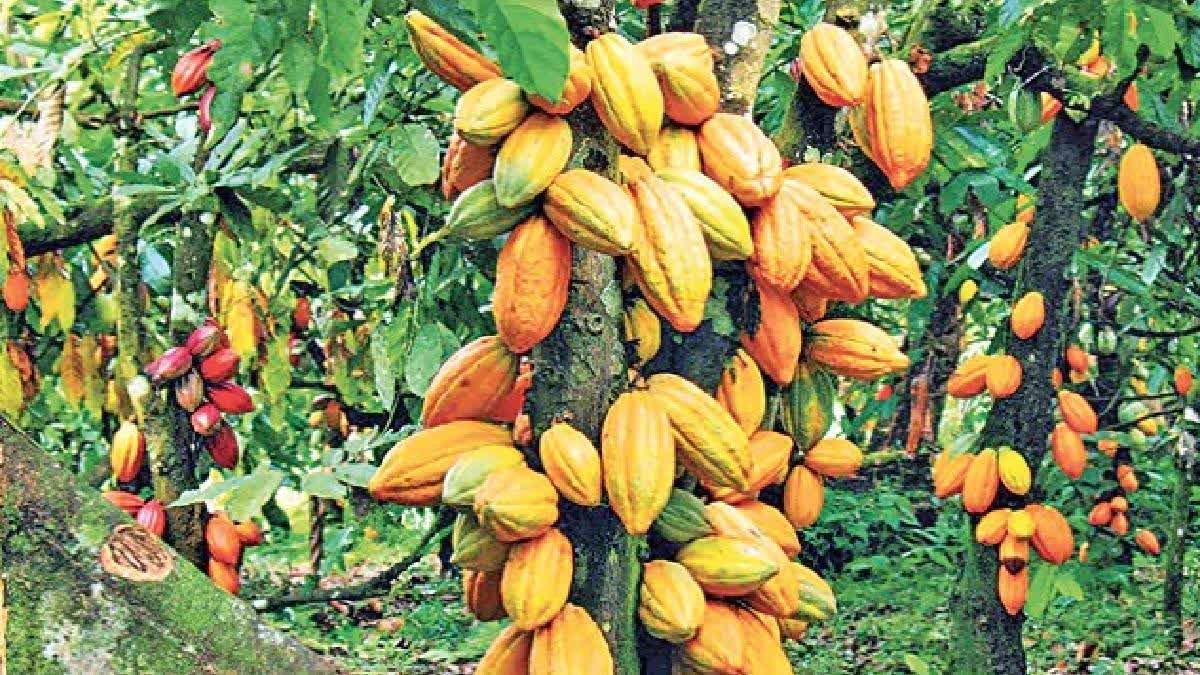

Eluru (Andhra Pradesh): While cocoa cultivation and yield are continuously declining worldwide due to pests and climate change, farmers in Andhra Pradesh have successfully transformed it into a profitable crop.
Considering the systematic cultivation in the state, Dr. P. Chowdappa, former director of the Central Plantation Crops Research Institute (CPCRI), Kasaragod (Kerala), said in an exclusive interview with Eenadu-ETV Bharat that Andhra Pradesh will soon become a global hub for cocoa. Chowdappa was in Eluru district to participate in a ‘Cocoa Conclave’.
Andhra Pradesh ranks No. 1 in cocoa cultivation
According to Chowdappa, the state has very fertile land and water resources for cocoa cultivation, and it grows well under the shade of trees. In Eluru, West Godavari, East Godavari, NTR district, Visakhapatnam, and Vizianagaram districts, cocoa is being cultivated under the shade of coconut and palm trees. Currently, it is cultivated in an area of 40,000 hectares in the state, but there is potential to expand cultivation to more than three lakh hectares.
The former CPCRI director explained, “Cocoa cultivation does not require separate land, and since it is grown as an intercrop in coconut and palm plantations, farmers incur fewer losses. Also, the fertilizer used in coconut and palm plantations is sufficient for this crop. Approximately 750 kg of leaves fall per acre, which cover the ground, preventing weed growth and retaining soil moisture. The leaves dry up, decompose, and turn into manure, strengthening the soil quality. In this way, it helps in increasing the yield. Even if other crops fail, this crop provides a consistent income for the farmers.” Several Countries Oppose Cocoa Cultivation
Chowdappa said that concerns are being raised in Ghana, East Africa, Brazil, and some Asian countries regarding deforestation and restrictions on purchasing this crop, which has led to a reduction in the area under cultivation. He said that the lack of shade and water on forest land, along with pest infestations, is causing lower yields. Child labor is also considered a contributing factor to the decline in cultivation. Compared to India, the trees in those countries are older, already between 40 and 50 years old, resulting in lower yields. He further added that yields begin after three years, and cocoa pods continue to be produced until the trees are 60 years old.
Andhra Pradesh Surpasses Kerala and Karnataka in Cocoa Cultivation
Chowdappa said that although cocoa cultivation began in Kerala and Karnataka in the 1970s, Andhra Pradesh, where cultivation started 30 years later, is now number one in the country. Kerala and Karnataka are second and third, respectively, in cocoa cultivation.
He said, “Due to the hard work and good management of farmers in Andhra Pradesh, the state is producing the highest yield of 1200 kg of cocoa beans (cocoa pods) per hectare. The global average is only 500 to 600 kg. In Andhra Pradesh, 12,000 to 13,000 tons of cocoa are produced annually from 40,000 hectares. In contrast, the total production in the entire country is only 30,000 tons. Andhra Pradesh accounts for 40 percent of the total production.”
The former director of CPCRI further added that the global demand for cocoa beans for chocolate and related products is approximately 5 million tons. He said, “India will need 125,000 tonnes of cocoa beans by 2030. For Andhra Pradesh to become a global hub, production needs to reach 500,000 tonnes by 2040. To achieve this, cultivation needs to be expanded by 10,000 hectares every year.”
Explaining the methods for procuring more saplings, Chowdappa said that currently, the Kerala Agricultural University and the Central Plantation Crops Research Institute in Kasaragod supply cocoa saplings across India. These institutions produce only 4 to 5 million saplings annually. He added that Andhra Pradesh alone requires 2.5 to 3 million new saplings.
At the cocoa conclave held in Eluru, the concept of forming farmer groups to grow and supply high-yielding saplings from mother plants was discussed. He said the horticulture department is preparing a proposal on this.
Chowdappa said, “The central and state governments are jointly providing training to farmers on marketing and adhering to quality standards. They are being provided with solar dryers and boxes for fermenting and drying the cocoa beans to produce high-quality beans. Efforts are also being made to arrange training sessions with representatives from chocolate manufacturing companies.”

