

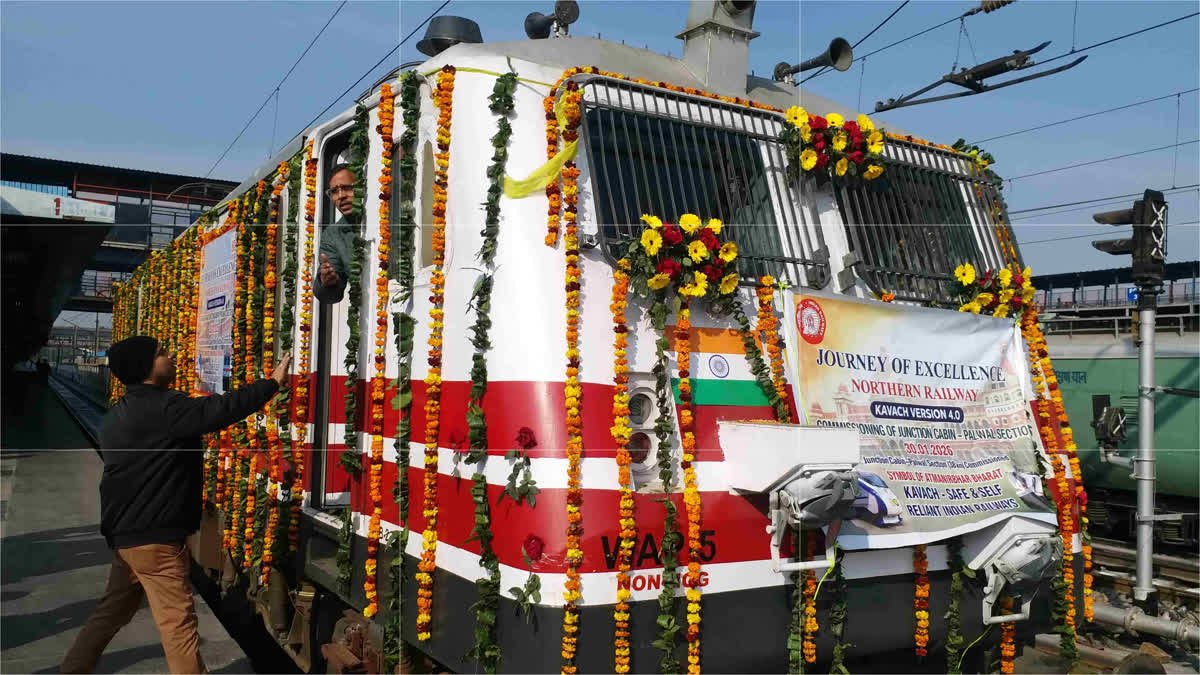

New Delhi: The indigenous safety system ‘Kavach 4.0’, being implemented in Indian Railways to prevent accidents such as train collisions and signal violations, is now emerging in a more technologically advanced form. Keshav Yadav, a marketing engineer at Medha Servo Drives Pvt. Ltd., the company that developed Kavach, provided detailed information about the system’s functionality and features in an interview. According to him, Kavach is not just a device, but an intelligent safety network that constantly communicates between the train, track, and signals.
In a conversation with ETV Bharat, Keshav Yadav explained that the primary objective of Kavach is to make train movement “fail-safe,” meaning that if a human error occurs at any level, the system will automatically intervene and prevent an accident. Through the Driver Machine Interface (DMI) unit installed in the locomotive, the loco pilot can see the status of the upcoming signal—red, yellow, or green—in real-time. Importantly, signal information will be available digitally even in conditions like fog, rain, or low visibility. This will enable trains to operate on schedule. The most important feature of Kavach 4.0 is SPAD protection (Signal Passing At Danger). If the loco pilot crosses a red signal for any reason, Kavach immediately applies the brakes automatically and stops the train. Similarly, the system incorporates software logic that continuously monitors the safe distance between two trains. In any situation—head-on, rear-end, or side movement—the train will automatically stop before a potential collision. Another major aspect of Kavach 4.0 is automatic speed control. The prescribed speed limit for each section is fed into the system. Even if the driver tries to increase the speed, the train cannot exceed the set limit. As soon as a train enters a loop line, station area, or a section with speed restrictions, Kavach automatically controls the speed. Considering areas with human populations, it also includes level crossing protection. This system can detect the status of the level crossing gate and stop the train if necessary. Additionally, the automatic horn feature sounds the horn, helping to alert people in the vicinity. This version of Kavach has evolved from version 1.0 to 4.0, which is considered updated and more advanced. This system is designed to conform to the highest international safety category, SIL-4 level.
It is worth noting that successful trials and commissioning of this system have been conducted on the Tughlakabad Junction cabin (Delhi) to Palwal section in the Delhi Division, where its functionality was tested under various conditions. The railways are expanding its implementation across the network in a phased manner. Systems like Kavach will help to virtually eliminate major rail accidents caused by human error in the future. Kavach 4.0 is emerging as a technological shield for Indian Railways, taking train operations beyond human dependence and into the realm of digital safety.

