

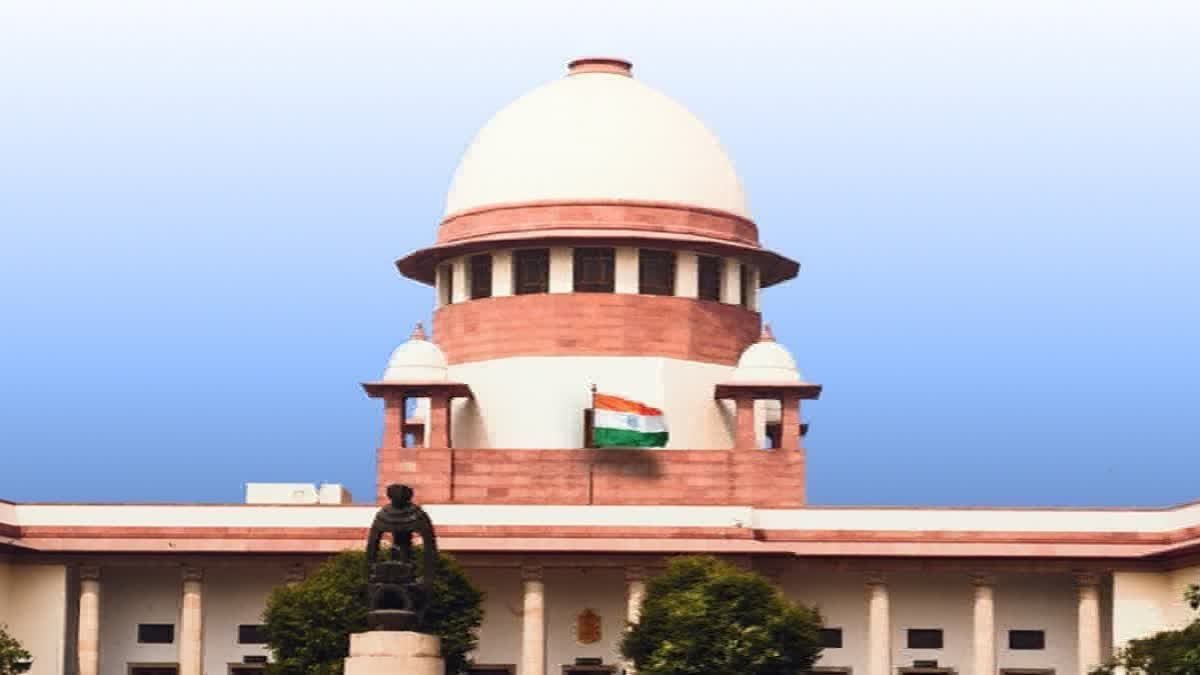

New Delhi: The Supreme Court on Thursday stayed the controversial rules of the University Grants Commission (UGC). These rules had sparked growing anger among students. The rules stipulated action against harassment of OBC, SC, and ST students, but offered no such assurance for students from the general category. A petition was filed against these rules. Hearing the petition, the Supreme Court stated that the UGC rules are vague. This means that the 2012 rules will remain in effect for now.
A joint bench of Supreme Court Chief Justice Surya Kant and Justice Joymalya Bagchi issued notices to the central government and the UGC on petitions challenging the regulations. The new regulations, which mandate all higher education institutions to constitute equity committees to address discrimination complaints and promote equity, were notified on January 13. The Chief Justice also posed a hypothetical question: Suppose a student from South India enrolls in an institution in North India (or vice versa), and faces derogatory remarks, and the caste identities of both the victim and the perpetrators are unclear, would the UGC provision be able to handle that situation?
During the hearing, the Chief Justice remarked, “After 75 years, in a country, whatever we have achieved in terms of creating a caste-less society, are we going backwards? What will happen?” The Chief Justice added, “Another rule that I find in the steps you are taking is that you are talking about separate hostels. For God’s sake, please don’t do that! We have lived in hostels; students live together. We have even had inter-caste marriages. We should move towards a caste-less society.”
The bench stated that if it did not intervene, it would have a dangerous impact, and said that it would divide society and have serious consequences. Justice Bagchi said that the petitioner’s lawyer was correct in stating that the 2012 regulations addressed discrimination on a broader and more inclusive scale, and also included discrimination in the form of ragging.
Justice Bagchi said, “Why should there be a regression in a protective or remedial law? The principle of non-regression has developed in environmental law. It is also applicable to laws that protect social justice and equality. We should not go back to a stage where we have separate schools, as was the case with Black children in the United States… where white boys and girls went to different schools. The unity of India should be reflected in educational institutions.”
The Chief Justice of India (CJI) said that mischievous elements in society could take advantage of such a situation. The Supreme Court, in its order, stated, “Issue notice, returnable on March 19. Solicitor General Tushar Mehta accepts notice. Since the issues raised in the 2019 petition will also have a bearing on the examination of the constitutionality… therefore, these petitions be tagged along with it. In the meantime, the UGC Regulations 2026 shall be kept in abeyance.”
The University Grants Commission (Promoting Equity in Higher Educational Institutions) Regulations, 2026 mandated that these committees must include members from Other Backward Classes (OBC), Scheduled Castes (SC), Scheduled Tribes (ST), persons with disabilities, and women. Nothing was mentioned regarding the general category.
The new regulations were framed to replace the UGC (Promoting Equity in Higher Educational Institutions) Regulations, 2012. The 2012 regulations were advisory, while the new 2026 regulations were mandatory. The petitions filed against the new regulations challenged them on the ground that the regulation strictly defined caste-based discrimination as discrimination against members of SC, ST, and OBC communities. It stated that by limiting the scope of caste-based discrimination to only the SC, ST, and OBC categories, the UGC has effectively denied institutional protection and grievance redressal to individuals from the general or unreserved category, who may also face harassment or discrimination based on their caste identity. Protests have erupted in several places against these regulations, with student groups and organizations demanding their immediate withdrawal.
What is the controversy?
The new UGC regulations were framed following a Supreme Court order. The new rules, which mandate the formation of Equal Opportunity Committees in all higher education institutions to investigate discrimination complaints and promote equality, were notified on January 13.
Under the University Grants Commission (Promotion of Equality in Higher Educational Institutions) Regulations, 2026, these committees are required to include representatives from Other Backward Classes (OBC), Scheduled Castes (SC), Scheduled Tribes (ST), persons with disabilities, and women. There was no mention of representation from the general category.
The petition stated that the new rules limit caste-based discrimination to only discrimination against members of the SC, ST, and OBC categories. Protests are also taking place in various locations against these rules, with student groups and organizations demanding their immediate withdrawal.
What are the new UGC rules?
An Equal Opportunity Centre (EOC) will be established in every college.
The EOC will provide assistance to backward and underprivileged students regarding studies, fees, and discrimination.
The committee will include members from SC, ST, OBC, women, and persons with disabilities. This committee will have a tenure of two years.Every college will have to form an Equality Committee, chaired by the head of the college.
An Equality Squad will also be formed in the college to monitor discrimination.
A meeting must be held within 24 hours of receiving a complaint of discrimination. A report must be submitted to the college head within 15 days.
The college head must initiate further action within 7 days.
The EOC will submit a report to the college every 6 months.
The UGC will constitute a national monitoring committee. The college’s grant may be withheld for violating the rules.
The college will have to send a report on caste-based discrimination to the UGC every year.
In serious cases, the UGC’s accreditation may also be revoked.
The college’s degree, online, and distance learning courses may be suspended.

