

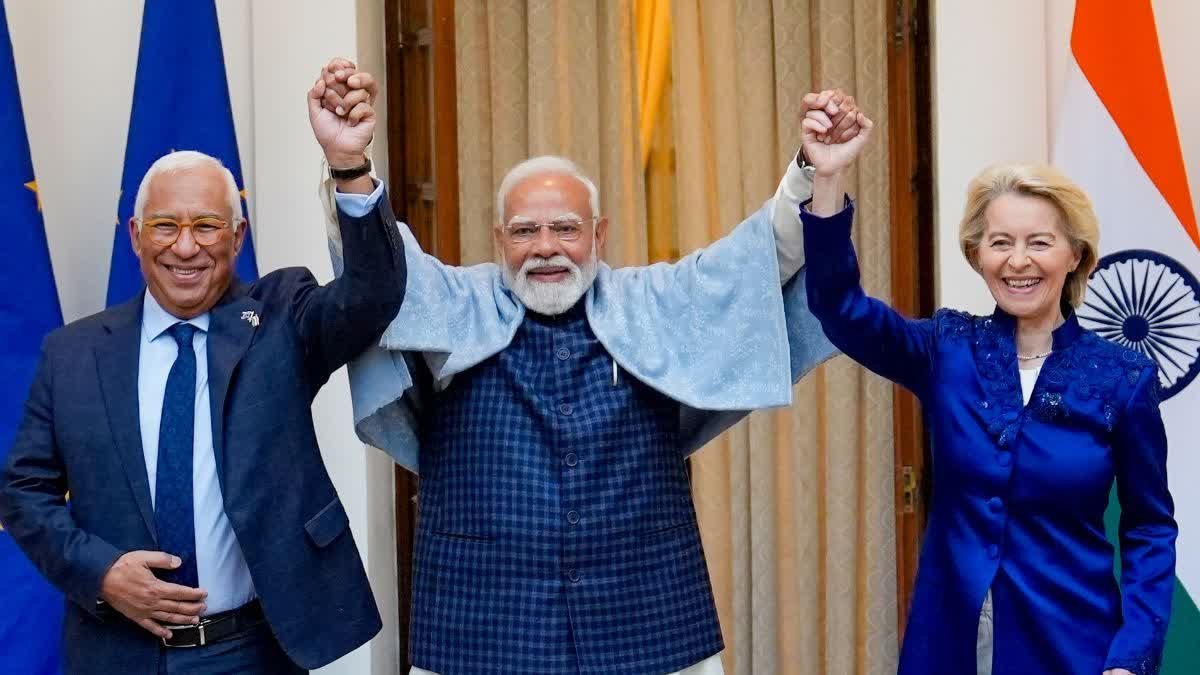

New Delhi: India and Europe have announced the signing of an ambitious free trade agreement, touted as the largest ever. This agreement comes against the backdrop of a volatile global environment and trade disruptions caused by the US tariff policy. Prime Minister Narendra Modi described it as the biggest trade agreement to date.
India-EU Announces FTA
Prime Minister Narendra Modi, European Commission President Ursula von der Leyen, and European Council President Antonio Costa jointly announced the India-European Union Free Trade Agreement (India-EU FTA) at the 16th India-EU Summit on Tuesday. The summit took place during the European leaders’ visit to India.
The exchange of documents on the FTA outcome took place between EU Trade Commissioner Maroš Šefčovič and Union Commerce Minister Piyush Goyal. This announcement marks a historic milestone in India-EU economic relations and trade engagement with a key global partner.
The FTA follows intensive negotiations since the resumption of talks in 2022. The announcement of the FTA on Tuesday is the culmination of years of sustained dialogue and cooperation between India and the EU, reflecting the political will and shared vision to build a balanced, modern, and rules-based economic and trade partnership.
European Union is India’s Largest Trading Partner
The European Union is India’s largest trading partner, and bilateral trade in goods and services has been steadily increasing over the past few years. In 2024-25, India’s bilateral trade in goods with the EU was ₹11.5 lakh crore (USD 136.54 billion), comprising exports of ₹6.4 lakh crore (USD 75.85 billion) and imports of ₹5.1 lakh crore (USD 60.68 billion). In 2024, India-EU services trade reached ₹7.2 lakh crore (USD 83.10 billion).
25% of Global GDP
India and the EU are the fourth and second largest economies respectively, together accounting for 25% of global GDP and one-third of global trade. The convergence of these two large, diverse, and complementary economies will create unprecedented trade and investment opportunities. Union Minister of Commerce and Industry, Shri Piyush Goyal, lauded the strategic vision and strong leadership of Hon’ble Prime Minister Narendra Modi.
He stated that the conclusion of the India-European Union Free Trade Agreement is a major achievement in India’s economic engagement and global outlook. It reinforces India’s vision of building reliable, mutually beneficial, and balanced partnerships.
Signing of the Free Trade Agreement: Know the Benefits
Beyond a conventional trade deal, the FTA is a comprehensive partnership with strategic dimensions and is one of the most significant FTAs. India has secured unprecedented market access for over 99% of Indian exports to the EU in terms of trade value, which also strengthens the ‘Make in India’ initiative. Besides goods, it will facilitate the seamless movement of skilled Indian professionals.
India, powered by a young and dynamic workforce and one of the fastest-growing major economies, is poised to leverage this FTA to create jobs, foster innovation, unlock opportunities across various sectors, and enhance its global competitiveness.
The India-EU trade pact covers traditional areas such as goods, services, trade facilitation, rules of origin, customs, and trade facilitation, as well as new areas like SMEs and digital trade. The India-EU FTA provides a significant boost to India’s labor-intensive sectors such as textiles, apparel, leather, footwear, marine products, gems and jewelry, handicrafts, engineering goods, and automobiles. With the agreement’s implementation, tariffs on exports worth approximately USD 33 billion have been reduced from up to ten percent to zero. Besides enhancing competitiveness, this empowers workers, artisans, women, youth, and MSMEs. It also integrates Indian businesses more deeply into global value chains and strengthens India’s role as a key player and supplier in global trade.
In the automotive sector, the carefully crafted quota-based auto liberalization package will not only allow EU automakers to introduce their models in higher price segments in India but will also open up opportunities for “Make in India” and exports from India in the future. Indian consumers will benefit from high-tech products and increased competition. Reciprocal market access in the EU market will also create opportunities for Indian-made automobiles to access the EU market.
The India-EU FTA is poised to bring about a significant transformation in India’s agricultural and processed food sector, providing a level playing field for Indian farmers and agri-businesses. Competition will increase in key areas such as tea, coffee, spices, fresh fruits and vegetables, and processed foods, strengthening rural employment.
This will also promote inclusive growth and solidify India’s position as a reliable global supplier. India has judiciously protected sensitive sectors such as dairy, cereals, poultry, soymeal, and certain fruits and vegetables, balancing export growth with domestic needs.

