

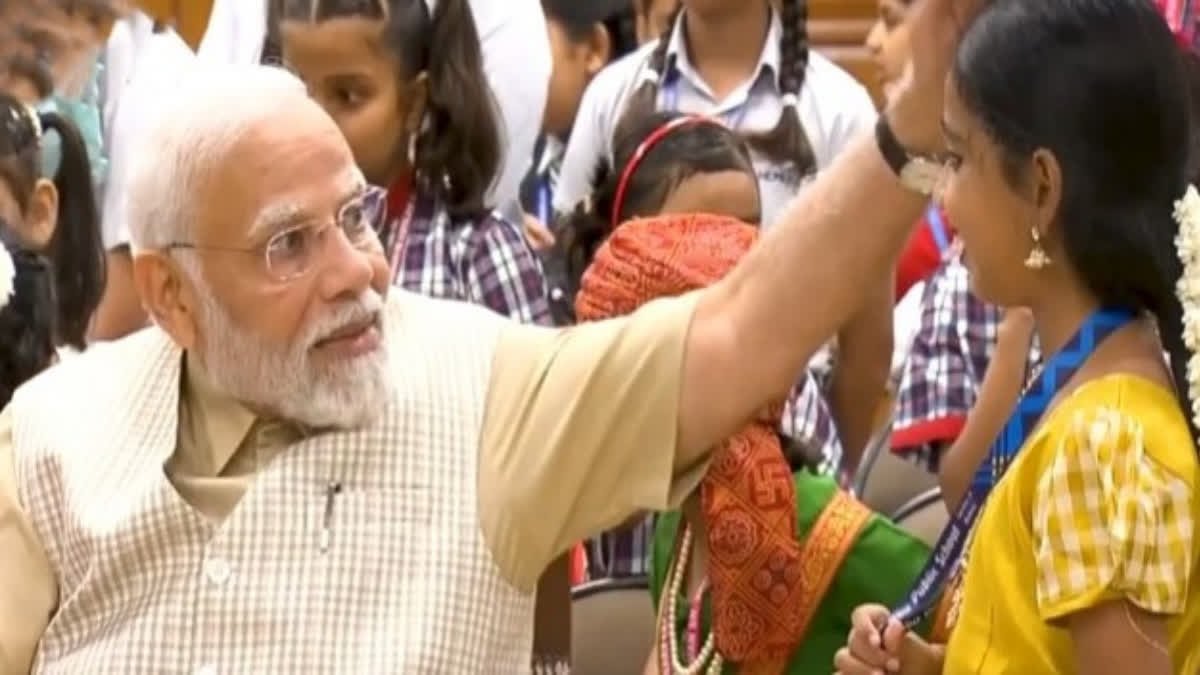

New Delhi: Every year, January 24th is celebrated as ‘National Girl Child Day’. This day reiterates the nation’s commitment to empowering girls from all sections of society and helping them progress. Initiated by the Ministry of Women and Child Development in 2008, this day serves as a reminder of the progress made so far and the significant challenges that millions of girls in the country still face.
This observance comes at a time when policymakers, academicians, and economists are emphasizing the urgent need for sustained government investment in girls’ education, health, and skill development, especially with the Union Budget 2026 on the horizon.
While social and health indicators have improved over the past few years, experts say that challenges such as gender discrimination, female feticide, child marriage, malnutrition, disparities in healthcare access, and unequal access to education continue to be major obstacles to girls’ empowerment.
Despite ambitious policy frameworks and flagship schemes, the reality for many girls – particularly in rural areas and smaller towns – remains affected by systemic discrimination and limited opportunities in education, science and technology, sports, defense services, and leadership roles. Former NCERT Director Professor J.S. Rajput emphasized that the lack of public investment in education remains the biggest challenge.
He told ETV Bharat, “All these shortcomings will only be addressed when 6% of the GDP (Gross Domestic Product) is allocated to education in the budget. We have been receiving this assurance since the time of the Kothari Commission report of 1964-65 and the National Education Policy of 1968. Every government has promised to allocate 6% of the GDP to education, but this has never materialized.”
Rajput stressed that the Budget 2026 commitments should include specific provisions for girls. Pointing to the severe shortage of teachers across the country, she said, “The budget should include special provisions for girls. Even if there is only one school, it should have an adequate number of teachers. The shortage of teachers is a major problem in many of our educational institutions, especially government and private colleges.”
Highlighting the importance of female teachers, she said, “Emphasis should be placed on appointing teachers, especially female teachers, so that they can interact with our girls and young women, understand their feelings, and instill confidence in them. They should not feel neglected or ignored, and they should not feel dependent on anyone. They should realize their own strength.”
Rajput also stressed the need for better training. She said, “Unfortunately, we do not have enough well-trained teachers. We should provide more training and special coaching to female teachers so that they understand the needs of girls and students can talk to them openly. Whatever has been said about girls’ education in the National Education Policy should be implemented and followed meticulously in all institutions. There should be no scope for any kind of discrimination.”
Recalling a major historical shift, Rajput credited the Kothari Commission and the 10+2 education framework with opening up avenues for girls in science and mathematics. She said, “On this day, I would like to remember Dr. D.S. Kothari, who first said that both girls and boys should study science and mathematics up to class 10. Before that, it was believed that girls were not good at mathematics and science, and they were given options like spinning, weaving, and home science.” She added, “It was this great scientist and physicist who said, ‘No, this is wrong. Girls can do better.'” And they have outperformed the boys. The 10+2 formula gave all girls the opportunity to study science and made it compulsory up to class 10. Since then, girls have progressed with confidence and excelled in every field, including science, space, and nuclear science.”
Connecting education to broader economic outcomes, Professor Seema Sharma of IIT Delhi highlighted gender equality as a prerequisite for inclusive development. She said, “I firmly believe that the goal of inclusive development cannot be achieved until gender equality is established at all levels of education.”
Making a global comparison, Sharma pointed out, “In developed countries, women’s participation is over 70%, while in India, the female labor force participation rate is approximately 40%.” She argued that India should transform this gap into an opportunity. She said, “India needs to convert this weakness into a great strength as a mission. This strategic shift will place India, the fastest-growing economy, at the forefront of global development.”

