
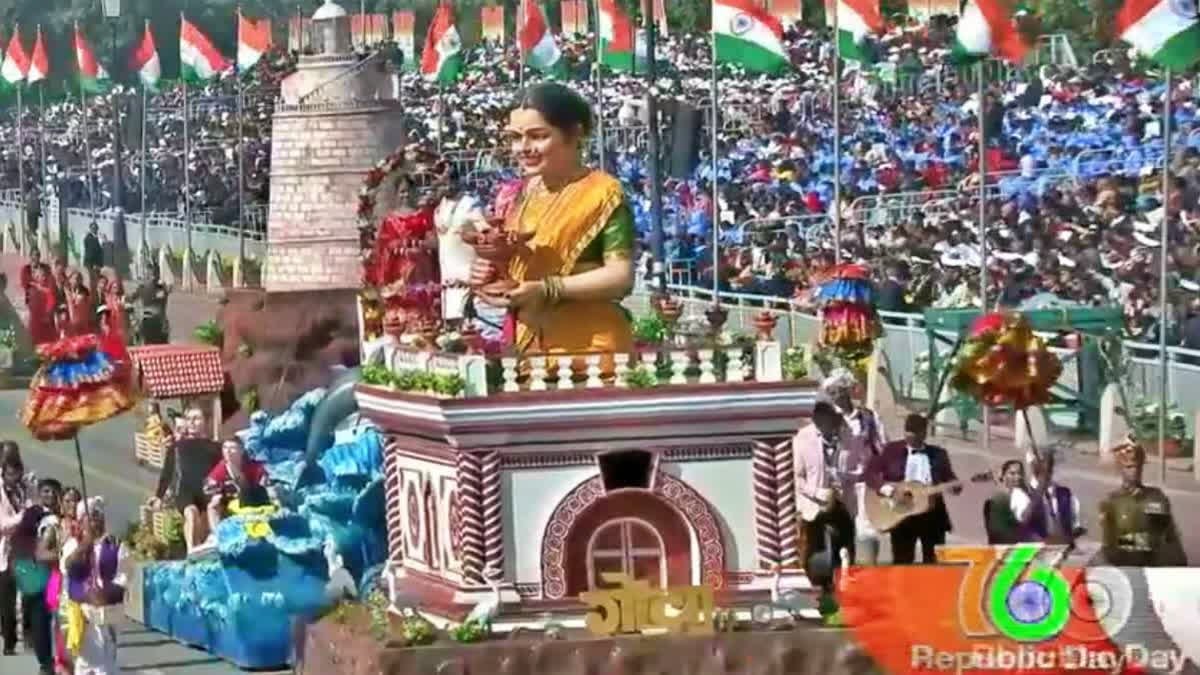

New Delhi: A total of 30 tableaux from 17 states and union territories and 13 central government departments will participate in this year’s Republic Day parade on Kartavya Path. The theme of these tableaux is ‘Mantra of Freedom: Vande Mataram and Mantra of Prosperity: Atmanirbhar Bharat (Self-Reliant India)’. Last time, Delhi’s tableau was selected for the Republic Day parade, with the main theme being ‘Quality Education’.
States and Departments Participating in the Tableaux
With the main theme focusing on the 150th anniversary of Vande Mataram and Atmanirbhar Bharat, the 30 tableaux from states, union territories, and ministries will showcase unity, self-reliance, and inclusive national progress.
The states and union territories presenting their tableaux include Assam, Chhattisgarh, Gujarat, Himachal Pradesh, Jammu and Kashmir, Kerala, Maharashtra, Manipur, Nagaland, Odisha, Puducherry, Rajasthan, Tamil Nadu, Uttar Pradesh, West Bengal, Madhya Pradesh, and Punjab.
The Air Force Headquarters, Naval Headquarters, Department of Military Affairs, Ministry of Culture, Department of School Education and Literacy, Ministry of AYUSH, Ministry of Home Affairs (NDMA and NDRF), Ministry of Home Affairs (BPRD), Ministry of Housing and Urban Affairs (CPWD), Ministry of Information and Broadcasting, Ministry of Panchayati Raj, Ministry of Power, and Ministry of Skill Development and Entrepreneurship will also present their tableaux.
States and Union Territories Not Participating
The major states and union territories not participating in the tableaux this time include Arunachal Pradesh, Mizoram, Tripura, Sikkim, Meghalaya, Jharkhand, Goa, Delhi, Karnataka, Telangana, and Andhra Pradesh.
There has been controversy surrounding the selection of tableaux in the past, following which the Ministry of Defence had proposed a ‘roll-over’ (rotational) plan for states and union territories in 2024. A three-year agreement was signed for 2024, 2025, and 2026, under which every state and union territory will get a chance to present its tableau at least once during these three years. Delhi has presented its tableau seven times in the last two decades, but this time its tableau was not selected.
Reasons for Non-Selection
The screening committee under the Ministry of Defence follows a detailed process to select participants for the parade. In addition, a rotation policy has been implemented for the past two years, ensuring that all states and union territories get an opportunity to participate over time.
The expert committee comprises artists and Padma awardees representing various fields. This committee decides on the theme, aesthetics, and standards of the tableaux and scrutinizes proposals from various states, union territories, and government departments.
An official said, “Several states failed to clear the screening committee’s selection process because the committee closely examines various aspects such as the theme, concept, design, and visual elements.”
Selection Process
According to a government note accessed by ETV Bharat, tableau proposals received from different organizations and agencies are examined in several meetings of the expert committee. The committee comprises eminent personalities from the fields of art, culture, painting, sculpture, music, architecture, choreography, etc.
In the first phase of selection, the sketches/designs of the proposals are reviewed, and if deemed necessary, suggestions are given for modifications to the sketches/designs. Once the committee approves the sketches/designs, the participants are asked to create 3D models of their proposals.
An organization cannot have more than one tableau participating in the parade. The concerned agencies are given sufficient time to prepare for the expert committee meetings. Absence from any meeting will be considered a ‘withdrawal’ and the concerned agency will not be invited to subsequent meetings. All expenses for attending the meetings must be borne by the respective agency.
All communication with the committee members will be conducted through the organization’s official representative. Artists or designers may accompany the official representative to note down suggestions given by the committee for improving their sketches, designs, or models. However, they will not interact directly with the expert committee members unless specifically permitted by the committee to explain a particular point.
Tribal Guests Invited from Across the Country
According to an official memorandum issued by the Ministry of Home Affairs, Government of India, approximately 400 tribal guests from different parts of the country have been invited to witness the ‘Republic Day Celebrations 2026’ in Delhi. These representatives and tableau artists will meet the Prime Minister and the Minister of Tribal Affairs.
Approximately 5,000 individuals (along with their spouses) who have made exceptional contributions to nation-building have been invited as special guests to witness the ‘Republic Day Parade 2026’ at Kartavya Path.
At least 50 couples from each state and Union Territory residing in Delhi are being invited to witness the Republic Day celebrations-2026 in their traditional attire. Additionally, winners of various competitions have also been invited to witness the ceremony.
Naming of Spectator Enclosures for Republic Day Parade and Beating the Retreat
This year, the spectator enclosures for the Republic Day Parade and Beating the Retreat 2026 will be uniquely named after rivers flowing across the country. These include Beas, Brahmaputra, Chambal, Chenab, Gandak, Ganga, Ghaghara, Godavari, Indus, Jhelum, Kaveri, Kosi, Krishna, Mahanadi, Narmada, Pennar, Periyar, Ravi, Son, Sutlej, Teesta, Vaigai, and Yamuna.
Similarly, the spectator enclosures for the Beating the Retreat ceremony-2026 will be named after Indian musical instruments, such as Bansuri, Damru, Ektara, Esraj, Mridangam, Nagara, Pakhawaj, Santoor, Sarangi, Sarinda, Sarod, Shehnai, Sitar, Surbahar, Tabla, and Veena.

