

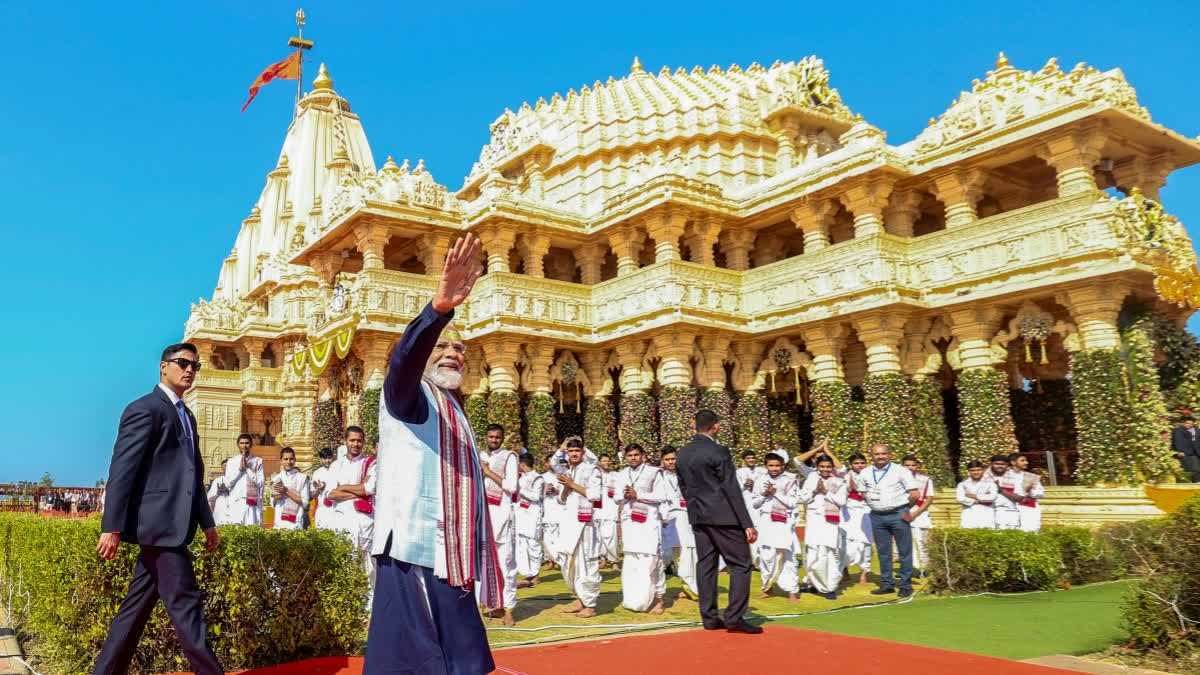

Amravati (Maharashtra): Nearly 1000 years ago, Sultan Mahmud Ghaznavi, an invader from Ghazni in present-day Afghanistan, attacked India. During these attacks, his soldiers destroyed several temples. Mahmud Ghaznavi launched a total of 17 attacks on India and extensively looted the Somnath temple in Gujarat. The 1000th anniversary of this attack is being observed. Significantly, the Somnath temple, which was destroyed by Mahmud Ghaznavi, was rebuilt in 1951 after India’s independence, thanks to the initiative of Sardar Vallabhbhai Patel, the country’s first Home Minister. Prime Minister Narendra Modi participated in the ‘Somnath Swabhiman Parv’ (Somnath Pride Festival) on Sunday.
Renowned historian Prof. Dr. Vaibhav Mhaske discussed the history of the attacks on the Somnath temple and its historical significance in detail during a conversation with ETV Bharat. Dr. Mhaske said, “Historical records state that the Somnath Temple in Saurashtra was built during the Chalukya period. This temple is also mentioned in the Mahabharata. The temple was repeatedly looted and rebuilt. For Indians, this temple remains a major center of faith. Mahmud of Ghazni launched a total of 17 attacks on the Somnath Temple, making its looting historically significant. He attacked India solely for plunder, looted vast amounts of wealth from the temple, and used it for the development of the city of Ghazni during his time.” Mhaske added, “Mahmud of Ghazni was born in 971 AD. He ruled from 1000 to 1030 AD. He was the Sultan of the city of Ghazni and is considered the first Muslim ruler to use the title of Sultan. His father’s name was Subuktigin. Mahmud of Ghazni was very cruel. In 1000 AD, he killed his brothers and eliminated his relatives to seize power. After that, he declared himself Sultan. Then his attention turned to India, and he launched a total of 17 attacks on India.”
He further added, “Mahmud of Ghazni attacked India a total of 17 times to plunder its wealth. To stop these attacks, a king named Jayapala of the Rajput dynasty in the Ohand province of present-day Pakistan confronted him. At that time, Jayapala himself went to the Ghazni province and told his army that if they failed to defeat Mahmud of Ghazni, they would commit suicide. Failing to defeat Ghazni, Jayapala declared his 11-year-old son Anandapala as king and committed suicide. Even at the young age of 12, Anandapala tried to stop Mahmud of Ghazni from attacking India, but he also failed. Subsequently, Anandapala’s son, Trilochanapala, was also unable to stop Ghazni.” Ghaznavi’s Last Attack in 1026
Dr. Vaibhav Mhaske says, “Mahmud of Ghazni launched his 17th and final attack on the Somnath temple in 1026. The king ruling Gujarat at the time, named Bhim, tried to stop him, resulting in three days of intense bloodshed. Mahmud of Ghazni killed many people, looted the Somnath temple once again, and amassed a vast amount of wealth. In the previous 16 attacks, he had not touched the temple’s idol, but in this 17th attack, his viziers (ministers) told him, ‘Prove that you are a true follower of Islam by destroying the temple’s idol.’ Upon this, Mahmud of Ghazni damaged the Shiva Lingam in the Somnath temple. After acquiring a large amount of loot, the Rajput kings gathered to intercept his return journey, but Mahmud of Ghazni changed his route and returned.”
Historian Dr. Vaibhav Mhaske stated, “Mahmud of Ghazni used the wealth looted from the Somnath temple in Saurashtra to build the city of Ghazni. He built a university and a large library there. In 1030, when Ghaznavi fell ill, he summoned a physician and said, ‘I want to become young again, cure me,’ but the physician replied that it was not possible. Finally, Ghaznavi breathed his last in 1030.”
Mhaske says that after the deaths of Anantpal and Jayapal, who had opposed Mahmud of Ghazni, several members of the royal family moved to Delhi. Subsequently, the Rajput Tomar dynasty developed Delhi as their future capital.
Lord Ellenborough Attacks Ghazni
Vaibhav Mhaske explained that in 1842, when India was under British rule, Governor-General Lord Ellenborough learned that the Somnath temple in Saurashtra had been looted several times by Mahmud of Ghazni. He then attacked Ghazni and brought some of its wealth back to India. British army officer William Nott was also with him at that time. He claimed to have brought a sandalwood door from the city of Ghazni, which was said to have belonged to the Somnath temple. However, historians have rejected this claim. Currently, that sandalwood door is kept in Agra.
The wealth worth crores of rupees looted from the Somnath temple was taken to the city of Ghazni. Although the city flourished during the time of Mahmud of Ghazni, today Ghazni is a city in ruins.
Historian Vaibhav Mhaske said, “India’s first Home Minister, Sardar Vallabhbhai Patel, oversaw the reconstruction of the Somnath temple in Saurashtra in 1951. After this reconstruction, the temple acquired a magnificent and glorious form. Today, the Somnath temple in Saurashtra has become a major center of faith for Indians.”

