

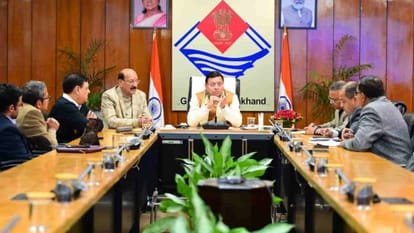

Uttarakhand’s two major upcoming multi-purpose projects, Kisau and Lakhwar, will get a new direction in the new year. The Union Home Ministry has taken charge of the projects and is continuously holding review meetings.
Revised DPR of Kisau ready, Home Secretary reviews it
The revised Detailed Project Report (DPR) of the Kisau dam project has been prepared. The project was conceived in the 1940s. A DPR was prepared in 1996, but it could not proceed due to environmental objections and other reasons. In 2008, the central government declared it a national project. A decision was made to prepare a new DPR, but the work did not progress. In 2021, a decision was made to prepare a revised DPR. This DPR is now ready, and the project is expected to cost approximately Rs 15,000 crore.
Late Thursday evening, the Home Secretary held a meeting on the project, which was also attended by Dr. Sandeep Singhal, MD of UJVNL and Kisau Corporation. It is being said that the Union Home Ministry wants to bring this project to the construction phase soon. The DPR will be sent to the central government for approval, which will include environmental and other clearances.
After Tehri, this second largest project in Asia will submerge 17 villages in Uttarakhand and Himachal Pradesh, displacing approximately 1000 families. After the completion of the multi-purpose Kisau hydroelectric project, 660 megawatts of electricity will be generated. Farmers in Uttarakhand, Uttar Pradesh, Haryana, Punjab, Delhi, and Himachal Pradesh will also get water for irrigation. This will also address the water shortage in the Yamuna River.
Lakhwar to provide irrigation and drinking water to six states
The Lakhwar multi-purpose project was approved by the government in 1976. Work on the project was stopped in 1992. Permission was granted to restart this 300-megawatt project. For this, a 204-meter-high concrete dam will be built on the Yamuna River near Lohari village in Dehradun. The dam will have a water storage capacity of 330.66 million cubic meters.
This will enable irrigation of 33,780 hectares of land. 78.83 million cubic meters of water will be available for domestic and industrial use and drinking water purposes in the six states of the Yamuna basin region. The associated Vyasi project has already commenced 120 MW of power generation by UJVNL (Uttarakhand Jal Vidyut Nigam Limited).
The Lakhwar project is now expected to gain momentum in the new year. It was declared a national project by the central government in 2018. The central government will bear 90 percent of the budget, while the state governments will contribute the remaining 10 percent. This will provide water for irrigation to Uttarakhand and Uttar Pradesh. The six states in the Yamuna basin (Delhi, Uttar Pradesh, Rajasthan, Haryana, Uttarakhand, and Himachal Pradesh) will receive drinking water during the summer months. The Ministry of Home Affairs is also reviewing this project.

