

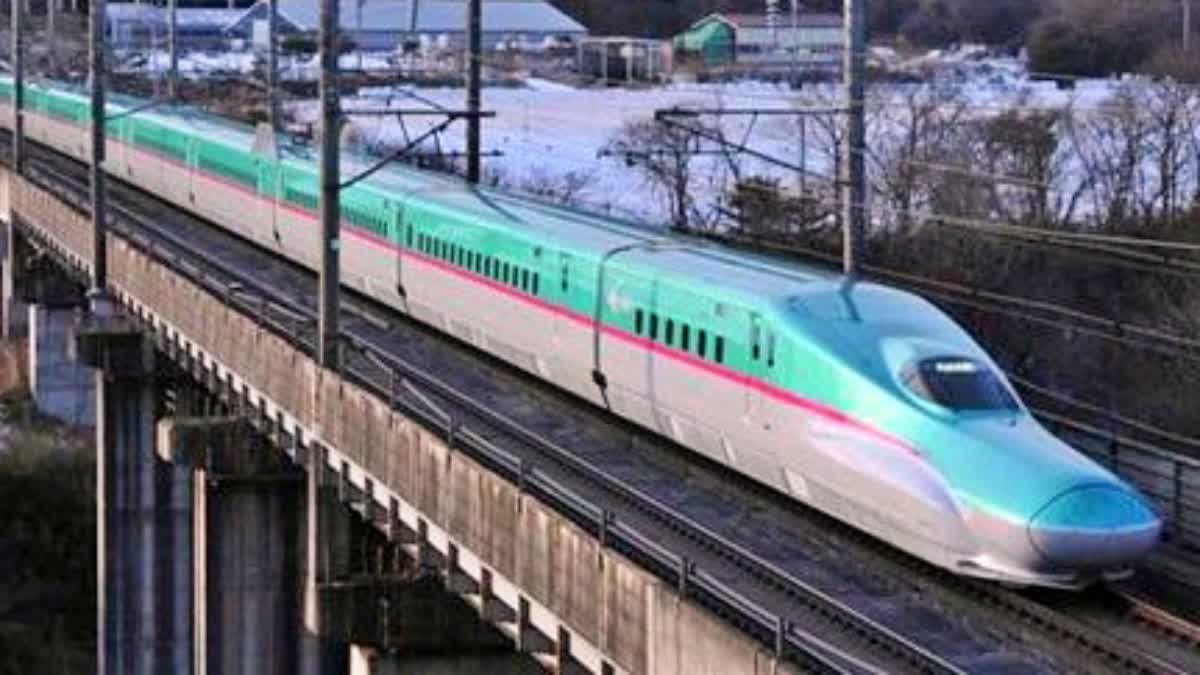

Hyderabad: Construction work on the Mumbai-Hyderabad bullet train project is progressing rapidly, with trial runs expected by 2026. Meanwhile, the railways are conducting feasibility studies for bullet trains on other routes, including the Hyderabad-Chennai project.
According to media reports, South Central Railway (SCR) has submitted the final alignment details to the Tamil Nadu government for inclusion in the Detailed Project Report (DPR). Officials said the DPR will be finalized within a month of receiving approval from the state government.
According to the report, in a recent letter to the Tamil Nadu State Transport Department, South Central Railway requested the state government to expedite the finalization of station locations, grant in-principle approval for land acquisition, and include the high-speed corridor in Tamil Nadu’s long-term infrastructure master plan. Railway officials also requested joint field inspections to avoid delays in the Final Location Survey (FLS), which is proceeding on a fixed timeline.
According to the report, a major change has been made to the proposed 778 km high-speed rail corridor. A new station has been added at Tirupati to facilitate pilgrims and the general public. According to the report, the Hyderabad-Chennai bullet train route will have two stations in Tamil Nadu: Chennai Central and a new high-speed rail station near Minjur in Tiruvallur district.
If this bullet train project materializes, the travel time between Chennai and Hyderabad will be approximately 2.20 hours, compared to the current 12-14 hours by conventional trains.
Initial Planning for Land Acquisition Survey Underway
According to the report, survey work and initial planning for land acquisition for the bullet train project are currently underway. 223.44 hectares of land are required in Tamil Nadu for this purpose, excluding forest land. A 11.6 km long tunnel is also proposed. Several crossings with highways and utility lines have also been identified. The Hyderabad-Chennai line is one of two high-speed corridors planned in South India, the other connecting Hyderabad and Bengaluru. Both projects are part of India’s larger strategy to expand high-speed rail connectivity beyond the Mumbai-Ahmedabad corridor, linking key economic centers in Telangana, Andhra Pradesh, Karnataka, and Tamil Nadu.

