

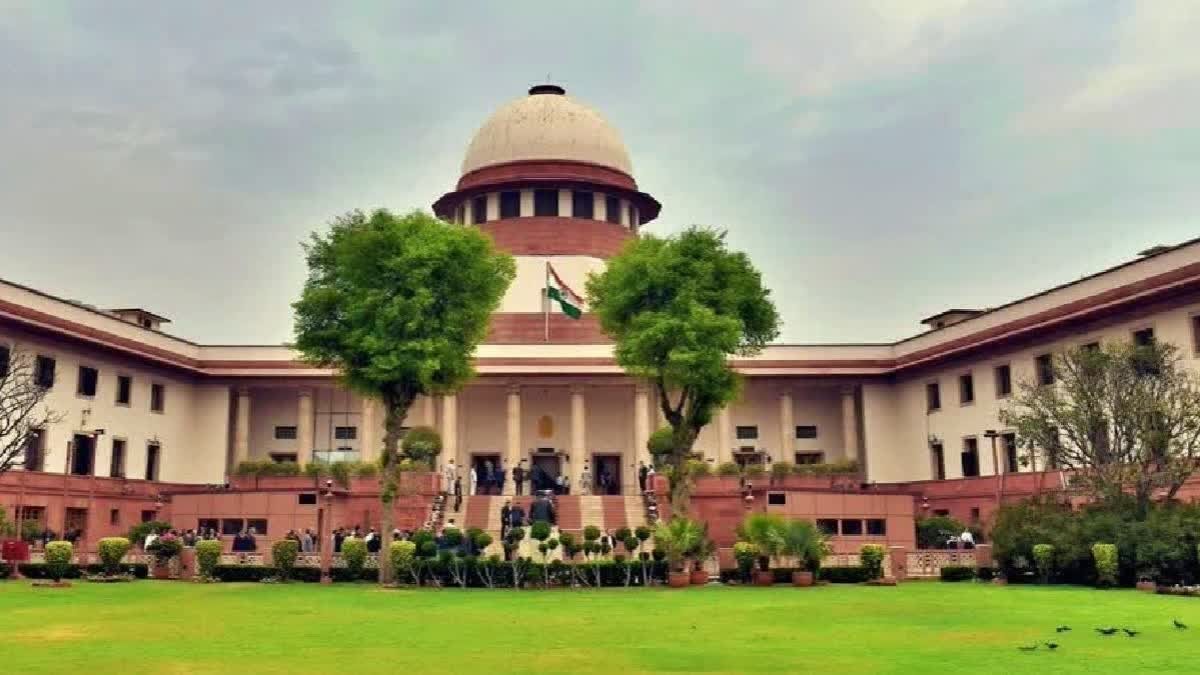

New Delhi: Controversy has deepened over Karnataka’s world-famous Mysore Dussehra festival. A petition was filed in the Supreme Court challenging the appointment of International Booker Prize winner Banu Mushtaq as the chief guest at the inaugural ceremony of the Dussehra festival at the Chamundi Temple in Mysore. The matter was heard in the Supreme Court today, September 19.
During the hearing, the Supreme Court refused to entertain the petition challenging the order passed by the Karnataka High Court on Friday, which approved the state’s decision to invite Booker Prize winner Banu Mushtaq as the chief guest at the inaugural ceremony of the Dussehra festival at the Chamundi Temple in Mysore.
The matter came up for hearing before a bench of Justices Vikram Nath and Sandeep Mehta. The bench asked the petitioner’s lawyer what the purpose of filing the petition was. The lawyer replied that it affected his rights under Article 25. The bench said it was not inclined to consider the matter. The lawyer requested the bench to hear his arguments.
The bench asked the lawyer, “What is the preamble of this country?” The lawyer replied that it is secular, and that it should not interfere with my religious activities. Justice Vikram Nath said that it is a state government program. The lawyer said that worship inside the temple is not secular. However, this argument did not satisfy the bench.
The lawyer said that she (Banu Mushtaq) should not be invited to the inauguration ceremony. To this, the bench said that it would dismiss the case and hear the next matter. The petition, filed by a person named HS Gaurav, stated that the petitioner has approached the Supreme Court against the High Court’s September 15 order. The High Court dismissed the petitioner’s petition and allowed Banu Mushtaq to inaugurate the Dussehra festival.
The petition argues that the High Court erroneously held that no legal or constitutional rights of the petitioner were being violated by inviting Banu Mushtaq to inaugurate the state-sponsored Dussehra festival, and that participation by followers of a particular religion or faith in festivals of other religions is not a violation of constitutional rights.
The petition states that the High Court erred in ignoring the fact that the invitation for the 2025 Dussehra festival clearly stated that Mushtaq would inaugurate the festival inside the Chamundeshwari Temple complex on September 22, 2025, between 10:10 a.m. and 10:40 a.m. The petition states that the inauguration will involve lighting lamps before the sanctum sanctorum of Goddess Chamundeshwari, and offering flowers, fruits, kumkum, turmeric, and other traditional items to the goddess.
The petition states that the High Court erred in failing to appreciate that the inauguration of Dussehra at the Goddess Chamundeshwari temple complex requires a puja that cannot be performed by a non-Hindu. The aforementioned puja must be performed in accordance with Hindu devotion and rituals, and it marks the beginning of the traditional ten-day Dussehra festival.
The petition states that Banu Mushtaq belongs to the Muslim community and cannot perform rituals before the goddess, which is against established Hindu religious and ceremonial practices. The petition states, “If such an inauguration is performed by a person of another religion, it violates the religious beliefs of Hindu worshippers and risks desecrating the sanctity of the festival by violating established rules regarding the worship of the deity on this auspicious day.”
The petition states that the High Court erred in failing to appreciate that the worship by a Hindu dignitary is an essential religious practice protected under Article 25. Therefore, the state’s interference in altering this practice violates the fundamental rights of Hindus.
The petition states that the High Court erred in failing to appreciate that essential religious practices governed by Agamic traditions were being violated by the Karnataka government’s decision to invite Banu Mushtaq, a non-Hindu, to inaugurate the 2025 Mysore Dussehra festival. The petitioner urged the Supreme Court to stay the High Court’s September 15 order.

