

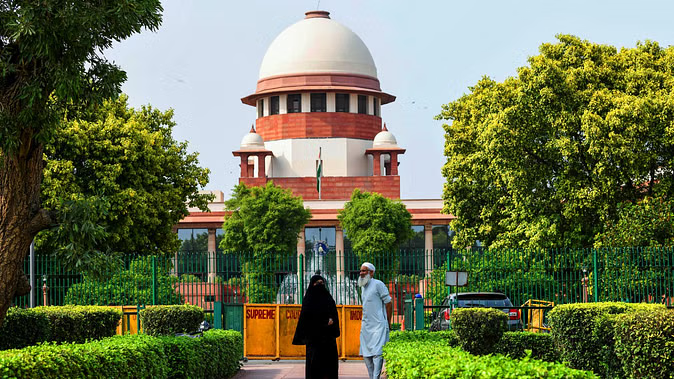

New Delhi: The Supreme Court has initiated the process for registration of Anand Karaj marriages, or Sikh marriages. The apex court directed states and union territories to notify marriage registration rules within four months. The Supreme Court stated that within a secular framework that respects religious identity and ensures civil equality, the law must provide a neutral and practical path. Therefore, Anand Karaj marriages should be registered and certified in the same manner as other marriages.
A bench of Justices Vikram Nath and Sandeep Mehta observed that the integrity of a constitutional promise is measured not only by the rights it confers, but also by the institutions that make those rights useful. In a secular republic, the state should not turn a citizen’s faith into a privilege or a hindrance. The bench said that when the law recognizes Anand Karaj as a valid form of marriage, yet there is no mechanism to register it, it is clear that the promise has been only half fulfilled. Now it remains to be determined that the process from the ceremony to the record is open, uniform, and fair.
The petition filed in the apex court sought directions to various states and union territories to make and notify rules under Section 6 of the Anand Marriage Act, 1909 (amended in 2012) to facilitate the registration of marriages solemnized according to Sikh rites.
The bench said that the 1909 Act was enacted to recognize the validity of marriages solemnized according to the Sikh rite of Anand Karaj. Through the 2012 amendment, Parliament inserted Section 6, which mandated states to make rules to facilitate the registration of such marriages, maintain marriage registers, and provide certified extracts. It also clarified that failure to register will not affect the validity of the marriage.
The bench noted that, according to the petitioner, while several states and union territories have notified rules relating to marriage registration under Section 6, many others have not yet done so. Each state must create a workable registration mechanism for Anand Karaj marriages. This duty is independent of the size of the beneficiary group in any jurisdiction, nor can it be evaded on the grounds that other marriage laws exist in parallel.
The bench observed that the availability of registration directly depends on equal treatment and orderly civil administration. Unequal access to statutory benefits across states and union territories results in unequal outcomes for similarly situated citizens. Furthermore, the bench considered harmonization of existing registration systems to be practical and necessary. Where a normal civil marriage registration framework exists, it should receive applications for registration of Anand Karaj marriages in the same manner as other marriages and, if the parties so request, record that the ceremony was solemnized by Anand Karaj.
The bench stated in the order that, with immediate effect and until such rules are notified, every state and union territory must ensure that marriages solemnized by Anand Karaj are received for registration under the prevailing marriage-registration framework without any discrimination. States and union territories that have already notified rules under Section 6 should continue to operate them.
The bench directed the central government to act as the coordinating authority and circulate within two months model rules compiled from jurisdictions that have already notified Section 6 rules to any state or union territory seeking guidance.
The Supreme Court directed the Centre to compile and submit a consolidated status report within six months, reflecting compliance by states and union territories. “We make it clear that no application for registration or certified extract of an Anand Karaj marriage will be rejected merely on the ground that rules under Section 6 of the Act have not yet been notified.”
In specific directions to Goa, the bench directed that all civil registration offices receive and process applications for registration of marriages solemnized by Anand Karaj under the existing framework without any discrimination. The Centre was directed to issue an appropriate notification under Section 6 of the Goa, Daman and Diu (Administration) Act, 1962, within four months. Following this extension, Goa was ordered to notify rules under Section 6 within four months.
It said that as an interim measure, Sikkim shall ensure that all registering authorities receive and process applications for registration of marriages solemnised by Anand Karaj under the existing Rules for Registration and Solemnity of Marriages in Sikkim (1963) without any discrimination. The bench directed the Centre to consider the proposal for extension of the 1909 Act to Sikkim under Article 371F(n) of the Constitution and submit it to the competent authority within four months, along with necessary restrictions or modifications.

