

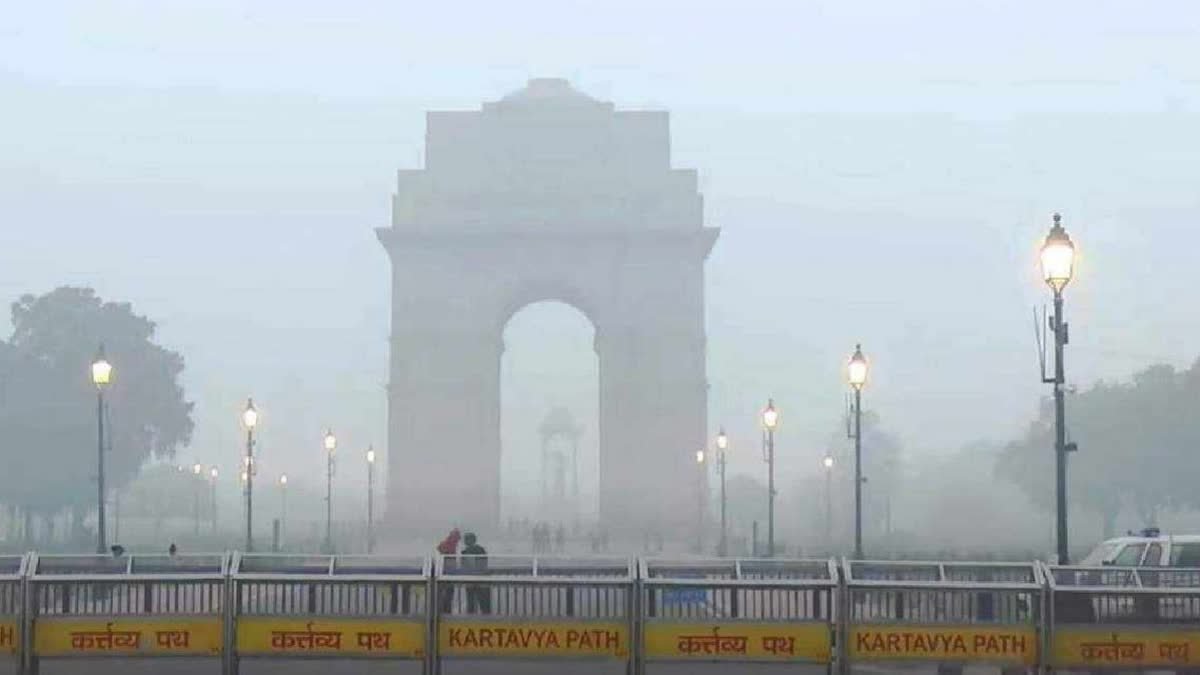

New Delhi: Every year, North India experiences severe air pollution during the winter months due to various reasons, including stubble burning. This causes serious health problems. Environmental expert BS Vohra on Wednesday advised authorities to act quickly with a multi-state strategy to curb air pollution in North India during the winter season.
Speaking to ETV Bharat, environmental activist BS Vohra said, “To curb winter air pollution in North India, authorities should act quickly with a coordinated, multi-state strategy. Key actions should include preventing stubble burning through support to farmers and alternatives, enforcing emission norms on vehicles and industries, controlling construction dust, and improving waste management.” He stressed the need for better public transportation, green infrastructure, and real-time air quality monitoring. Vohra said that before winter, agencies should prepare a winter action plan with clear roles, emergency measures (such as anti-smog guns), and public awareness campaigns. Success depends on strict enforcement, interstate cooperation, and investment in clean technologies.
The environmental expert said that without proactive planning, winter smog will continue to be an annual health and environmental crisis. He said, “Air pollution is a nationwide issue, but Delhi experiences significantly higher air pollution levels than many other parts of India. This is due to a combination of factors, such as heavy vehicular traffic, industrial emissions, construction dust, and seasonal crop burning in neighboring states.”
He added, “In addition, its geographical location and weather patterns, especially in winter, trap pollutants in the air, further worsening the situation. Compared to cities like Bengaluru or Chennai and hill stations with cleaner air, Delhi often records dangerous AQI levels.”
Government Steps to Tackle Air Pollution:
The National Clean Air Programme (NCAP) is being launched by the Union Ministry of Environment, Forest and Climate Change, with the aim of improving air quality in 131 non-attainment cities/urban agglomerations with a population of over one million across 24 states/union territories by engaging all relevant stakeholders.
There are a total of six non-attainment cities in the Delhi NCR region, of which three cities – Delhi, Alwar, and Noida – receive funding under the National Clean Air Programme (NCAP), while the other three cities – Ghaziabad, Meerut, and Faridabad – receive support from the Fifteenth Finance Commission.
City action plans have been initiated for implementation in all six identified cities to improve air quality. A Graded Response Action Plan (GRAP) was developed for the Delhi-NCR region to address the problem of sudden increases in air pollution levels.
The Commission for Air Quality Management (CAQM) issued an updated GRAP in December 2024, providing additional guidelines for its implementation. The actions specified for different Air Quality Index (AQI) levels under GRAP are periodically activated by a sub-committee established by the CAQM.
In 2018, the Ministry of Agriculture and Farmers Welfare launched a scheme to provide subsidies for the purchase of crop residue management machinery and the establishment of Custom Hiring Centers (CHCs) in Delhi and the states of Punjab, Haryana, and Uttar Pradesh for in-situ management of paddy straw. It may be recalled that Union Minister for Environment, Forest, and Climate Change, Bhupender Yadav, chaired a meeting on Delhi-NCR air quality on September 16 in Delhi with the Commission for Air Quality Management (CAQM), the Delhi government, NCR states, and other relevant agencies. They evaluated the measures being implemented for the prevention and control of air pollution in Delhi and the National Capital Region.
Yadav expressed his commitment to collaborate with all stakeholders and citizens to improve air quality in the country, especially in the Delhi-NCR region and its surrounding areas. He emphasized the need to green Delhi and the NCR by initiating tree plantation under the “Ek Ped Maa Ke Naam” campaign, a mission-oriented approach.

